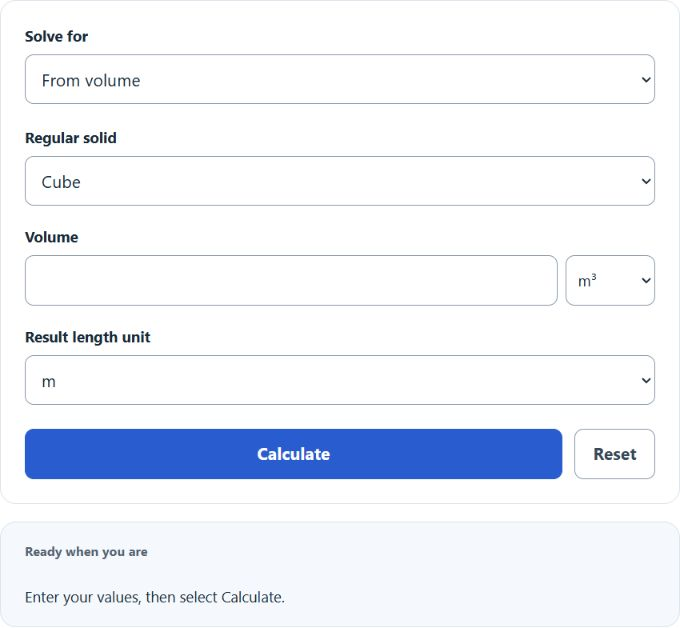
Calculate the edge length of cubes, tetrahedrons, octahedrons, dodecahedrons, and icosahedrons from volume, area, or radius measurements.
- All Math and Numbers Calculators
- All Length Calculators
- Spiral Length Calculator
- Dome Surface Area Calculator
- Perimeter Ratio Calculator
Edge Length Formula
The calculator inverts the standard formulas for the five Platonic solids to solve for edge length a from a known measurement.
- a — edge length
- V — volume, S — surface area
- R — circumradius (vertex to center)
- r — inradius (face center to center)
- ρ — midradius (edge midpoint to center)
- k — shape coefficient (see table below)
All formulas assume a regular solid with equal edges and uniform faces. Inputs are converted to SI units internally, so you can mix units (for example, surface area in in² and read out edge length in cm).
Shape Coefficients and Reference Values
Multiply each coefficient by the indicated power of a to get the corresponding measurement.
| Solid | V / a³ | S / a² | R / a | r / a | Edges |
|---|---|---|---|---|---|
| Tetrahedron | 0.1178 | 1.7321 | 0.6124 | 0.2041 | 6 |
| Cube | 1.0000 | 6.0000 | 0.8660 | 0.5000 | 12 |
| Octahedron | 0.4714 | 3.4641 | 0.7071 | 0.4082 | 12 |
| Dodecahedron | 7.6631 | 20.6457 | 1.4013 | 1.1135 | 30 |
| Icosahedron | 2.1817 | 8.6603 | 0.9511 | 0.7558 | 30 |
Common cube edge lengths from volume:
| Volume | Edge length |
|---|---|
| 1 L (1000 cm³) | 10 cm |
| 1 ft³ | 12 in |
| 1 m³ | 100 cm |
| 1 US liquid gallon (231 in³) | 6.136 in |
| 5 m³ | 1.710 m |
Worked Examples
Cube from volume. A cube holds 27 cm³. Edge length is the cube root: a = ∛27 = 3 cm.
Cube from space diagonal. A cubic box has a space diagonal of 17.32 cm. Edge length is a = 17.32 / √3 ≈ 10 cm.
Icosahedron from surface area. A 20-faced die has a surface area of 8.66 cm². Edge length is a = √(8.66 / 8.6603) ≈ 1 cm.
Tetrahedron from circumradius. If R = 1, then a = 1 / 0.6124 ≈ 1.633.
Tip: For any regular solid, doubling the edge multiplies surface area by 4 and volume by 8. Use this to sanity-check a result before trusting it.