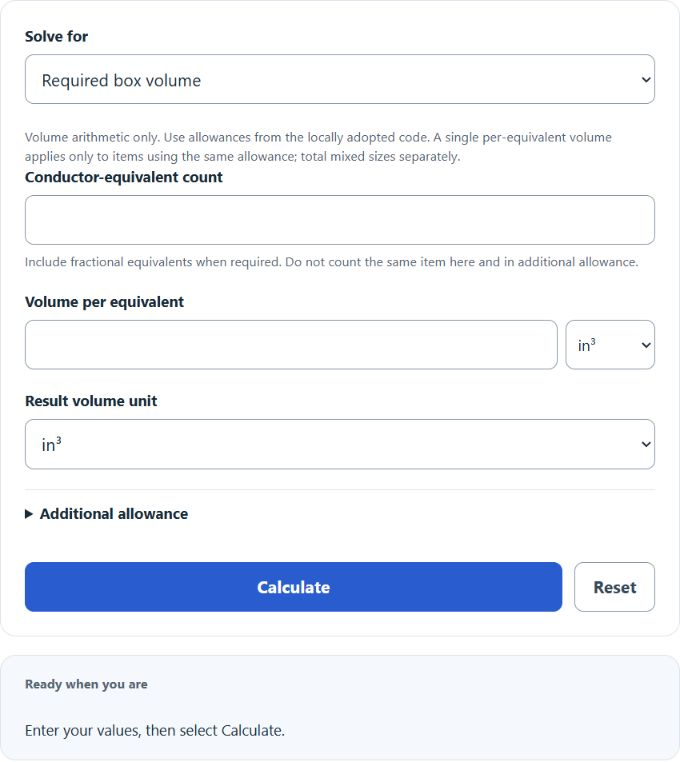
Choose a solve mode to calculate electrical box-fill volume, maximum whole equivalents, or an inverse allowance. Results use in³, ft³, cm³, L, or m³; separately entered additional allowance defaults to zero.
- All Construction Calculators
- Electrical Length Calculator
- Transformer Wire Size Calculator
- Inverter Cable Size Calculator
Electrical Box Fill (Volume) Formula
For a group using one volume allowance D, the simplified box-fill formula is shown below. For mixed conductor sizes, sum each size’s required volume separately and include volumes outside this group in A.
- BS = required box volume
- N = total conductor-equivalent count
- D = volume allowance per conductor equivalent
- A = additional volume allowance for devices, fittings, clamps, or other required allowances
If you are solving for the maximum number of conductor equivalents that fit in a known box volume, the formula is:
- floor means the result is rounded down to the nearest whole conductor-equivalent count.
If you are solving for the volume allowance per conductor equivalent, the formula is:
If you are solving for the additional volume allowance, the formula is:
The calculator uses cubic inches as the base unit internally. If you enter cubic feet, cubic centimeters, liters, or cubic meters, the value is converted to cubic inches before the formula is applied, then converted back to your selected output unit.
The calculator can perform four related functions:
- Find required box volume: enter conductor equivalents, volume per conductor equivalent, and any additional allowance.
- Find maximum conductor equivalents: enter box volume, volume per conductor equivalent, and additional allowance. The maximum whole count is rounded down; required fractional allowances must still be included in N or A.
- Find volume per conductor equivalent: enter box volume, conductor equivalents, and additional allowance.
- Find additional volume allowance: enter box volume, conductor equivalents, and volume per conductor equivalent.
Common Box Fill Volume Allowances by Wire Size
The reference allowances below follow 2023 NEC Table 314.16(B). Use the NEC edition adopted locally; this calculator accepts your entered allowances and does not automatically select a code edition.
| Conductor Size | Volume Allowance per Conductor Equivalent | Calculator D Value |
|---|---|---|
| 18 AWG | 1.50 in³ | 1.50 |
| 16 AWG | 1.75 in³ | 1.75 |
| 14 AWG | 2.00 in³ | 2.00 |
| 12 AWG | 2.25 in³ | 2.25 |
| 10 AWG | 2.50 in³ | 2.50 |
| 8 AWG | 3.00 in³ | 3.00 |
| 6 AWG | 5.00 in³ | 5.00 |
Typical Conductor-Equivalent Counting Rules
Use the table below to help decide what to enter for N and A. Exact counting can depend on the installation and code edition.
| Item in the Box | Typical Box Fill Treatment | How to Use It in the Calculator |
|---|---|---|
| Insulated conductor that enters and leaves the box | Counts as 1 conductor equivalent | Add 1 to N |
| Pigtail that originates and terminates in the same box | Often does not count as a separate conductor | Usually do not add to N |
| Equipment grounding conductors | Under the 2020 and 2023 NEC, up to four equipment grounding conductors entering a box share one volume allowance; each additional one adds one-quarter allowance, based on the largest grounding conductor entering the box. | Include the required fractional allowance in N only when D matches; otherwise include its volume in A. |
| Device yoke, such as a switch or receptacle | Commonly counts as 2 conductor equivalents of the largest conductor connected to it | Either add 2 to N or enter the equivalent volume in A |
| Internal cable clamp or fitting | May require an additional volume allowance | Add the required volume to A |
Example Calculations
Example 1: Find the required box volume
You have 9 conductor equivalents of 12 AWG wire. The volume allowance for 12 AWG is 2.25 in³. There is no extra device or fitting allowance entered separately.
The required box volume is 20.25 in³.
Example 2: Find the maximum conductor equivalents
You have a 22.5 in³ box, 14 AWG conductors, and 4.0 in³ of additional allowance. For 14 AWG, use 2.00 in³ per conductor equivalent.
The box can fit a maximum of 9 conductor equivalents using those inputs.
FAQ
What is a conductor equivalent in box fill?
A conductor equivalent is a counting unit used to convert wires, devices, grounds, clamps, and fittings into required box volume. A simple insulated conductor usually counts as one conductor equivalent. Other items, such as device yokes or grounding conductors, may count differently. Multiply each group’s equivalent count by its applicable volume allowance, then add the required volumes.
Why does the calculator round down when finding conductor count?
The maximum whole count for the selected D is rounded down, so (22.5 − 4.0) / 2.00 permits 9 whole equivalents. This does not remove fractional code allowances, such as additional grounding-conductor allowances; include those in the fill calculation.
What should you enter for additional volume allowance?
Enter any box-fill volume that is not already included in your conductor-equivalent count. This may include allowances for devices, fittings, clamps, or other items depending on how you are doing the count. If you include those items directly in N, do not also include the same volume in A, or the box fill will be counted twice.
Sources and verification: Reference table and grounding discussion use the 2023 NEC. For example, five entering 12 AWG grounds use 1.25 × 2.25 = 2.8125 in³; eight use 2 × 2.25 = 4.50 in³. These are grounding allowances only; add all other required volumes. A bonding jumper entirely within the box is not an entering grounding conductor. NFPA 70; NFPA published 2023 existing-code text, 314.16(B)(5). Verified October 20, 2026.