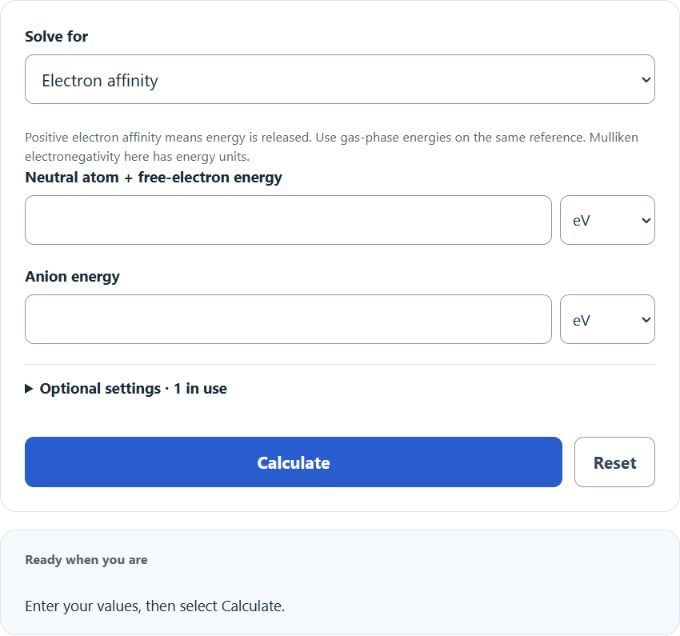
Calculate electron affinity from system and anion energies, or find Mulliken electronegativity from ionization energy and electron affinity.
Related Calculators
- Shielding Constant Calculator
- Standard Enthalpy Calculator
- J to kJ/mol Calculator
- Moles To Particles Calculator
- All Chemistry Calculators
Electron Affinity Formula
The following two example problems outline the steps and information needed to calculate the Electron Affinity.
Variables:
- EA is the electron affinity (eV per particle, or a consistent molar energy unit); positive means energy is released
- Ee is the energy of the neutral atom plus a free electron on the chosen reference
- Ea is the energy of the anion
To calculate electron affinity, subtract the anion energy from the neutral-atom plus free-electron energy, using the same reference and units. For Mulliken electronegativity, use χM = (IE + EA)/2; this unscaled average has energy units, not the dimensionless Pauling scale.
How to Calculate Electron Affinity?
The following steps outline how to calculate the Electron Affinity.
- First, determine the energy of the neutral atom plus a free electron on a consistent reference.
- Next, determine the energy of the anion.
- Next, gather the formula from above = EA = Ee - Ea.
- Finally, calculate the Electron Affinity.
- After inserting the variables and calculating the result, check your answer with the calculator above.
Example Problem :
Use the following variables as an example problem to test your knowledge.
energy of the neutral atom plus a free electron = 5 eV
energy of the anion = 3 eV
EA = Ee - Ea = 5 eV - 3 eV = 2 eV (energy released)