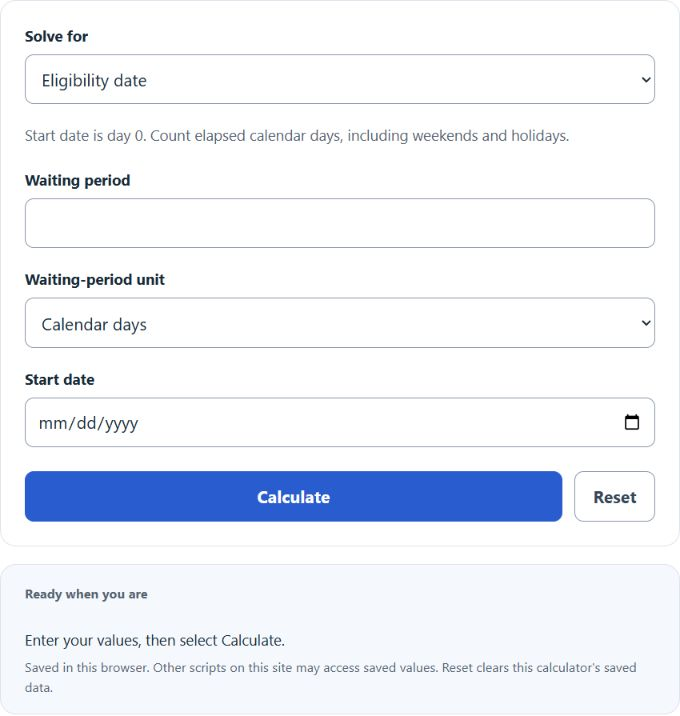
Calculate an eligibility date from a start date and waiting period in days or weeks, with the first of the following month, or count days between dates.
Assumptions Read first
- Choose the value to solve for, then enter the other two values.
- Waiting Period is a whole number of calendar days or weeks (7 days each); Start Date is day 0, so Eligibility Date occurs the elapsed waiting period after Start Date.
- Dates are treated as all-day values using UTC calendar arithmetic, without local time-zone or daylight-saving shifts; month/year rollovers and Gregorian leap years are handled.
- No business-day, weekend, holiday, or plan rules are applied; the first-of-month dates are shown as extra lines for plans that start coverage on the 1st.
- When deriving Waiting Period, Eligibility Date must be on or after Start Date.
When to Use This Calculator
- Find an eligibility date from a known start date and waiting period.
- Back-calculate a start date from a required eligibility date and waiting period.
- Determine the waiting period length between two known dates.
- Use for HR, benefits, insurance, licensing, or onboarding timelines.
Input Definitions
- Start Date — the date the waiting period begins (e.g., hire or event date).
- Waiting Period (days) — number of calendar days after the start date; use whole numbers.
- Eligibility Date — the first date eligibility takes effect after the waiting period.
- Formulas — Eligibility Date = Start Date + Waiting Period; Start Date = Eligibility Date – Waiting Period; Waiting Period (days) = Eligibility Date – Start Date.
Related Calculators
- Benefits Effective Date Calculator
- Date Calculator
- Days From Today Calculator
- Contract End Date Calculator
- Employment Duration Calculator
- All Personal Finance Calculators
Calculator Functions
| Function | What it does | What it requires |
|---|---|---|
| Eligibility date | Finds the date a waiting period ends | Requires the waiting period in calendar days or weeks and the start date |
| Start date | Finds the date a waiting period has to begin to end on a chosen eligibility date | Requires the waiting period in calendar days or weeks and the eligibility date |
| Waiting period | Counts the calendar days between a start date and an eligibility date | Requires the start date and the eligibility date |
Every function counts calendar days, so weekends and holidays are included, and the start date is day 0. Results list both dates, the elapsed days, the same span in weeks and the day of the week. The Eligibility date function also gives the first of the month on or after the result and the first of the following month, for plans that begin coverage on the 1st.
Eligibility Date Formulas
| E | Eligibility date |
| S | Start date, such as a hire date or enrollment date (day 0) |
| W | Waiting period in calendar days. One week is 7 days |
Eligibility date
The main formula applies directly. A 90-day waiting period that starts on January 1, 2026 ends on April 1, 2026. A 60-day period from January 15, 2026 ends on March 16, 2026, and the first of the month on or after that date is April 1, 2026.
Start date
The waiting period is counted backward from the eligibility date. To be eligible on July 1, 2026 after 30 days, the period has to start on June 1, 2026.
Waiting period
The result is the number of days elapsed, with the start date as day 0. From January 1, 2026 to April 1, 2026 is 90 calendar days. The calculator also reports the dates touched, which is one more than the elapsed days because it counts both end dates.
Waiting Period for Health Coverage
Under the federal rule for group health plans, as of November 2026, a waiting period cannot be longer than 90 days [1]. Every calendar day counts, including weekends and holidays, beginning on the enrollment date, and a plan may let coverage begin before the 91st day when that day falls on a weekend or holiday [1]. Entering 90 days here returns the 91st day counted that way, which is the latest date coverage can begin under a 90-day waiting period. An orientation period of up to one month may come before the waiting period starts [1].
Limits of This Estimate
- The result is date arithmetic only. A plan document, policy or statute may define the start date differently, round to the first of a month, or count working days or hours of service instead.
- Business days and holidays are not skipped. A waiting period stated in business days needs a different count.
- Waiting periods stated in months are not supported, because months have different lengths. Enter the period in days or weeks.
Sources
- U.S. Department of Health and Human Services, 45 CFR 147.116, Prohibition on waiting periods that exceed 90 days: 90-day limit, counting of calendar days and the one-month orientation period