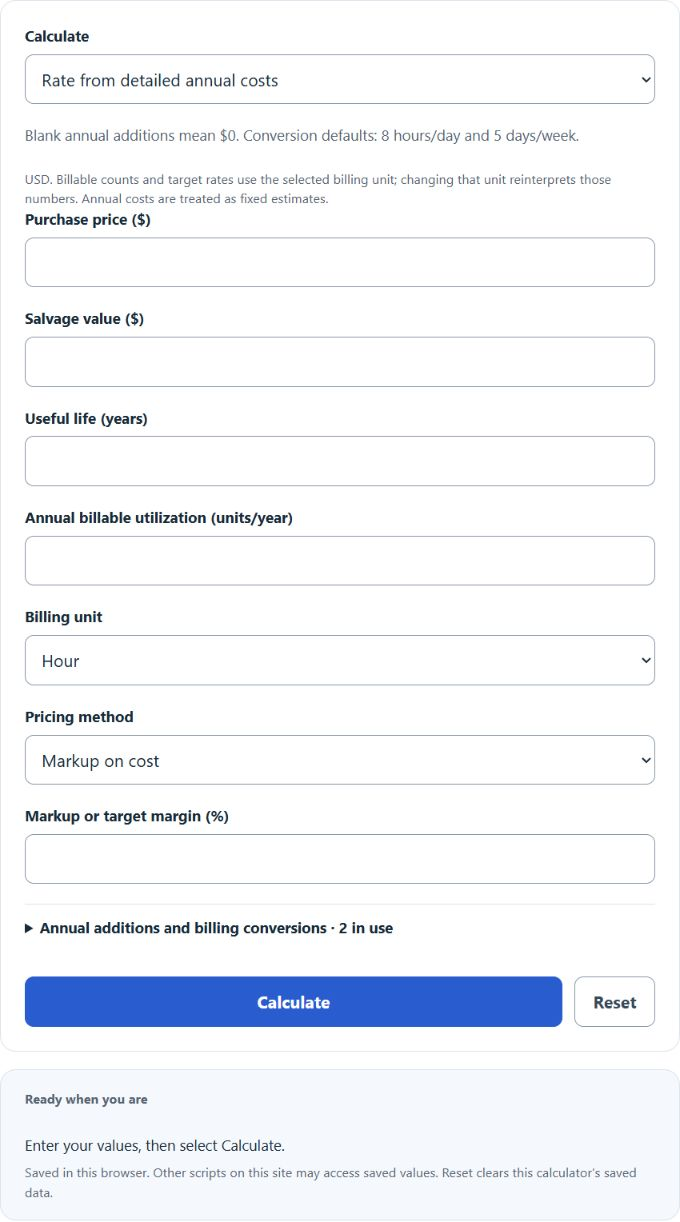
Calculate equipment rental rates from depreciation, annual costs, billable utilization, and markup or target margin on included costs, with hourly, daily, and weekly pricing.
- All Business Calculators
- All Rate Calculators
- Cost Per Hour Calculator
- Hourly Rate Calculator
- Cost Per Day Calculator
- Service Price Calculator
Equipment Rental Rate Formula
The equipment rental rate recovers the annual cost of owning and operating equipment over expected billable hours or days, then applies either a markup on cost or a target margin on the included costs.
- AD = annual depreciation
- PP = purchase price of the equipment
- SV = expected salvage value at the end of useful life
- UL = useful life in years
- TAC = total annual costs
- FC = annual financing costs
- INS = annual insurance cost
- TL = annual taxes and licensing cost
- MR = annual maintenance and repairs
- FU = annual fuel and utilities
- ST = annual storage cost
- TR = annual transportation cost
- ARN = annual revenue needed
- PM = the selected markup or target margin percentage; a target margin must be below 100%
The calculator first spreads the equipment’s loss in value across its useful life using straight-line depreciation. It then adds the entered annual ownership and operating costs and applies the selected pricing method. Finally, it divides the required annual revenue by your expected rental utilization. If you choose hourly, the utilization value should be hours per year. If you choose daily, it should be days per year.
Typical Equipment Rental Cost Inputs
Use annual amounts for recurring costs. Blank optional annual additions mean 0; enter the purchase, salvage and useful-life values explicitly.
| Input | What to Include | Common Notes |
|---|---|---|
| Purchase price | Equipment cost, delivery, setup, and attachments if they are part of the rental asset | Use the full capitalized cost, not the down payment |
| Salvage value | Expected resale or trade-in value at the end of useful life | Cannot be greater than the purchase price |
| Financing costs | Annual interest or financing charges | Enter only the yearly cost, not the full loan balance |
| Maintenance and repairs | Service, inspections, wear parts, repairs, and routine upkeep | Older equipment usually needs a higher estimate |
| Transportation | Delivery, pickup, hauling, loading, and unloading costs | Include only costs not billed separately to the renter |
Utilization and Profit Margin Reference
| Factor | Lower Value Means | Higher Value Means |
|---|---|---|
| Expected rental utilization | Fewer billable hours or days, so each rental period must carry more cost | More billable hours or days, so the cost is spread across more rentals |
| Useful life | Higher annual depreciation | Lower annual depreciation |
| Markup or target margin | Lower markup above annual cost | Higher markup above annual cost |
Example Equipment Rental Rate Calculations
Example 1: Hourly rental rate
Suppose the equipment has a purchase price of $50,000, a salvage value of $10,000, and a useful life of 5 years.
Annual depreciation is:
Assume the annual costs are $2,000 financing, $1,200 insurance, $600 taxes and licensing, $4,000 maintenance and repairs, $3,000 fuel and utilities, $1,000 storage, and $1,200 transportation.
With a 20% markup on cost:
If expected utilization is 700 rental hours per year:
The hourly rental rate is $36.00 per hour.
Example 2: Daily rental rate
Suppose annual revenue needed after costs and profit is $30,000, and the equipment is expected to rent for 120 days per year.
The daily rental rate is $250.00 per day.
Equipment Rental Rate FAQ
Should fuel be included in the rental rate?
Include fuel and utilities only if you pay for them as part of the rental. If the renter pays for fuel separately, enter 0 for fuel or include only the amount you expect to cover yourself.
Why does lower utilization increase the rental rate?
The same annual costs must be recovered from fewer billable hours or days. For example, if annual revenue needed is $24,000, renting the equipment for 1,000 hours requires $24 per hour. Renting it for only 500 hours requires $48 per hour.
Is profit margin the same as markup?
No. Markup is profit divided by cost; margin is profit divided by revenue. With $10,000 annual costs, a 25% markup requires $12,500 revenue, while a 25% target margin requires about $13,333.33. This calculator uses all included annual costs, so that margin can differ from accounting gross margin. Hourly, daily and weekly equivalents use configurable defaults of 8 billable hours per day and 5 billable days per week.