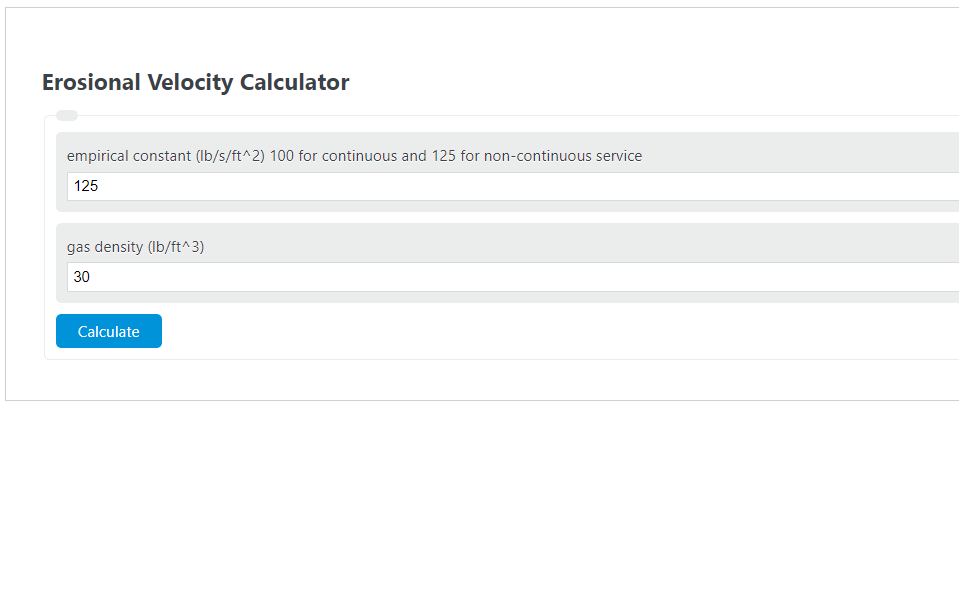
Calculate the API RP 14E erosional-velocity screening limit, compare actual pipe velocity, and estimate maximum flow in field or SI units.
- All Construction Calculators
- All Velocity Calculators
- Settling Velocity Calculator
- Groundwater Velocity Calculator
Erosional Velocity Formula
- Ve = erosional velocity limit, ft/s
- C = empirical constant (field units)
- rho_m = mixture density at flowing conditions, lb/ft³
For the pipe check, actual velocity is V = Q / A, with A = pi * D² / 4, using the line-condition volumetric flow rate. For multiphase, the mixture density is the mass-weighted average:
Gas density at line conditions uses rho_G = 2.699 * SG_g * P / (Z * T) with P in psia and T in °R. The metric form of the API 14E equation uses C ≈ 1.22 × the field value when ρ is in kg/m³ and Ve is in m/s.
Reference Values
Common C values from API RP 14E and how to read the utilization output.
| Service | C (field) | Notes |
|---|---|---|
| Continuous, solids-free, non-corrosive | 100 | Default per API 14E |
| Intermittent, solids-free | 125 | Short-duration flow |
| Continuous, with corrosion inhibitor or CRA | 150–200 | Requires monitoring |
| Solids present | < 100 | Use sand-specific erosion model (DNV RP O501) |
| Utilization | Interpretation |
|---|---|
| < 90% | Acceptable design margin |
| 90–100% | Marginal; revisit pipe size or C value |
| > 100% | Above limit; increase ID or reduce flow |
Worked Example
Gas-condensate line, C = 100, mixture density 12 lb/ft³, 4-inch ID (4.026 in), flowing 8 ft³/s.
- Allowable velocity: Ve = 100 / √12 = 28.9 ft/s
- Pipe area: A = π × (4.026/12)² / 4 = 0.0884 ft²
- Actual velocity: V = 8 / 0.0884 = 90.5 ft/s
- Utilization: 90.5 / 28.9 = 313% — well above limit, increase line size.
FAQ
Is API 14E conservative? For clean fluids it is generally conservative. For fluids with sand it can be non-conservative; use a sand-erosion model instead.
Which density do I use for multiphase? The no-slip mixture density at flowing pressure and temperature, not standard conditions.
Why does the metric C differ? The 1.22 factor reconciles units when ρ is in kg/m³ and Ve in m/s. The underlying limit is the same.
Does the limit account for elbows or fittings? No. Local velocities at bends and chokes can exceed the line value; derate C or check those points separately.