Calculate Simpson’s rule error bound from K, a, b, and n, or find the minimum even n needed to keep the error below a target value for a given interval.
- All Math and Numbers Calculators
- Relative Error Calculator
- Control Limit Calculator
- Class Width Calculator
Error Bound Formula
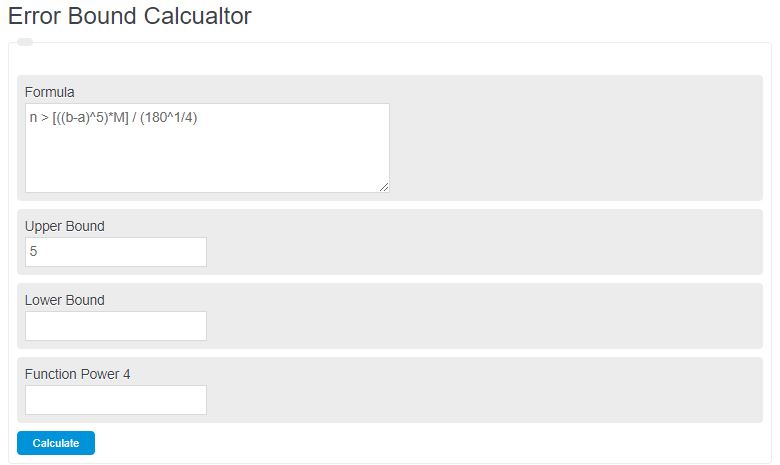
The following equations are used to calculate the Simpson’s Rule error bound and (optionally) the minimum even number of subintervals needed for a target tolerance.
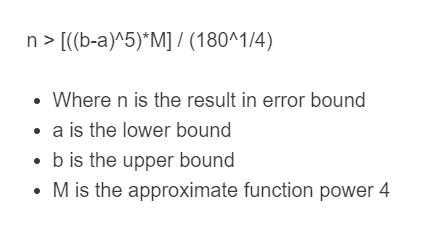
- Where |ES| is the error bound (maximum possible magnitude of the Simpson’s Rule error),
- a is the lower bound,
- b is the upper bound,
- n is the number of subintervals (must be an even integer),
- M is the maximum value of |f⁽⁴⁾(x)| on the interval [a,b],
- E is the target error tolerance (a maximum acceptable bound on the error).
Error Bound Definition
An error bound is an upper bound on the magnitude of the error between an approximation and the true value. In the context of the composite Simpson’s Rule, the error bound estimates how far the numerical integral may be from the exact integral based on the interval length, the number of subintervals, and an upper bound on the absolute value of the function’s 4th derivative.
Error Bound Example
Lets look at an example problem of how to use this formula.
- First, determine the upper bound. For this example we will assume it is 4.
- Next, determine the lower bound. For this example we will say its' 1.
- Next, determine M = max |f⁽⁴⁾(x)| on [1,4]. We will say this value is 3 for this problem.
- Choose a target error tolerance. For this example, let E = 0.001.
- Finally, solve for the minimum even n:
n ≥ (( (b−a)5 M ) / (180 E))1/4 = ((35·3)/(180·0.001))1/4 ≈ 7.98, so the minimum even n is 8 (and the resulting bound is ≈ 9.89063×10⁻⁴).