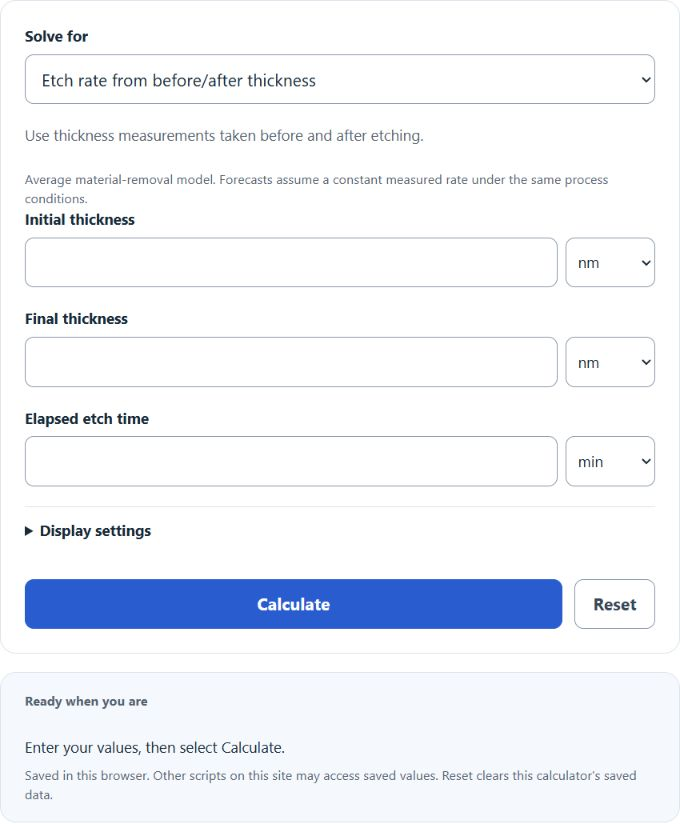
Calculate average etch rate from before/after thickness or removed depth and elapsed time. Estimate removal depth or process time using a supplied constant rate. Mask selectivity is not modeled.
Related Calculators
- Selectivity Factor Calculator
- Contact Angle Calculator
- Water Dilution Calculator
- M To Normality Calculator
- All Chemistry Calculators
Etch Rate Formula
Average etch rate is material-removal depth divided by elapsed etch time. Before/after thickness measurements give removed depth = initial thickness − final thickness. Forecasts assume the supplied rate remains constant under the same process conditions; actual rates can vary with material, chemistry, temperature and loading.
Variables:
- ER is the Etch Rate (microns/min)
- D is the total depth (microns)
- T is the total time (min)
To calculate the etch rate, divide the total depth by the total time.
How to Calculate Etch Rate?
The following steps outline how to calculate the Etch Rate.
- First, determine the total depth (microns).
- Next, determine the total time (min).
- Next, gather the formula from above = ER = D / T.
- Finally, calculate the Etch Rate.
- After inserting the variables and calculating the result, check your answer with the calculator above.
Example Problem :
Use the following variables as an example problem to test your knowledge.
total depth (microns) = 3
total time (min) = 20
ER = 3 µm / 20 min = 0.15 µm/min = 150 nm/min. Conversely, 150 nm/min for 20 minutes removes 3 µm in the constant-rate model; removing 3 µm at that rate takes 20 minutes.