Calculate Euclidean distance from 2D and 3D points, coordinate lists, or differences with units in mm, cm, m, km, inches, and more.
- All Math and Numbers Calculators
- All Distance Calculators
- Midpoint Calculator
- Distance Between Two Point Calculator
- Distance From Point to Plane Calculator
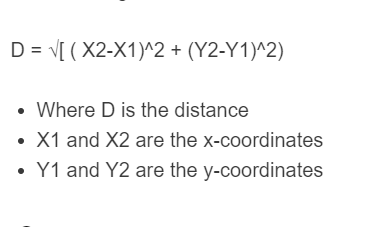
Euclidean Distance Formula
The calculator uses the Pythagorean form of distance, extended to any number of dimensions.
- d = Euclidean distance between the two points
- x₁, y₁, … = coordinates of point A
- x₂, y₂, … = coordinates of point B
For the Differences input format, you supply the deltas directly and the formula reduces to d = √(Δx₁² + Δx₂² + … + Δxₙ²). Both points must use the same unit, and both must have the same number of dimensions. The result is always non-negative.
Reference Tables
Common 2D and 3D check values you can use to verify the calculator or sanity-check your own work.
| Point A | Point B | Distance |
|---|---|---|
| (0, 0) | (3, 4) | 5 |
| (1, 1) | (4, 5) | 5 |
| (−2, 3) | (4, −5) | 10 |
| (0, 0, 0) | (2, 3, 6) | 7 |
| (1, 2, 2) | (4, 6, 14) | 13 |
Quick unit conversion for the most common length units. The calculator displays equivalent distances when you choose a length unit. Changing the coordinate unit reinterprets the entries; use the same unit for every coordinate.
| From | To meters |
|---|---|
| 1 mm | 0.001 m |
| 1 cm | 0.01 m |
| 1 in | 0.0254 m |
| 1 ft | 0.3048 m |
| 1 yd | 0.9144 m |
| 1 km | 1000 m |
| 1 mi | 1609.344 m |
Worked Examples
2D example. Find the distance between (1, 2) and (4, 6).
Δx = 3, Δy = 4. d = √(9 + 16) = √25 = 5.
3D example. Find the distance between (0, 0, 0) and (2, 3, 6).
Δx = 2, Δy = 3, Δz = 6. d = √(4 + 9 + 36) = √49 = 7.
n-dimensional example. For A = (1, 2, 3, 4) and B = (5, 6, 7, 8), each squared difference is 16. d = √(16 × 4) = √64 = 8.
Why squaring matters. Squaring removes negative signs so direction does not affect the result. Distance from A to B equals distance from B to A.
Euclidean vs. Manhattan. Euclidean distance is the straight-line path. Manhattan distance sums the absolute differences (|Δx| + |Δy| + …) and is always greater than or equal to the Euclidean value.