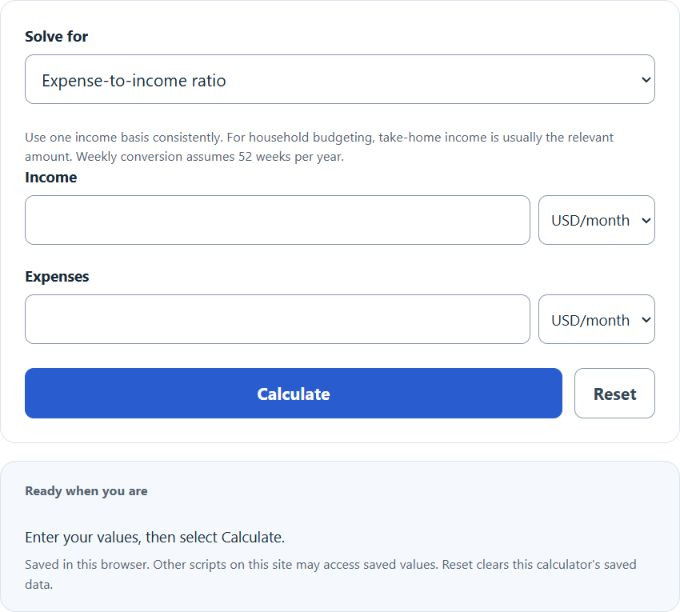
Calculate an expense-to-income ratio across monthly, weekly, or annual periods, reverse-solve a spending target, and review cash left after expenses.
Expense-to-Income Ratio Formula
The following formula is used to calculate the Expense-to-Income Ratio.
- Where EIR is the Expense-to-Income Ratio (%)
- E is the total monthly expenses ($)
- I is the total monthly income ($)
To calculate the expense-to-income ratio, divide monthly expenses by positive monthly income, then multiply by 100. Annual amounts are divided by 12; weekly amounts are multiplied by 52 and divided by 12. Use a consistent income basis and USD amounts. Reverse modes solve monthly expenses or income at an explicitly entered target ratio.
How to Calculate Expense-to-Income Ratio?
The following example problems outline how to calculate Expense-to-Income Ratio.
Example Problem #1:
- First, determine the total monthly expenses ($).
- The total monthly expenses ($) are given as 3,000.
- Next, determine the total monthly income ($).
- The total monthly income ($) is provided as 7,000.
- Finally, calculate the Expense-to-Income Ratio using the equation above:
EIR = E / I * 100
The values given above are inserted into the equation below and the solution is calculated:
EIR = 3,000 / 7,000 * 100 ≈ 42.857 (%)
FAQ
What is the importance of calculating the Expense-to-Income Ratio?
Calculating the Expense-to-Income Ratio is crucial for personal financial planning and management. It helps individuals understand how much of their income is being spent on expenses, which can be a key indicator of financial health. A lower ratio suggests better financial stability, as it indicates that a smaller portion of income is dedicated to expenses, leaving more for savings and investments.
How can one improve their Expense-to-Income Ratio?
Improving the Expense-to-Income Ratio can be achieved by either reducing monthly expenses or increasing monthly income. Strategies for reducing expenses include budgeting, cutting non-essential spending, and seeking more cost-effective options for necessary expenses. To increase income, individuals might consider seeking higher-paying employment, taking on additional work, or exploring passive income opportunities.
Is there an ideal Expense-to-Income Ratio?
There is no universal ideal ratio for all expenses. The 50/30/20 budgeting guideline applies 50% of take-home pay to needs, 30% to wants and 20% to saving and debt goals; it does not cap total expenses at 50%. The relevant budget depends on which expenses and income basis you include.