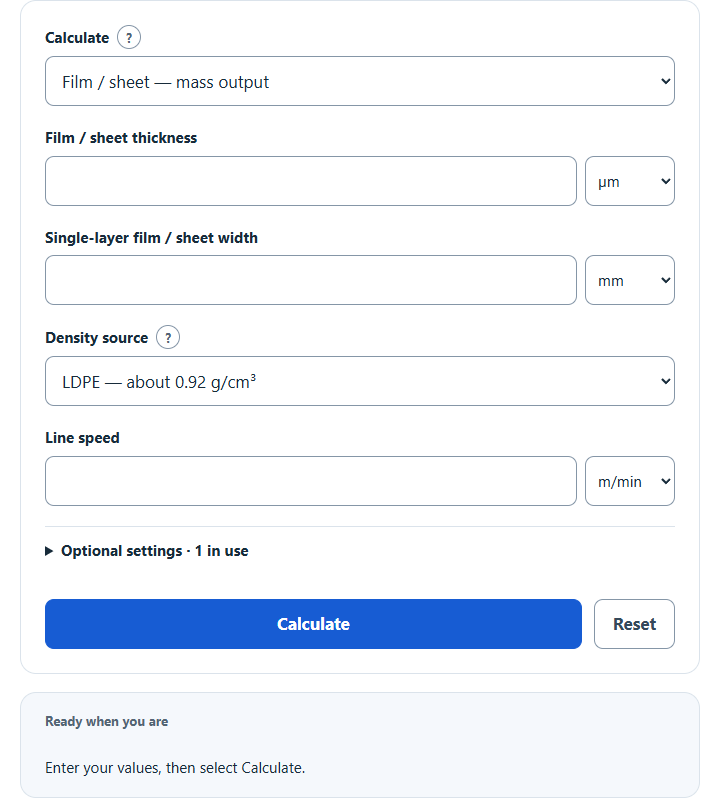
Calculate extruder output in kg/h or lb/h from film, tube or rod size, line speed and a typical resin density, or find the line speed for a target output.
Ideal Screw Drag Flow
The Screw — ideal drag flow mode estimates the zero-pressure drag-flow component of a single-start screw’s metering section. Enter screw diameter D, radial channel depth H, helix angle φ, screw speed and melt density at process conditions. The film, tube and rod modes instead calculate product throughput from geometry and line speed.
Qd = ½π²D²HN sin(φ) cos(φ), with D and H in metres and N in revolutions per second (rpm ÷ 60). Qd is in m³/s; multiply by melt density in kg/m³ and 3,600 for kg/h, or by 3,600,000 for L/h. The angle is measured from the plane perpendicular to the screw axis. A single-start square-pitch screw has φ = atan(1/π), about 17.6568°.
This shallow-channel approximation uses ideal width W = πD sin(φ), neglecting flight width, and assumes a fully filled, isothermal Newtonian melt without wall slip. It excludes back pressure, leakage, finite-width corrections, feeding and melting limits. It is not actual machine capacity. Use supplier melt-density data at processing temperature and pressure; room-temperature solid-resin density is unsuitable. The Penn State single-screw extrusion notes derive the drag-flow component and explain how die pressure changes net throughput.
For example, D = 100 mm, H = 5 mm, N = 60 rpm and φ = 17.6568° give approximately 71.314 mL/s, or 256.731 L/h. With a supplied melt density of 750 kg/m³, the ideal mass rate is approximately 192.548 kg/h. The density here is an example input, not a resin preset.
Output Rate (kg/h) Formula
The following formula applies to the calculator’s Cyclic output mode: mass per cycle divided by cycle time. It is separate from the continuous film, tube and rod geometry modes.
Variables:
- O is the output (kg/hour)
- SW is the shot weight (grams)
- CT is the cycle time (seconds)
To calculate the output rate, divide the shot weight by 1000 to convert it to kilograms, then multiply by the number of cycles in an hour (3600 seconds divided by the cycle time).
What is Output Rate (kg/h)?
Output rate is the mass of material produced per unit time, commonly expressed as kilograms per hour (kg/h). In a cyclic process, the output rate is determined by the mass produced each cycle (shot weight) and how long each cycle takes (cycle time). Continuous extrusion throughput is also measured in kg/h, but it generally depends on factors like screw design, material, temperatures, and screw speed, and is not typically calculated from “shot weight” and “cycle time.”
How to Calculate Output Rate (kg/h)?
The following steps outline how to calculate the output rate.
- First, determine the shot weight (SW) in grams (mass produced per cycle).
- Next, determine the cycle time (CT) in seconds.
- Use the formula from above: O = (SW / 1000) * (3600 / CT).
- Finally, calculate the output rate (O) in kilograms per hour.
- After inserting the variables and calculating the result, check your answer with the calculator above.
Example Problem :
Use the following variables as an example problem to test your knowledge.
shot weight (SW) = 150 grams
cycle time (CT) = 30 seconds