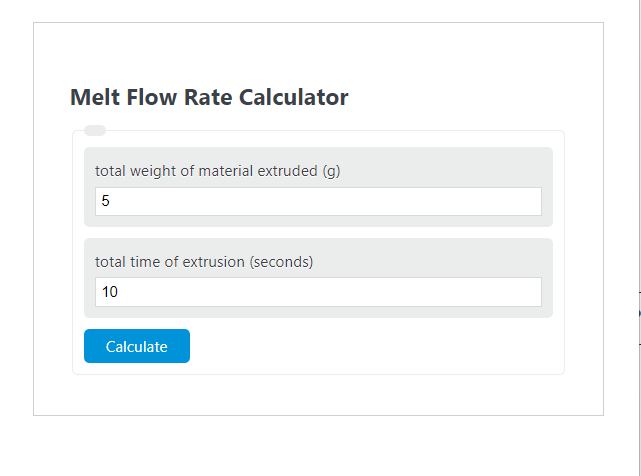
Calculate MFR from cut mass and time, reverse cut mass or interval, or calculate MVR and density-derived MFR while retaining test temperature and load.
- All Chemistry Calculators
- Extruder Power Calculator
- Extrusion Force Calculator
- Injection Molding Cooling Time Calculator
- Melt Flow Index Calculator
- Extrusion Ratio Calculator
- Plastic Shrinkage Calculator
Melt Flow Rate Formula
Melt flow rate is a quick way to describe how easily a molten polymer flows during a timed extrusion test. In practical terms, it tells you how much material passes through the test setup over a fixed interval. Higher values usually indicate easier flow, while lower values usually indicate a more resistant, higher-viscosity melt.
This calculator converts the measured extruded mass and elapsed time into the common reporting unit of grams per 10 minutes.
Variable Definitions
- MFR = melt flow rate
- WE = total weight of material extruded
- T = total extrusion time in seconds
| Input | What it Represents | Typical Use |
|---|---|---|
| Total Weight of Material Extruded | The mass collected during the timed run | Measured on a scale after extrusion |
| Total Time of Extrusion | The duration of the run | Recorded in seconds, minutes, or hours |
| Melt Flow Rate | The normalized flow result | Usually reported in g/10-min |
Why the Conversion Factor Is 600
The formula uses a factor of 600 because melt flow rate is commonly expressed over 10 minutes, while the timing input is often measured in seconds.
That conversion lets a short timed test be scaled to the standard 10-minute basis.
Equivalent Forms
If you need to solve for a different variable, the relationship can be rearranged as follows.
If the test time is already in minutes, the expression becomes simpler.
How to Calculate Melt Flow Rate
- Measure the mass of polymer extruded during the test interval.
- Record the exact extrusion time.
- Convert the time to seconds if needed.
- Insert the values into the formula.
- Report the final result in grams per 10 minutes unless a different output unit is required.
Example
If 8 grams of material are extruded in 120 seconds, the melt flow rate is:
The result is 40 g/10-min.
How to Interpret the Result
- Higher melt flow rate: the polymer melt generally flows more easily and may fill thin sections more readily.
- Lower melt flow rate: the melt generally resists flow more and may behave as a thicker material during processing.
- Useful for comparison: the value is most meaningful when materials are compared under the same test conditions.
Melt flow rate is often used as a screening or quality-control number rather than a complete description of rheological behavior. Two materials can have similar flow-rate values and still process differently in real manufacturing conditions.
Important Notes for Accurate Comparison
- Use the same material family when making performance comparisons.
- Keep test temperature and applied load consistent.
- Make sure the collected mass reflects only the timed extrusion segment.
- Verify unit consistency before interpreting the result.
- Do not confuse a high flow rate with universally better performance; the ideal value depends on the process and part design.
Common Mistakes
- Entering time in minutes when the value is actually in seconds.
- Using total batch weight instead of only the material produced during the measured interval.
- Comparing results from different temperatures or different loads.
- Rounding the measured mass or time too aggressively.
Frequently Asked Questions
Is a higher melt flow rate always better?
No. A higher value means easier flow, but the best range depends on the molding or extrusion process, part geometry, and required material performance.
Can this calculator be used for reverse calculations?
Yes. If you know the melt flow rate and one other variable, you can solve for the missing mass or time using the rearranged formulas above.
Why is melt flow rate usually reported over 10 minutes?
Reporting on a 10-minute basis creates a consistent reference point that makes test results easier to read and compare.
Can I compare results across all plastics directly?
Direct comparison is limited. The number is most useful when the testing conditions and material type are comparable.