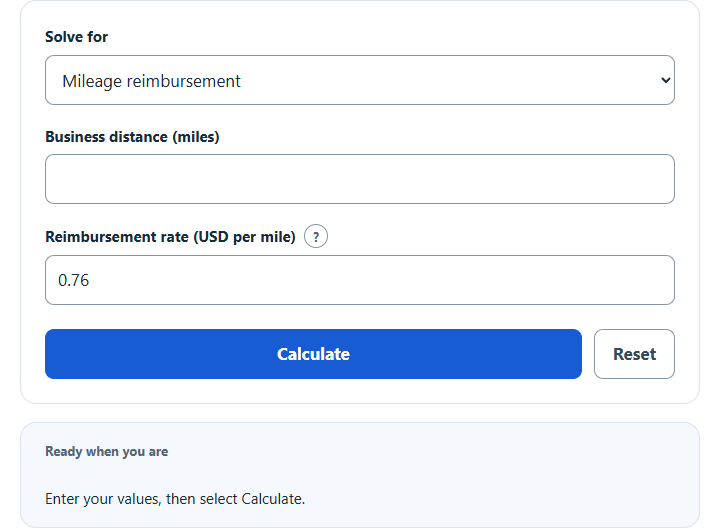
Calculate mileage reimbursement or a car allowance from business miles and a per-mile rate, preset to the 2026 IRS rate, or find miles from a payment.
Related Calculators
- Fringe Benefit Rate Calculator
- Annual Variable Pay Calculator
- Bonus Multiplier Calculator
- Months Of Service Calculator
- All Business Calculators
Car Allowance Formula
Variables:
- FCA is the car allowance (or mileage reimbursement) in dollars ($)
- M is the miles driven (mi)
- R is the per‑mile rate ($/mi). The calculator initially uses R = 0.76 $/mi (IRS business rate for July 1 through December 31, 2026).
To calculate car allowance, multiply the miles driven by the per‑mile rate (R).
Monthly allowance, tax and FAVR calculations
For a monthly allowance comparison, enter the allowance offered and the business miles driven in that same month. The effective gross rate is allowance ÷ business miles. The mileage benchmark is business miles × reimbursement rate; the displayed difference is the offer minus that benchmark. A positive difference is not proof that the allowance covers your vehicle costs, and the IRS standard mileage rate does not prescribe a fair or mandatory employer payment.
For a fully taxable flat allowance, the after-tax mode estimates net monthly allowance = gross allowance × (1 − combined marginal tax rate ÷ 100). Enter the estimated income and employee payroll tax rate applying to the additional allowance. It does not calculate tax brackets, wage caps, withholding, a fuel-card benefit or a deduction. In the U.S., payments under a qualifying accountable plan are treated differently from taxable nonaccountable allowances; business connection, adequate accounting and return of excess amounts matter.
The FAVR mode uses rates from an established fixed and variable rate plan: monthly payment = monthly fixed payment + business miles × variable per-mile rate. The fixed payment must already reflect the business-use share of the plan’s projected fixed costs, such as depreciation or lease payments, insurance and registration. The variable rate covers projected operating costs such as fuel, oil, tires and maintenance. It is not the IRS standard mileage rate. Annual projections assume the same payment inputs and mileage for 12 months. Monetary outputs are rounded independently to the nearest cent; annual amounts use unrounded monthly values.
This payment calculation does not design or certify an IRS-compliant FAVR plan. For 2026, the maximum standard automobile cost used to compute a FAVR allowance is $61,700. A compliant plan also has mileage, vehicle, employee, insurance, substantiation and recordkeeping requirements; entering an amount below that cap alone does not establish eligibility or tax-free treatment.
What is a typical monthly car allowance?
There is no single amount that is fair for every driver. Motus reported a $575 monthly average for 2024 in its car-allowance article; that historical vendor figure is not a verified national average for 2026 or a recommended payment. Job requirements, business mileage, local costs, vehicle costs and tax treatment all affect a suitable allowance. Use the monthly comparison mode with the actual offer and your own business mileage rather than treating an old average as a current standard.
How to Calculate Car Allowance?
The following steps outline how to calculate the Car Allowance.
- First, determine the miles driven.
- Next, gather the formula from above: FCA = M × R (the initial July–December 2026 rate is R = 0.76 $/mi; change it for other dates or policies).
- Finally, calculate the Car Allowance.
- After inserting the variables and calculating the result, check your answer with the calculator above.
Example Problem :
Use the following variables as an example problem to test your knowledge.
Miles driven (M) = 500 miles, rate (R) = $0.76/mile → FCA = 500 × 0.76 = $380.00.
Frequently Asked Questions
What factors can affect the car allowance rate?
Car allowance (or mileage reimbursement) rates can vary based on the employer’s policy, the country/jurisdiction, the year (many “standard” rates are updated annually), and the reimbursement method (for example, a standard per‑mile rate versus reimbursing actual documented expenses).
Is the car allowance rate the same for all types of vehicles?
It depends on the policy being used. A standard mileage rate (such as the U.S. IRS standard business mileage rate) generally applies the same per‑mile rate for most passenger vehicles, while employer policies or “actual expense” reimbursements can differ by vehicle and operating costs.
Can I claim more than the calculated car allowance on my taxes?
Tax rules vary by country and situation. In the U.S., self‑employed taxpayers generally choose either the standard mileage rate or the actual‑expense method for a vehicle (with recordkeeping requirements), and employees generally cannot deduct unreimbursed employee business expenses on their federal return under current law. For your specific case, consult your tax authority or a qualified tax professional.
How often should I calculate my car allowance?
Recalculate whenever your per‑mile rate changes (for example, annual updates), your driving patterns change materially, or your employer/jurisdiction changes the reimbursement policy.
Rate checked October 20, 2026 against the IRS standard mileage-rate table. For 2026 business travel, use $0.725/mile for January 1–June 30 and $0.76/mile for July 1–December 31. For a trip spanning both periods, calculate each portion separately and add the totals. These optional tax rates do not set a mandatory employer reimbursement rate.