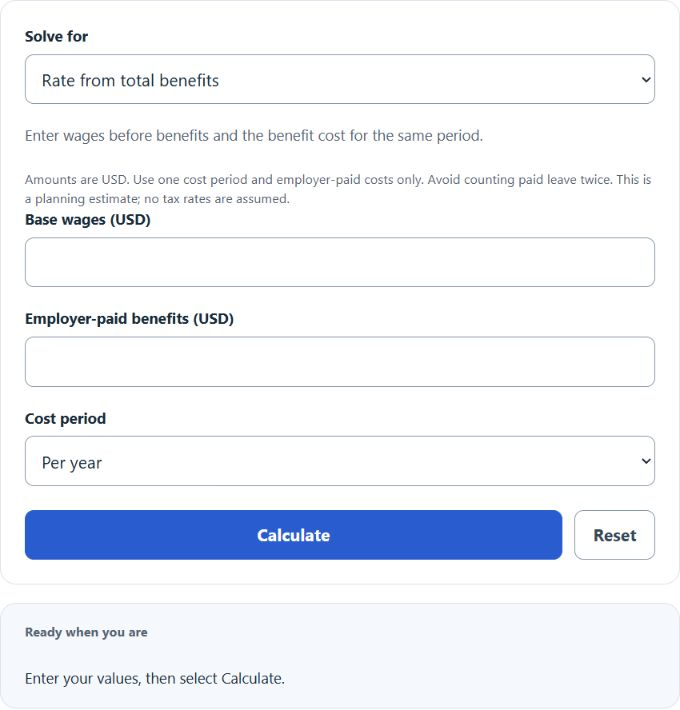
Calculate fringe benefit rates, employer-paid benefit costs, and loaded labor costs from wages, total or itemized benefits, payroll taxes, and applied rates.
- All Business Calculators
- Real Wage Rate Calculator
- Effective Labor Rate Calculator
- Loaded Labor Rate Calculator
- Direct Labor Costs Calculator
Fringe Benefit Rate Formula
- Total Fringe Benefits = sum of employer-paid health and insurance, retirement contributions, paid leave value, payroll taxes, and other non-wage compensation
- Base Wages = salary or hourly pay before benefits, for the same time period
Component mode adds employer tax cost as Base Wages × Effective Tax Rate / 100. Rate-based modes use Fringe Cost = Base Wages × Rate / 100. Avoid adding paid leave already included in base wages. Use the same period (annual, hourly, monthly) for every input or the rate will be wrong.
Rate Inputs and Benefit Components
Rates depend on the employer’s cost pool, wage base and included categories. The tables identify information to obtain from employer records; they are not current benchmarks or statutory rates.
| Employer Type | Rate source |
|---|---|
| Private sector, full-time | Employer cost records |
| Federal government / military | Agency cost records |
| State / university research | Approved organizational cost pool |
| Construction / Davis-Bacon | Applicable contract and employer records |
| Part-time / contract | Actual employer-paid costs |
| Component | Input guidance |
|---|---|
| FICA (Social Security + Medicare) | Use the effective employer rate; Social Security wage bases and exemptions may apply. |
| Federal + state unemployment | Use applicable effective employer cost |
| Workers’ compensation | Use employer insurance cost |
| Health / dental / vision | Use employer-paid premiums |
| Retirement match | Use employer contributions |
| Paid leave value | Add only costs excluded from base wages |
Example
In this illustrative planning example, base wages are $60,000 per year and exclude the separately added paid leave value. The employer pays $9,000 for health insurance, $3,000 in retirement match, $4,590 in payroll taxes (7.65%), and $5,000 in paid leave value.
Total benefits: $9,000 + $3,000 + $4,590 + $5,000 = $21,590
Rate: $21,590 / $60,000 × 100 = 35.98%
Loaded cost: $81,590 per year, or about $39.23 per hour at 2,080 hours.
When to use each mode. Use Rate from total benefits with known benefit cost. Use Rate from benefit components to itemize employer costs. Use a rate-based benefit-cost or loaded-cost mode with a documented applicable rate. Amounts use USD; changing the cost period label does not convert them.