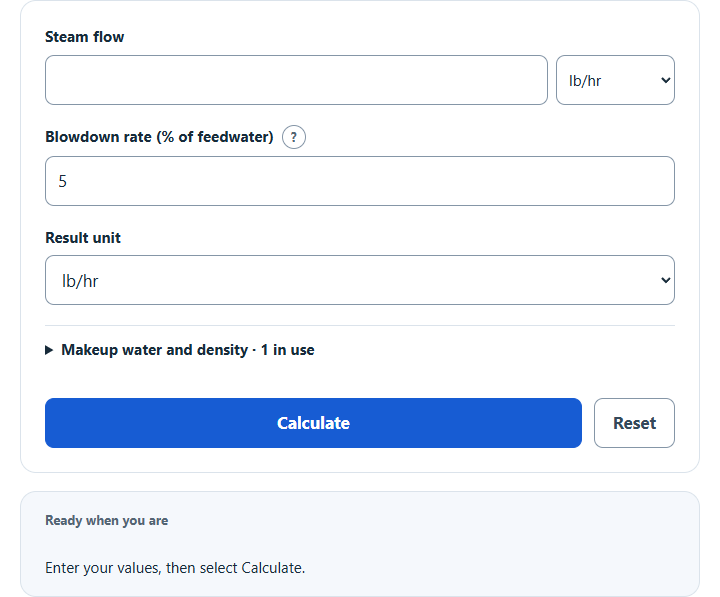
Calculate boiler feedwater flow from steam flow and blowdown rate, with blowdown and makeup water flow in lb/hr, kg/hr, gpm, L/min or m³/hr.
Related Calculators
- CFS to GPM Calculator
- m3/h to cfm Converter
- Conductivity To TDS Calculator
- microsiemens to ppm Converter
- All Unit Converters
Feed Water Flow Formula
The following formula is used to estimate the feedwater flow needed to produce a given steam generation rate. For a simple steady-state mass balance (ignoring attemperation sprays and other side streams), the feedwater equals the steam produced plus any continuous blowdown.
Variables:
- Fw is the feedwater mass flow rate (e.g., kg/h, lb/h)
- Sf is the steam generation rate (steam mass flow rate)
- BD is the blowdown fraction of the feedwater (e.g., 0.05 for 5% blowdown)
To calculate the feedwater flow, divide the steam generation rate by (1 − BD). If blowdown is negligible (BD ≈ 0), then Fw ≈ Sf.
Estimate Boiler Feed Pump Duty
Select Boiler feed pump duty. Enter the required feedwater volume flow before any allowance. You can take it from the Feedwater flow result using the actual water density. Enter the boiler and feedtank gauge pressures using the same reference. For a vented feedtank, use zero gauge pressure. Enter the delivery elevation minus the feedtank water level, the combined pipe and valve head loss at the design flow, and the pump efficiency at that duty point.
In SI units, use pressure in pascals, flow in m³/s, liquid density (ρ) in kg/m³, gravity (g) in m/s², head in meters and efficiency as a fraction. The calculation assumes steady liquid flow with negligible velocity head at the reference points. If recirculation adds to the flow through the pump, include that flow in the duty calculation. Recheck pipe and valve losses at the resulting design flow.
For example, 36 m³/hr with a specified 25% flow allowance gives a design flow of 45 m³/hr. At 400 kPa(g) boiler pressure and 100 kPa(g) feedtank pressure, the pressure difference is 300 kPa. With 960 kg/m³ water, a 5 m rise, 2 m of head loss and 75% pump efficiency, the estimate is about 38.9 m of total head and 6.10 kW of shaft power.
Use the estimated duty point to review pump curves over the expected operating range. Check the available net positive suction head (NPSH) against the manufacturer’s requirements with an appropriate margin, especially for hot feedwater close to boiling. Shaft power describes the load on the pump shaft. Motor sizing also depends on the pump’s load curve and the operating range.
What is Feed Water Flow?
Feed water flow refers to the rate at which water is supplied to a boiler to be converted into steam. This is a critical parameter in the operation of boilers and steam generation systems. The feed water must be carefully controlled to ensure stable boiler operation, maintain the desired steam output, and prevent issues such as overheating or scaling. For a given steam production rate, feedwater flow is primarily determined by the steam demand and losses such as blowdown (and any other side streams), not by boiler efficiency.
How to Calculate Feed Water Flow?
The following steps outline how to calculate the Feed Water Flow.
- First, determine the steam generation rate (Sf).
- Next, determine the continuous blowdown rate as a percent of feedwater (BD), if applicable (otherwise assume 0%).
- Finally, calculate the Feed Water Flow using the formula Fw = Sf / (1 − BD).
- After inserting the values and calculating the result, check your answer with the calculator above.
Example Problem :
Use the following variables as an example problem to test your knowledge.
Steam generation rate (Sf) = 500 kg/h
Assume blowdown = 5% of feedwater (BD = 0.05)
Feedwater flow (Fw) = 500 / (1 − 0.05) = 526.3 kg/h
(Optional for heat input estimates) Steam enthalpy (Hs) = 2800 kJ/kg
(Optional for heat input estimates) Feedwater enthalpy (Hw) = 500 kJ/kg
(Optional for heat input estimates) Boiler efficiency (η) = 85%