Convert feet to steps or steps to feet using stride length or height-based estimates, plus quick counts for common walking paces and ranges.
| Feet to Steps | Steps to Feet |
|---|---|
| 10 ft = 4 steps | 1,000 steps = 2,500 ft |
| 25 ft = 10 steps | 2,000 steps = 5,000 ft |
| 50 ft = 20 steps | 3,000 steps = 7,500 ft |
| 100 ft = 40 steps | 5,000 steps = 12,500 ft |
| 250 ft = 100 steps | 7,500 steps = 18,750 ft |
| 500 ft = 200 steps | 10,000 steps = 25,000 ft |
| 1,000 ft = 400 steps | 12,000 steps = 30,000 ft |
| 1,320 ft = 528 steps | 15,000 steps = 37,500 ft |
| 2,640 ft = 1,056 steps | 20,000 steps = 50,000 ft |
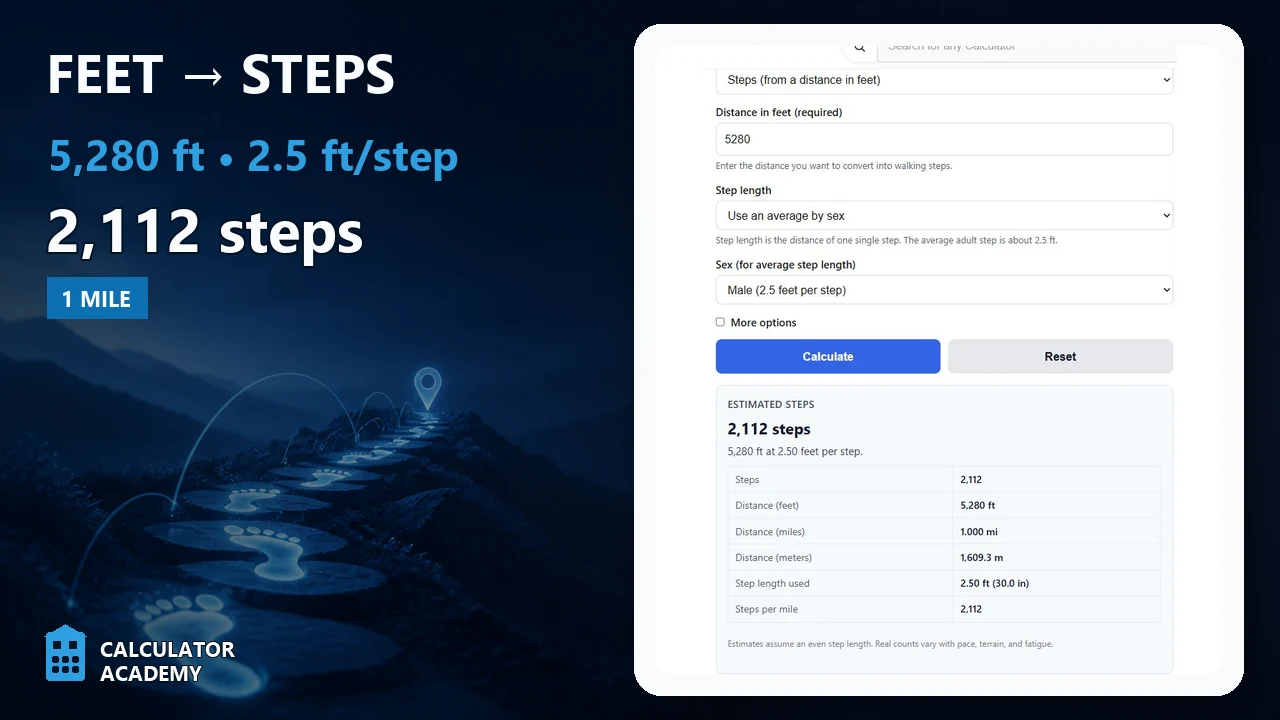
| 5,280 ft = 2,112 steps | 25,000 steps = 62,500 ft |
| 10,000 ft = 4,000 steps | 30,000 steps = 75,000 ft |
| 20,000 ft = 8,000 steps | 40,000 steps = 100,000 ft |
| Formulas: steps = feet ÷ stride; feet = steps × stride. Assumes stride = 2.5 ft/step. | |
| Feet to Steps | Steps to Feet |
|---|---|
| 10 ft = 4.55 steps | 1,000 steps = 2,200 ft |
| 25 ft = 11.36 steps | 2,000 steps = 4,400 ft |
| 50 ft = 22.73 steps | 3,000 steps = 6,600 ft |
| 100 ft = 45.45 steps | 5,000 steps = 11,000 ft |
| 250 ft = 113.64 steps | 7,500 steps = 16,500 ft |
| 500 ft = 227.27 steps | 10,000 steps = 22,000 ft |
| 1,000 ft = 454.55 steps | 12,000 steps = 26,400 ft |
| 1,320 ft = 600 steps | 15,000 steps = 33,000 ft |
| 2,640 ft = 1,200 steps | 20,000 steps = 44,000 ft |
| 5,280 ft = 2,400 steps | 25,000 steps = 62,500 ft |
| 10,000 ft = 4,545.45 steps | 30,000 steps = 66,000 ft |
| 20,000 ft = 9,090.91 steps | 40,000 steps = 88,000 ft |
| Formulas: steps = feet ÷ stride; feet = steps × stride. Assumes stride = 2.2 ft/step. | |
Feet To Steps Formula
The core formula for converting feet to steps divides total distance by stride length:
Steps = Distance (ft) / Stride Length (ft)
Stride length can be measured directly or estimated from height. For walking, multiply height in inches by 0.415 (men) or 0.413 (women), then divide by 12 to get stride length in feet. For running, the multiplier increases to approximately 0.52, reflecting the longer ground contact phase of a running gait. A 5’10” man walking has an estimated stride of about 2.42 ft/step, meaning 1,000 feet requires roughly 413 steps. The same person running covers about 3.03 ft/step, reducing the count to roughly 330 steps for the same distance.
Stride Length by Height Reference
The table below shows estimated walking and running stride lengths across a range of heights, along with the approximate number of steps required to cover one mile (5,280 ft) at each stride. These values use the standard 0.415 multiplier for walking and 0.52 for running.
| Height | Walking Stride (ft) | Walking Steps/Mile | Running Stride (ft) | Running Steps/Mile |
|---|---|---|---|---|
| 4’10” (58 in) | 2.01 | 2,627 | 2.51 | 2,104 |
| 5’0″ (60 in) | 2.08 | 2,538 | 2.60 | 2,031 |
| 5’2″ (62 in) | 2.14 | 2,467 | 2.69 | 1,962 |
| 5’4″ (64 in) | 2.21 | 2,389 | 2.77 | 1,906 |
| 5’6″ (66 in) | 2.28 | 2,316 | 2.86 | 1,846 |
| 5’8″ (68 in) | 2.35 | 2,247 | 2.95 | 1,790 |
| 5’10” (70 in) | 2.42 | 2,182 | 3.03 | 1,743 |
| 6’0″ (72 in) | 2.49 | 2,120 | 3.12 | 1,692 |
| 6’2″ (74 in) | 2.56 | 2,063 | 3.21 | 1,644 |
| 6’4″ (76 in) | 2.63 | 2,008 | 3.29 | 1,605 |
| Walking stride = height (in) x 0.415 / 12. Running stride = height (in) x 0.52 / 12. Steps/mile = 5,280 / stride. | ||||
Factors That Change Stride Length
Height-based formulas provide a useful starting point, but actual stride length varies based on several measurable factors. Age is the most significant: adults over 60 typically show stride lengths 10 to 20% shorter than younger adults of the same height, driven by reduced hip flexibility, lower muscle mass, and changes in gait mechanics. Walking speed also matters considerably. At a brisk 4 mph pace, stride lengthens by roughly 15% compared to a casual 2.5 mph stroll. Terrain introduces further variation: uphill walking shortens stride by about 10 to 15%, while soft surfaces like sand or grass reduce it by roughly 10 to 20% compared to pavement. Fatigue compounds these effects over long distances, with stride length declining 5 to 8% in the final quarter of a walk as muscles tire.
Pedometer and Fitness Tracker Accuracy
Modern fitness trackers use MEMS accelerometers to detect the rhythmic swing of the wrist or hip during walking. Each swing cycle registers as two steps. In controlled testing, most wrist-worn devices land within plus or minus 100 steps over a 6,000-step walk, with waist-worn accelerometers slightly more accurate than wrist models. Accuracy drops at slow speeds below about 2 mph, where the acceleration signal becomes harder to distinguish from background noise. Driving, typing, and other repetitive arm motions can also register false steps, with commuters accumulating several hundred phantom steps daily. For the most accurate manual conversion, measuring your own stride over a known 50 to 100 foot distance and dividing provides a personalized feet-per-step value that outperforms any formula or device estimate.
Daily Step Counts and Health Research
The widely cited 10,000-steps-per-day target originated not from medical research but from a 1965 Japanese marketing campaign for a pedometer called Manpo-kei (literally “10,000 steps meter”). Subsequent large-scale research has established more nuanced thresholds. A 2022 meta-analysis published in The Lancet, covering 47,471 adults across 15 international cohorts, found that all-cause mortality risk drops progressively up to about 7,000 to 10,000 steps per day for adults under 60, and 6,000 to 8,000 steps per day for adults 60 and older. Beyond those ranges, additional steps provide diminishing returns. An NIH-funded study found that adults averaging 8,000 steps daily had a 51% lower risk of all-cause mortality compared to those taking 4,000 steps, and those taking 12,000 steps had a 65% lower risk. Intensity appears less important than volume: the same NIH research found no significant additional benefit from higher step intensity after accounting for total daily steps.
What is Feet to Steps?
Feet to steps is a distance-to-count conversion that estimates how many walking or running steps are needed to cover a given number of feet. The conversion depends almost entirely on stride length, which ranges from roughly 2.0 ft/step for shorter individuals walking slowly to 3.3 ft/step for tall runners. For quick mental math, dividing feet by 2.5 gives a reasonable average estimate (yielding about 2,112 steps per mile). This conversion is useful in fitness tracking, physical therapy goal-setting, workplace wellness challenges, and urban planning studies that measure pedestrian traffic in step equivalents. Unlike pure unit conversions (such as feet to meters), feet to steps is inherently person-specific, which is why this calculator offers height-based and custom stride inputs for more accurate results.
Sources
National Institute of Standards and Technology. Guide for the Use of the International System of Units (SI).