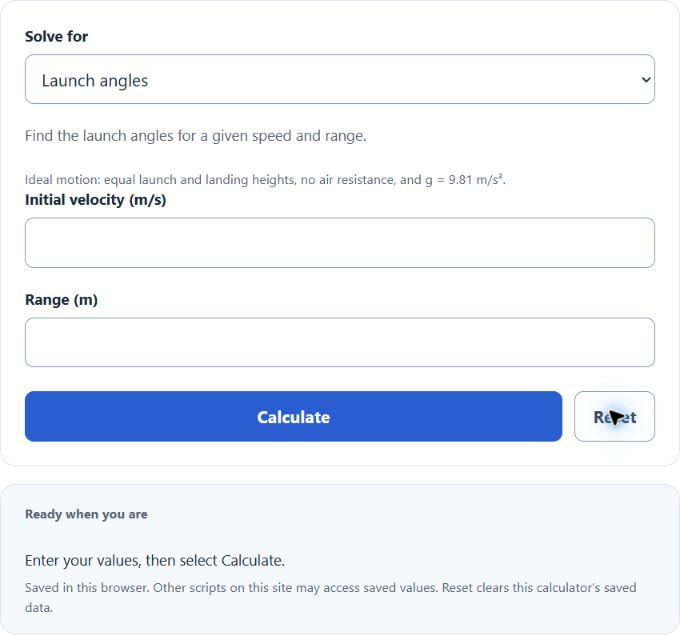
Choose launch angles, initial velocity, or range, then enter the two required values. This ideal projectile model assumes equal launch and landing heights, no air resistance, and g = 9.81 m/s².
Related Calculators
- Free Fall Calculator
- Impact Energy Calculator
- Kinetic Energy to Mass Calculator
- Net Force Calculator
- All Physics Calculators
Firing Angle Formula
The following equation gives the lower launch angle. The higher solution is 90° minus the lower angle; both coincide at 45° at maximum range.
- Where FA is the firing angle (°)
- V is the initial velocity (m/s)
- R is the range (m)
- g is the gravitational acceleration (9.81 m/s²)
Choose Launch angles and enter the initial velocity and range. A range greater than V²/g has no real solution in this equal-height model.
What is a Firing Angle?
Definition:
The firing angle is the angle at which a projectile is launched relative to the horizontal plane, playing a vital role in determining its range and trajectory.
How to Calculate Firing Angle?
Example Problem:
The following example outlines the steps and information needed to calculate the firing angle.
First, determine the initial velocity. In this example, the initial velocity is 50 m/s.
Next, determine the range. In this example, the range is 200 m.
Finally, calculate the firing angle using the formula above:
FA = (1/2) arcsin((R × g)/(V^2))
FA = (1/2) arcsin((200 * 9.81)/(50^2))
FA ≈ 25.8511°; the higher solution is approximately 64.1489°.
FAQ
What role does the firing angle play in projectile motion?
The firing angle determines the initial trajectory of a projectile, influencing its range, height, and overall flight path.
How do I choose which value to calculate?
Choose the value to calculate from the Solve for menu. Enter the two displayed inputs; the result appears in the separate results area.
What gravitational acceleration value is used in the calculations?
The calculator uses a gravitational acceleration of 9.81 m/s², which is the standard value on Earth.