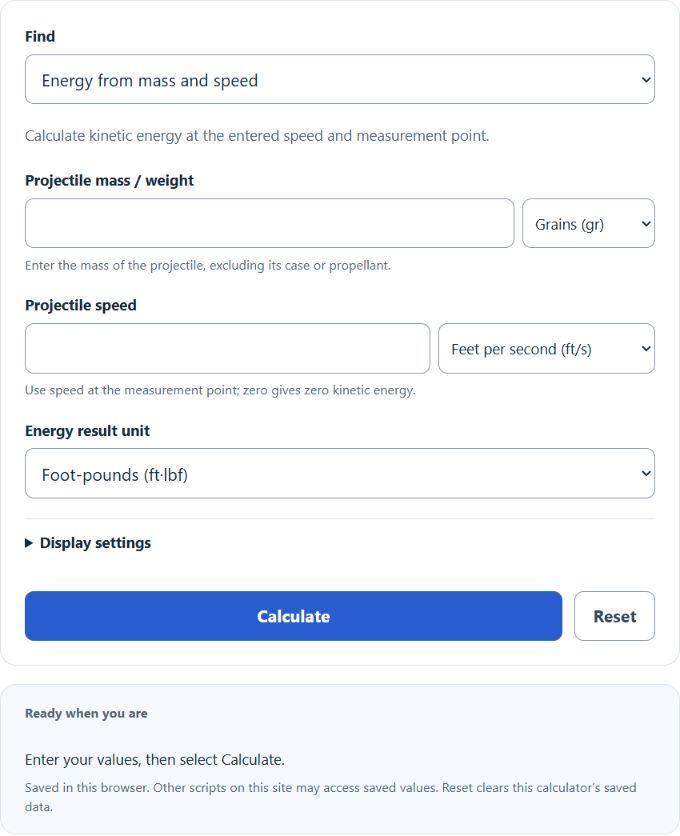
Calculate projectile energy in foot-pounds and joules from weight and velocity, or solve for required velocity or projectile weight using grains, grams, fps, or metric units.
- All Unit Converters
- FPE Calculator
- Muzzle Energy Calculator
- FPS to Joules Calculator
- Joules to FPS Calculator
- Bullet Energy Calculator
Foot-Pounds of Energy Formula
The calculator uses the standard kinetic energy equation, rewritten so you can plug in projectile weight in grains and velocity in feet per second directly.
- KE = kinetic energy in foot-pounds (ft-lb)
- m = projectile weight in grains (gr)
- v = projectile velocity in feet per second (ft/s)
- 450,436.67979 ≈ unit conversion divisor (2 × 7000 gr/lb × 32.17404856 ft/s²). The calculator uses SI mass and speed with the exact defined unit factors.
The equivalent divisor is approximately 450,436.67979 for grains and feet per second; 450,436 is a rounded convention. Energy scales linearly with weight but with the square of velocity, so doubling velocity quadruples energy. The figure is a muzzle or point-of-measurement value only. It does not account for drag, drop, or terminal performance.
The calculator converts mass to kilograms and speed to meters per second, computes E = ½mv² in joules, and converts the result using 1 ft·lbf = 1.3558179483314004 J.
The three modes use the same formula in different ways:
- Energy mode: solves KE directly from weight and velocity.
- Speed mode: solves v = √(2E/m) from mass and energy. Zero energy gives zero speed for a positive mass.
- Mass mode: solves m = 2E/v² from positive speed and positive energy. Zero speed and zero energy do not determine a unique mass.
Reference Values
These are illustrative mass and speed inputs with kinetic energies rounded to the nearest whole foot-pound. They are not specifications for particular commercial loads. Actual measured speed varies with equipment and conditions; the broad classes in the second table are descriptive examples rather than performance thresholds.
| Cartridge / Projectile | Weight (gr) | Velocity (ft/s) | Energy (ft-lb) |
|---|---|---|---|
| .177 air pellet | 7.9 | 1,000 | 18 |
| .22 LR | 40 | 1,200 | 128 |
| Hunting arrow | 400 | 280 | 70 |
| 9mm Luger | 124 | 1,150 | 364 |
| .45 ACP | 230 | 850 | 369 |
| .357 Magnum | 125 | 1,450 | 583 |
| .223 Remington | 55 | 3,240 | 1,282 |
| .308 Winchester | 150 | 2,800 | 2,611 |
| .300 Win Mag | 180 | 2,960 | 3,501 |
| Energy Range (ft-lb) | Typical Class |
|---|---|
| Under 20 | Low-power airguns, light target pellets |
| 20 – 80 | Magnum airguns, bows, light arrows |
| 80 – 300 | Rimfire, heavy arrows, light handguns |
| 300 – 800 | Common centerfire handgun loads |
| 800 – 3,500 | Centerfire rifle loads |
| Over 3,500 | Magnum rifle and large dangerous-game loads |
Worked Examples and Common Questions
Example 1: 9mm 124 gr at 1,150 ft/s.
KE ≈ (124 × 1,150²) / 450,436.67979 = 364.07 ft·lbf, or 493.61 J. Rounded to a whole foot-pound, this is 364 ft·lbf.
Example 2: .308 150 gr at 2,800 ft/s.
KE ≈ (150 × 2,800²) / 450,436.67979 = 2,610.80 ft·lbf, which rounds to 2,611 ft·lbf.
Example 3: Reverse solve. For 500 ft·lbf and a 230 gr projectile, speed ≈ sqrt(500 × 450,436.67979 / 230) = 989.55 ft/s, or 990 ft/s rounded to a whole unit.
Why grains and ft/s? The divisor approximately 450,436.67979 combines the mass, speed and energy unit factors. If m is mass in pounds and v is speed in ft/s, the equivalent divisor is 2 × 32.17404856. Grains and pounds here measure mass; the foot-pound energy unit is foot times pound-force.
Does foot-pounds measure stopping power? No. Foot-pounds is kinetic energy at the muzzle or chronograph point. Terminal effect depends on bullet construction, expansion, penetration, and shot placement. Use ft-lb to compare loads, not to predict wound performance.
How accurate is the result? This is the classical kinetic-energy model for ordinary nonrelativistic speeds. Display precision does not establish measurement accuracy. For a 150 gr projectile at 2,800 ft/s, increasing speed by 50 ft/s raises energy by about 94.08 ft·lbf; decreasing it by 50 ft/s lowers energy by about 92.41 ft·lbf.
Converting to joules. Multiply ft·lbf by 1.3558179483314004. Thus exactly 364 ft·lbf is about 493.52 J; the unrounded 124 gr example gives 493.61 J. The calculator shows both energy units.
Why does velocity matter more than weight? Energy scales with v². A 10% velocity increase raises energy about 21%. A 10% weight increase raises energy only 10%. That is why high-velocity rifle rounds outpace heavy but slow handgun rounds in ft-lb even with much lighter projectiles.