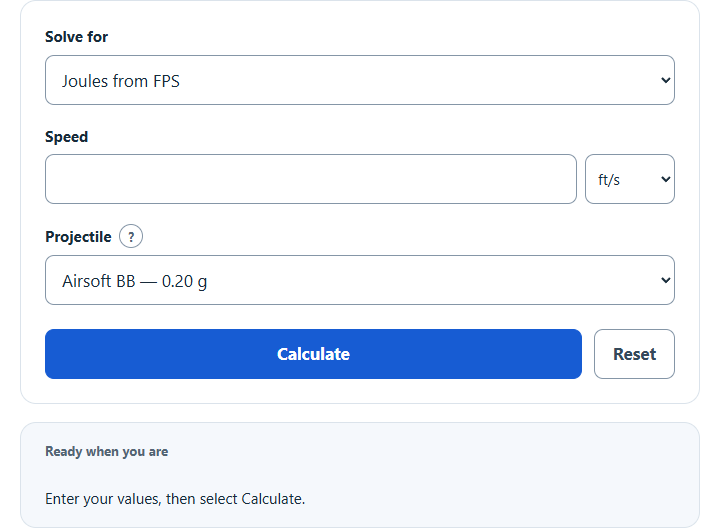
Convert FPS to joules for an airsoft BB, pellet or other projectile: enter feet per second and pick a BB weight or mass, or convert joules back to FPS.
- All Unit Converters
- Muzzle Energy Calculator
- Muzzle Velocity Calculator
- Joules to FPS Calculator
- Foot Pounds of Energy Calculator
- Bullet Energy Calculator
Joules from FPS Formula
Variables:
- J is the Joules from FPS (joules)
- FPS is the total feet per second (FPS)
- m is the mass (grams)
| Velocity (ft/s) | Energy (J) |
|---|---|
| 200 | 0.372 |
| 220 | 0.450 |
| 240 | 0.535 |
| 250 | 0.581 |
| 260 | 0.628 |
| 280 | 0.728 |
| 300 | 0.836 |
| 320 | 0.951 |
| 330 | 1.012 |
| 340 | 1.074 |
| 350 | 1.138 |
| 360 | 1.204 |
| 380 | 1.342 |
| 400 | 1.486 |
| 420 | 1.639 |
| 450 | 1.881 |
| 480 | 2.140 |
| 500 | 2.323 |
| 550 | 2.810 |
| 600 | 3.345 |
| * Rounded to 3 decimals. Uses KE = 0.5 × m × v² with v = FPS × 0.3048 m/s and m = 0.20 g (0.00020 kg). | |
How to Calculate Joules from FPS?
The following steps outline how to calculate the Joules from FPS.
- First, determine the total feet per second (FPS).
- Next, determine the mass (grams).
- Next, use J = (FPS × 0.3048)² × 0.5 × mass in grams ÷ 1000.
- Finally, calculate the Joules from FPS.
- After inserting the variables and calculating the result, check your answer with the calculator above.
Example Problem :
Use the following variables as an example problem to test your knowledge.
total feet per second (FPS) = 4000
mass (grams) = 30; energy = 0.5 × 0.030 × (4000 × 0.3048)² = 22,296.7296 J.
FAQs
What is a joule in terms of energy?
A joule is a unit of energy in the International System of Units (SI). It is defined as the amount of work done when a force of one newton is applied over a distance of one meter. In the context of projectiles or ballistics, it measures the kinetic energy of the object.
Why is it important to calculate Joules from FPS?
Calculating joules from feet per second and mass gives the object’s classical kinetic energy. Energy alone does not predict impact damage, terminal effects or legal status.
Can the formula provided be used for any type of projectile?
The formula applies to classical, nonrelativistic motion when mass and speed at the point of interest are known. It does not model drag, relativistic speeds or terminal effects. Use matching units; the calculator also converts metric speed and mass units.
How does changing the mass (grams) of the projectile affect the joules calculated?
Increasing the mass of the projectile while keeping the speed (FPS) constant will result in a higher value of joules, indicating more kinetic energy. Conversely, decreasing the mass will result in lower joules, indicating less kinetic energy. This is because the kinetic energy (measured in joules) is directly proportional to the mass of the object.