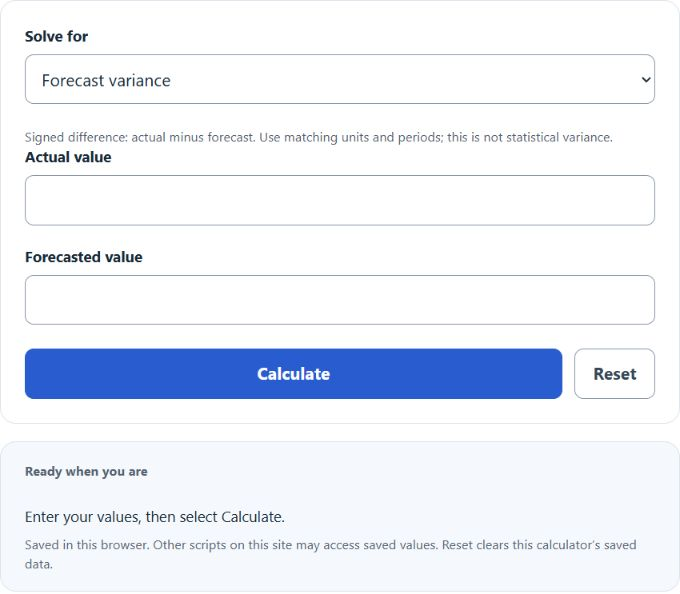
Choose forecast variance, actual value or forecasted value, then enter the two required values in matching units and periods.
Related Calculators
- Variance Calculator
- Least Square Error Calculator
- Population Prediction Calculator
- AIC Rating Calculator
- Hurst Coefficient Calculator
- All Statistics Calculators
Forecast Variance Formula
This calculator uses forecast variance to mean the signed difference between actual and forecasted values, not statistical variance. Use matching units and periods.
Variables:
- V is the forecast variance
- A is the actual value
- F is the forecasted value
To calculate the forecast variance, subtract the forecasted value from the actual value. This will give you the difference between what was predicted and what actually occurred.
What is Forecast Variance?
Forecast variance is a measure used to assess the accuracy of a forecast by comparing the forecasted values to the actual values. It represents the difference between what was predicted and what actually occurred. A positive variance indicates that the actual value was higher than the forecasted value, while a negative variance indicates that the actual value was lower than the forecasted value. Forecast variance is commonly used in various fields such as finance, supply chain management, and project management to evaluate the performance of forecasting models and make necessary adjustments for future predictions.
How to Calculate Forecast Variance?
The following steps outline how to calculate the Forecast Variance.
- First, determine the actual value (A).
- Next, determine the forecasted value (F).
- Next, calculate the forecast variance using the formula V = A - F.
- Finally, calculate the Forecast Variance.
- After inserting the values and calculating the result, check your answer with the calculator above.
Example Problem :
Use the following variables as an example problem to test your knowledge.
Actual Value (A) = 150
Forecasted Value (F) = 130