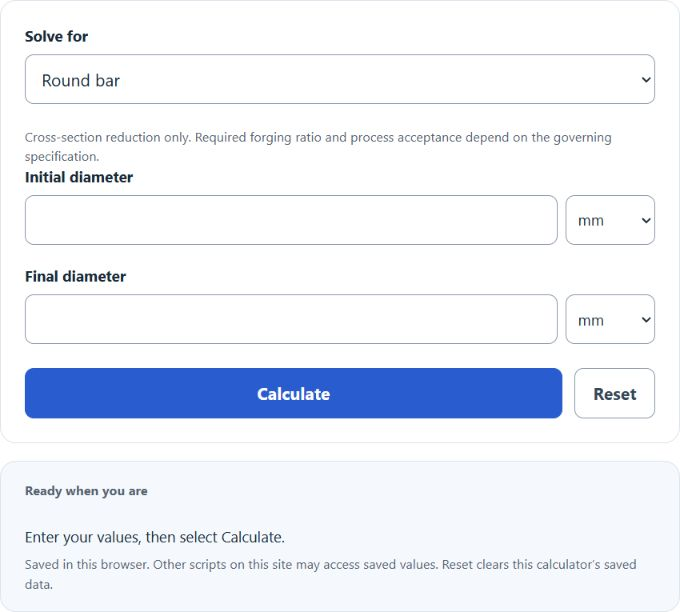
Calculate forging ratio from initial and final round, rectangular, or area values and see reduction percentage and section size output.
Related Calculators
- Extrusion Ratio Calculator
- Axial Force Calculator
- Compressive Stress Calculator
- Taper Per Foot Calculator
- All Construction Calculators
Forging Ratio Formula
The forging ratio is the ratio of the starting cross-sectional area to the final cross-sectional area after forging. This area ratio describes drawing-out geometry; it does not measure material quality or all deformation history.
For a round bar reduced to a smaller round, the formula expands to:
For a square bar:
For a rectangular section:
To find the final size needed to hit a target ratio:
- FR = forging ratio, expressed as X:1
- A_initial = cross-sectional area of the starting stock
- A_final = cross-sectional area after forging
- D = diameter of round bar or billet
- S = side length of square bar
- W, T = width and thickness of rectangular section
The calculator provides round bar, rectangular section, known areas and target round diameter modes. Target diameter is a geometric result for a stated area ratio, not a process acceptance decision.
Typical Forging Ratio Benchmarks
Forging ratio requirements vary by application and specification. The area reductions below follow the geometry. A ratio alone does not establish suitability for a listed application; use the governing material and process specification.
| Forging Ratio | Area Reduction | Typical Use |
|---|---|---|
| 2:1 | 50% | Light forging, non-critical parts |
| 3:1 | 66.7% | Common minimum for structural forgings |
| 4:1 | 75% | Pressure vessel and shaft forgings |
| 5:1 to 6:1 | 80% to 83.3% | High-integrity rotors, aerospace shafts |
| 8:1+ | 87.5%+ | Critical alloy and tool steel work |
Conversion between dimensional reduction and forging ratio for round bar:
| D_initial / D_final | Forging Ratio |
|---|---|
| 1.41 | 2:1 |
| 1.73 | 3:1 |
| 2.00 | 4:1 |
| 2.45 | 6:1 |
| 2.83 | 8:1 |
Worked Examples
Example 1: Round bar to round bar. A 200 mm diameter billet is forged to a 100 mm diameter shaft. Initial area = π × 200² / 4 = 31,416 mm². Final area = π × 100² / 4 = 7,854 mm². Forging ratio = 31,416 / 7,854 = 4:1. Area reduction is 75%.
Example 2: Target size from a target ratio. You start with a 12-inch round billet and need a 5:1 forging ratio. Final diameter = 12 / √5 = 12 / 2.236 = 5.37 inches. The unrounded geometric limit is 12/√5 ≈ 5.3666 inches. Rounding up to 5.37 inches gives slightly less than 5:1; process acceptance requires the governing specification.
FAQ
Is 3:1 a universal minimum? No. The required ratio depends on the material, product, deformation route and governing specification. This calculator does not certify compliance.
Does forging ratio account for upset forging? The same area-ratio principle applies, but the direction of working changes. For upset operations, the ratio is sometimes expressed as height reduction rather than cross-section reduction. Check the governing specification.
Is forging ratio the same as reduction ratio? In open-die and cogging work the terms are used interchangeably. In rolling and drawing, "reduction ratio" follows the same area-ratio definition.
What if my final area is larger than my initial area? An area ratio below 1:1 means the section grew. Upset-forging reduction may instead use initial height divided by final height; check the governing specification.