Calculate stock free float shares and percentage from outstanding, restricted and closely held shares, or project schedule free float in days.
- All Business Calculators
- Schedule Variance Calculator
- Earned Value Calculator
- EAC Calculator
- Project Time Calculator
- Construction Completion Date Calculator
Free Float Formula
The calculator runs in stock and schedule modes. Each mode uses its own formula.
Stock free float (shares):
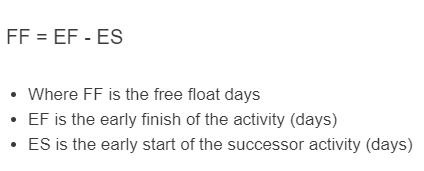
Project schedule free float (days): These equations apply to zero-lag finish-to-start links. Calendar dates are 00:00 UTC boundaries; durations are elapsed 24-hour days, without workday calendars or inclusive finish-day counting.
If you do not know the activity early finish, the calculator computes it first:
Variables:
- Outstanding Shares: issued shares currently held by shareholders, excluding treasury shares.
- Restricted Shares: shares locked by law or contract (insider lockups, employee restricted stock, etc.).
- Closely Held Shares: additional ownership holdings excluded by the chosen methodology, excluding any shares already counted as restricted.
- ES(successor): earliest relevant early start among immediate successor activities for zero-lag finish-to-start links.
- EF(activity): early finish of the activity you are analyzing.
- ES(activity): early start of the activity.
- Duration: how long the activity takes, in days.
The Stock shares mode subtracts non-float shares from outstanding shares and reports the percentage. The Project schedule modes subtract the activity early finish from the successor early start and return days of slack. You can enter day numbers or calendar dates, and you can either type the activity early finish directly or let the calculator add duration to the early start.
Reference Tables
Use these as quick checks against your inputs and results.
Stock free float interpretation
| Free Float % | Arithmetic interpretation | Interpretation limit |
|---|---|---|
| Below 10% | More than 90% excluded | Float alone does not determine liquidity |
| 10% to 25% | 75% to 90% excluded | Eligibility depends on the selected methodology |
| 25% to 50% | 50% to 75% excluded | Eligibility depends on the selected methodology |
| 50% to 75% | 25% to 50% excluded | Float alone does not predict trading activity |
| Above 75% | Less than 25% excluded | Float alone does not determine spreads or depth |
Schedule free float interpretation
| Free Float Value | Meaning | Action |
|---|---|---|
| Negative | Activity finishes after successor starts | Review dependency and timing assumptions |
| Zero | No slack before next activity | Any delay hits the successor |
| 1 to 3 days | 1 to 3 elapsed days of slack | Monitor closely |
| More than 3 days | More than 3 elapsed days of slack | Assess successor constraints |
Examples and FAQ
Example 1: Stock free float. A company has 10,000,000 outstanding shares. Insiders hold 2,500,000 additional closely held shares, separate from 1,000,000 restricted shares from a recent IPO lockup. These exclusions do not overlap. Free float = 10,000,000 − 1,000,000 − 2,500,000 = 6,500,000 shares. Free float percentage = 6,500,000 / 10,000,000 × 100 = 65%.
Example 2: Schedule free float. Activity B has an early start of day 5 and a duration of 4 days, so its early finish is day 9. Its immediate successor, Activity C, has an early start of day 12. Free float = 12 − 9 = 3 days. Activity B can slip up to 3 days without delaying Activity C.
How is free float different from total float? Free float is the delay an activity can absorb without pushing its immediate successor. Total float is the delay it can absorb without pushing the project finish. In a consistently calculated standard precedence schedule, free float does not exceed total float.
Does free float include treasury shares? No. Treasury shares are not part of outstanding shares, so they never enter the free float calculation. If a data source reports "issued" shares instead of "outstanding," subtract treasury stock first.
Can free float be negative on a schedule? Mathematically yes, and the calculator will show it. A negative result means the predecessor finishes after the successor is supposed to start, which is a discrepancy under the stated zero-lag finish-to-start assumptions and needs review.
What counts as closely held? Generally shares owned by company officers, directors, controlling shareholders, governments, parent companies, and strategic partners. Index providers like S&P and FTSE publish their own thresholds, and exclusions differ by holder type and methodology; there is no universal 5% rule.