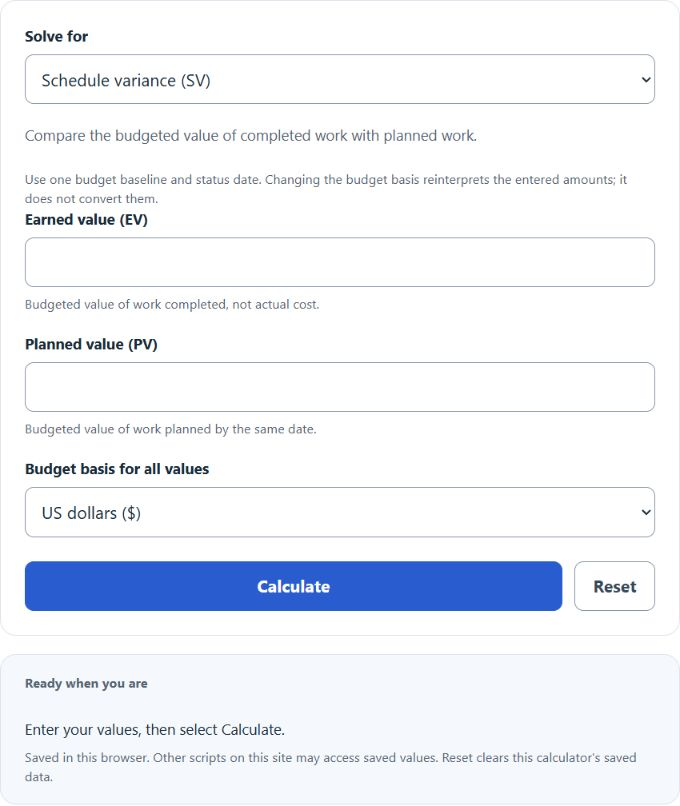
Calculate earned value schedule variance, its percentage, and the schedule performance index, or solve for earned and planned value using a consistent budget basis.
- Free Float Calculator
- Labor Productivity Calculator
- Earned Value Calculator
- Cost Variance Calculator
- Budget Variance Calculator
- Completion Percentage Calculator
- All Business Calculators
Schedule Variance Guide
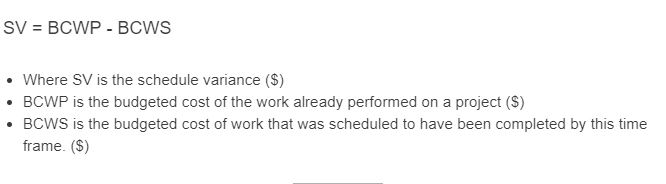
Schedule variance (SV) is an earned value management metric that compares the value of work actually completed with the value of work that was planned to be completed by the same status date. This calculator can solve for SV, BCWP, or BCWS when any two values are known.
| Term | Meaning | Common Alias | Unit |
|---|---|---|---|
| BCWP | Budgeted cost of work performed to date | Earned Value (EV) | Budgeted currency, hours, or work units |
| BCWS | Budgeted cost of work scheduled by the status date | Planned Value (PV) | Budgeted currency, hours, or work units |
| SV | Difference between earned value and planned value | Schedule Variance | Budgeted currency, hours, or work units |
How to Interpret the Result
| SV Result | What It Means | Practical Interpretation |
|---|---|---|
| Positive | More earned work than planned | More planned work value has been completed than expected by the status date. |
| Zero | Earned value matches plan | Completed work value matches the plan exactly at that checkpoint. |
| Negative | Less earned work than planned | Less planned work value has been completed than expected by the status date. |
Rearranged Forms
If you need to solve for one of the inputs instead of schedule variance, use these forms:
How to Calculate Schedule Variance
- Set a single project status date.
- Determine the budgeted value of the work actually completed by that date.
- Determine the budgeted value of the work that should have been completed by that date.
- Subtract the scheduled value from the performed value.
Example Calculation
If the project has earned $48,000 of budgeted work but was scheduled to have earned $52,000 by the same checkpoint:
An SV of -$4,000 means the project is behind schedule in earned value terms.
Important Notes
- Use the same status date for both BCWP and BCWS.
- Use the same baseline budget for both values.
- Keep all inputs on the same budget basis: currency, budgeted labor hours, or consistent budgeted work units. Changing the calculator’s basis reinterprets the amounts; it does not convert them.
- Schedule variance is a value-based measure, not a direct measure of calendar days or critical-path status. SV is defined when PV is zero, but SV percentage and SPI are not because they divide by PV.
- A negative schedule variance does not automatically mean the project is over budget.
Best Uses for This Calculator
- Weekly or monthly project performance reviews
- Earned value reporting dashboards
- Comparing planned progress against actual progress
- Flagging schedule slippage early enough to take corrective action
Common Questions
Why is schedule variance shown in dollars instead of time?
Because the metric compares budgeted value earned versus budgeted value planned, giving heavier weight to higher-value work.
Does a positive SV always mean the project is healthy?
It means more budgeted work value has been earned than planned at that checkpoint. Review the critical path, cost, quality, and scope separately; SV can return to zero at full completion even if the project finished late.
Can schedule variance be exactly zero?
Yes. A result of $0 means the earned value matches the planned value at the selected status date.