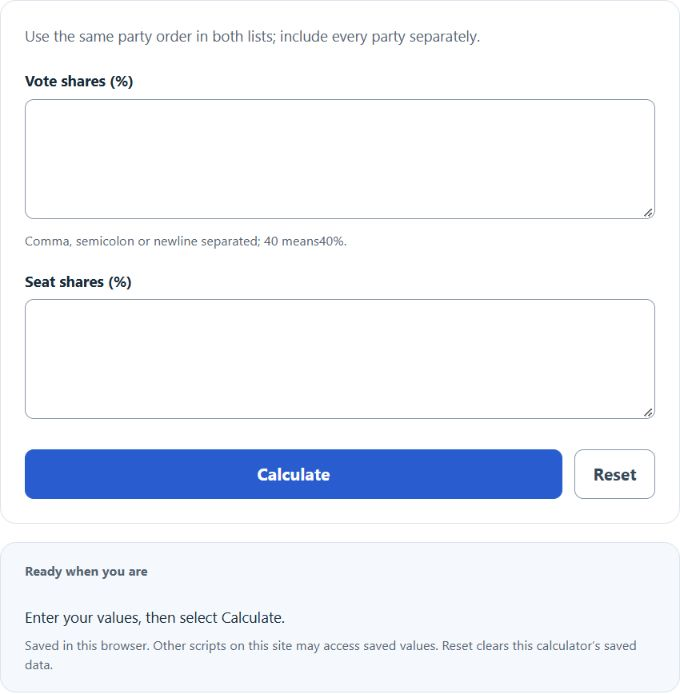
How do I use this calculator?
This calculator computes the Gallagher (Least Squares) Index for an election result using vote-share and seat-share percentages for all parties. Prefer individual parties; grouping several as “Other” can change the index.
Calculator Operations:
- Enter the list of vote percentages for all parties (e.g., 40, 60).
- Enter the matching list of seat percentages for the same parties in the same order (e.g., 30, 70).
- Click Calculate to compute the Gallagher Index (lower values indicate more proportional outcomes).
The number of parties is not a separate parameter—the calculator determines it from how many entries you provide. Be sure the vote and seat lists contain the same number of values and represent the same set of parties.
Use the calculate button when all known values have been entered and use the reset button when you want to clear the values from the calculator.
Calculate the Gallagher Index from vote and seat percentages for each party to measure how proportional an election result is overall.
- All Statistics Calculators
- Banzhaf Index Calculator
- Shapley-Shubik Power Index Calculator
- Effective Number of Parties Calculator
- Percentage Calculator
- Percentage Difference Calculator
Gallagher Index Formula
The Gallagher Index, also called the Least Squares Index, measures how closely an election’s seat shares match its vote shares. A value of 0 means perfect proportionality. As the value increases, the gap between votes received and seats awarded becomes larger.
| Term | Meaning |
|---|---|
GI |
Gallagher Index value |
vi |
Vote-share percentage for party i |
si |
Seat-share percentage for party i |
n |
Total number of parties or categories included in the result |
The index squares each party’s vote-seat gap, so larger mismatches count more heavily than smaller ones. That makes the Gallagher Index especially useful when you want major distortions in representation to stand out clearly.
How to Calculate the Gallagher Index
- List every party or category included in the election result.
- Enter each party’s vote share as a percentage.
- Enter each party’s seat share as a percentage in the same order.
- Find the difference between vote share and seat share for each party.
- Square each difference.
- Add the squared differences together.
- Multiply the total by 1/2.
- Take the square root.
If you only have raw vote totals or seat counts, convert them to percentages first.
Example Calculation
Suppose an election has four party groupings with the following vote and seat shares:
| Party | Vote Share | Seat Share | Difference | Squared Difference |
|---|---|---|---|---|
| A | 42% | 48% | -6 | 36 |
| B | 31% | 28% | 3 | 9 |
| C | 17% | 18% | -1 | 1 |
| D | 10% | 6% | 4 | 16 |
The sum of squared differences is 62.
The Gallagher Index for these shares is approximately 5.57. Interpretation requires consistent party definitions and comparison with other election results; this value alone does not establish a severity category.
How to Interpret the Result
- 0 means the seat distribution matches the vote distribution exactly.
- Lower values indicate a more proportional election outcome.
- Higher values indicate greater disproportionality between public support and legislative representation.
- Because differences are squared, one large overrepresentation or underrepresentation can raise the index substantially.
- The measure is most useful when comparing elections, districts, or electoral systems on the same scale.
Why the Gallagher Index Is Useful
This index is widely used to evaluate electoral proportionality because it condenses many party-level differences into a single number while still penalizing large distortions. It can help answer questions such as:
- How proportional was a particular election?
- Did electoral reform reduce disproportionality?
- Which election produced a seat bonus for larger parties?
- How do two countries or election years compare?
Calculator Input Tips
- Enter vote percentages and seat percentages for the same parties in the same order.
- Both lists should contain the same number of entries.
- Vote shares should total about 100%, and seat shares should also total about 100%. The calculator flags deviations above 0.5 percentage points without normalizing the data; totals near 100% alone do not verify completeness.
- Include minor parties and independents separately where possible. Aggregating them into Other can increase or decrease the index; disclose any grouping.
- Small rounding differences are usually acceptable, but large rounding errors can distort the result.
- Do not mix percentages with raw counts in the same calculation.
Common Mistakes
- Mismatched order: entering Party A’s vote share next to Party B’s seat share.
- Incomplete data: leaving out small parties or independent candidates.
- Using counts instead of percentages: the formula requires shares on a common percentage basis.
- Totals far from 100%: this usually signals missing categories or incorrect data entry.
Frequently Asked Questions
Can the Gallagher Index be negative?
No. Because the formula squares each party’s difference and then takes a square root, the result is always zero or positive.
Is a lower Gallagher Index always better?
If your goal is proportional representation, lower values are generally preferred. However, whether an electoral system is “better” depends on the broader design goals of that system, such as stability, local representation, or governability.
Do I need to include every party?
Yes. Use every party’s vote and seat shares separately for a full-election index. A calculation that omits parties covers only the entered contributions. Combining multiple parties into Other can distort the result; disclose grouping when separate shares are unavailable.
What happens if vote shares and seat shares match exactly?
Then every party’s difference is zero, the total squared difference is zero, and the Gallagher Index is zero.