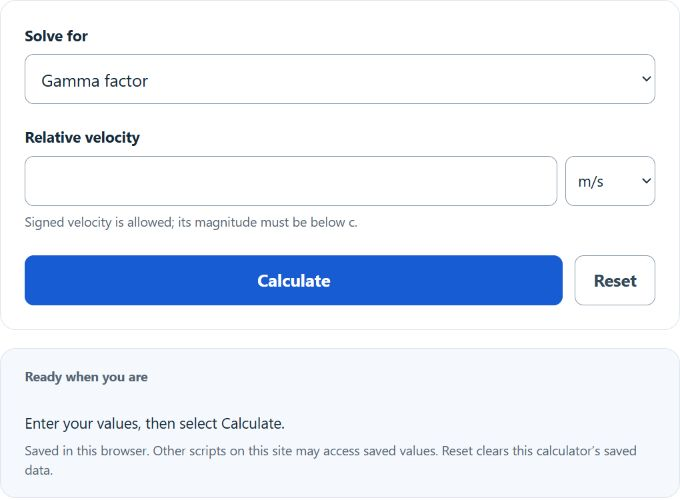
Calculate velocity or gamma factor from the other for special relativity, with velocity units in m/s, km/h, mph, or ft/s and unit conversion.
Related Calculators
- Thermal Velocity Calculator
- Kinetic Energy to Velocity Calculator
- Speed to Energy Calculator
- Acceleration to Energy Calculator
- All Physics Calculators
Gamma Factor Formula
The gamma factor, written as γ, is the special relativity scaling factor that links high-speed motion to time dilation, length contraction, and relativistic energy. It is dimensionless, always at least 1 for real physical speeds, and grows rapidly as velocity approaches the speed of light.
Many relativistic calculations become easier if velocity is first written as a fraction of the speed of light.
If you already know the gamma factor and want to solve for velocity, rearrange the equation to get the inverse relationship below.
Variable Definitions
- γ = gamma factor
- v = object velocity
- c = speed of light in vacuum, 299,792,458 m/s
- β = velocity written as a fraction of the speed of light
What the Gamma Factor Tells You
The gamma factor is the multiplier that determines how strongly relativistic effects appear in a given frame. When velocity is small compared with the speed of light, the gamma factor is very close to 1 and classical mechanics is usually sufficient. At very high speeds, gamma increases sharply, which is why relativistic effects become impossible to ignore.
Two of the most common uses of the gamma factor are time dilation and length contraction.
- Time dilation: a moving clock accumulates less proper time than the time measured in the stationary frame.
- Length contraction: lengths measured parallel to the direction of motion appear shorter by a factor of 1 divided by gamma.
- Energy and momentum: gamma also appears in relativistic energy and momentum formulas, which is why it is central in high-energy physics.
How to Use the Gamma Factor Calculator
- Select Gamma factor, enter the relative velocity and unit, and select Calculate.
- Make sure the speed is below the speed of light.
- Read the computed gamma factor.
- For the inverse, select Speed from gamma, enter γ ≥ 1, choose an output unit, and select Calculate. The result is a speed magnitude; direction is not determined.
- Use the result to interpret time dilation, contraction, or other relativistic quantities.
Important input rules:
- The velocity magnitude must be below c. Zero velocity gives γ = 1.
- Gamma cannot be less than 1 for ordinary massive objects.
- Values extremely close to the speed of light can produce very large gamma factors.
Example Calculation
For an object traveling at 150,000,000 m/s:
This means relativistic effects are present but still moderate. In that frame, a moving clock would accumulate about 1 / 1.15497 of the stationary-frame time, and lengths parallel to motion would be reduced by the same factor.
Quick Reference: Speed vs. Gamma
| Speed | Gamma (γ) | Moving Clock Accumulates | Observed Length Along Motion |
|---|---|---|---|
| 0.10c | 1.0050 | 99.50% of stationary-frame time | 99.50% of proper length |
| 0.50c | 1.1547 | 86.60% | 86.60% |
| 0.80c | 1.6667 | 60.00% | 60.00% |
| 0.90c | 2.2942 | 43.59% | 43.59% |
| 0.99c | 7.0888 | 14.11% | 14.11% |
| 0.999c | 22.3663 | 4.47% | 4.47% |
Quick Reference: Gamma to Velocity
If your problem gives gamma first, these benchmark values help show how quickly required velocity approaches the speed of light.
| Gamma (γ) | Equivalent Speed | Interpretation |
|---|---|---|
| 1 | 0c | No relativistic effect from motion |
| 2 | 0.8660c | Time in the moving frame accumulates at half the stationary-frame rate |
| 5 | 0.9798c | Strong relativistic effects |
| 10 | 0.9950c | Very large dilation and contraction |
| 100 | 0.99995c | Extreme relativistic regime |
Common Questions
Why does gamma increase so quickly near the speed of light?
Because the denominator in the gamma equation becomes very small as velocity approaches the speed of light. That makes gamma rise slowly at first and then surge upward near the limit.
Can the gamma factor be less than 1?
No. For real physical speeds of massive objects, gamma is always 1 or greater.
What happens at the speed of light?
The denominator goes to zero, so the gamma factor would diverge. That is why massive objects cannot be accelerated to the speed of light within standard special relativity.
Why is my result almost exactly 1?
Most everyday speeds are tiny compared with the speed of light, so relativistic corrections are negligible and gamma stays very close to 1.