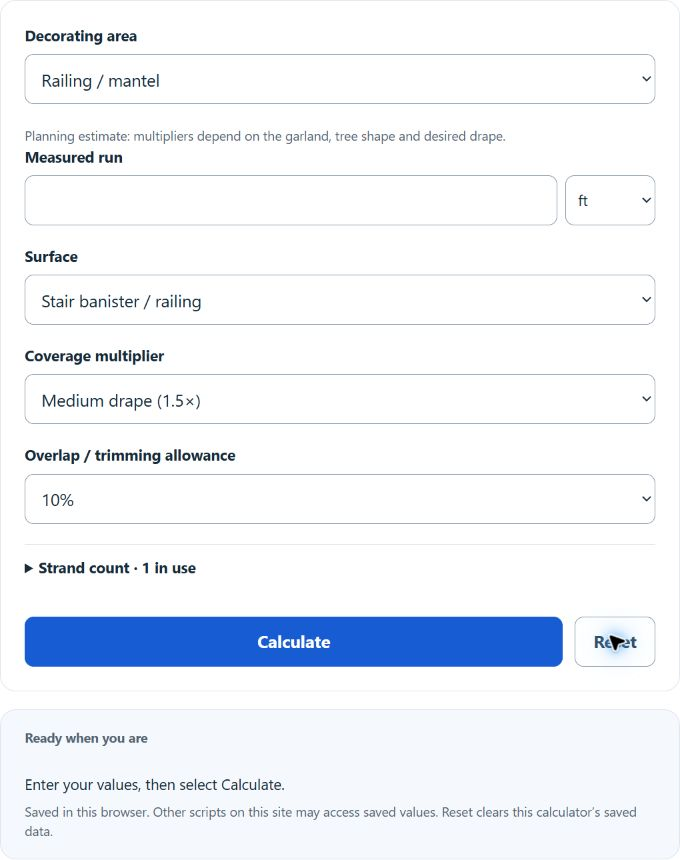
Estimate garland length for railings, Christmas trees, doors and windows based on size, coverage style, strand length, and trim allowance.
Related Calculators
- Fabric Consumption Calculator
- Bias Tape/Binding Calculator
- Picture Spacing Calculator
- Wrapping Paper Size Calculator
- All Everyday Life and Education Calculators
Garland Length Formula
The calculator uses three formulas, one for each mode. All length inputs are converted to feet for the math, then converted back to your chosen unit for display.
Railing or mantel mode:
Christmas tree mode:
Door or window mode:
- L = recommended garland length to buy
- M = measured length of the railing, mantel, porch, or column
- H = tree height
- D = density factor in feet of garland per foot of tree height (6, 9, or 12)
- W = top width of the door or window frame
- S = side drop length
- N = number of sides draped (0, 1, or 2)
- C = coverage or drape multiplier (1 to 2)
- E = extra allowance for overlap and trimming (0, 0.10, or 0.15)
Assumptions: garland is sold in straight strand lengths and laid along the surface, not stretched tight. The selected multiplier is a planning allowance for swag, spiral wrap, and natural sag; it does not calculate an exact spiral path. The extra allowance covers hooks, end positioning, and waste from trimming. Strand count is rounded up because you cannot buy a partial strand.
The Railing / Mantel mode applies the multiplier directly to your measured run. The Christmas Tree mode converts tree height into garland length using a density factor, since a tree wraps in a spiral and needs much more garland than its height. The Door / Window mode builds the base length from the top plus side drops before applying the drape multiplier. The strand calculator divides the final length by the package length and rounds up.
Reference Tables
Use these as a starting point if you are not sure which multiplier or density to pick.
| Surface or Style | Coverage Multiplier | Look |
|---|---|---|
| Straight mantel run | 1.2× | Light, simple |
| Mantel with end drops | 1.5× | Standard |
| Banister with swag | 1.5× | Standard |
| Spiral column wrap | 2× | Full |
| Door frame, straight | 1× | Tight fit |
| Door frame, light swag | 1.2× | Standard |
| Tree Height | Light (6 ft/ft) | Medium (9 ft/ft) | Full (12 ft/ft) |
|---|---|---|---|
| 5 ft | 30 ft | 45 ft | 60 ft |
| 6 ft | 36 ft | 54 ft | 72 ft |
| 7 ft | 42 ft | 63 ft | 84 ft |
| 8 ft | 48 ft | 72 ft | 96 ft |
| 9 ft | 54 ft | 81 ft | 108 ft |
Worked Examples and FAQ
Example 1: 15 ft banister. You have a stair railing measuring 15 ft and want a standard swag look with 10% extra.
L = 15 × 1.5 × 1.10 = 24.75 ft. Round to 25 ft. Two 9 ft strands give 18 ft, so buy three 9 ft strands for 27 ft total.
Example 2: 7 ft tree, medium density.
L = 7 × 9 × 1.10 = 69.3 ft. Buy eight 9 ft strands (72 ft total).
Example 3: 36 in door, 80 in drops on both sides, light swag, 15% extra.
Base = 36 + 80 × 2 = 196 in = 16.33 ft. L = (196 / 12) × 1.2 × 1.15 = 22.54 ft. Buy three 9 ft strands.
Why does a tree need so much garland? Garland wraps in a spiral. Each loop is wider than the tree's height step, so a 7 ft tree easily eats 60 ft or more of garland.
Should I round up or down? Always round up. Garland that comes up short is the most common complaint. Leftovers can be cut into wreaths, swags, or centerpieces.
What if I am combining real and faux garland? Calculate each section separately. Real cedar or pine often sags more, so push the coverage multiplier one step higher.
How does strand length affect cost? Longer strands waste less. If a 9 ft strand and an 18 ft strand cost the same per foot, the 18 ft option usually means fewer connection points and a cleaner look.