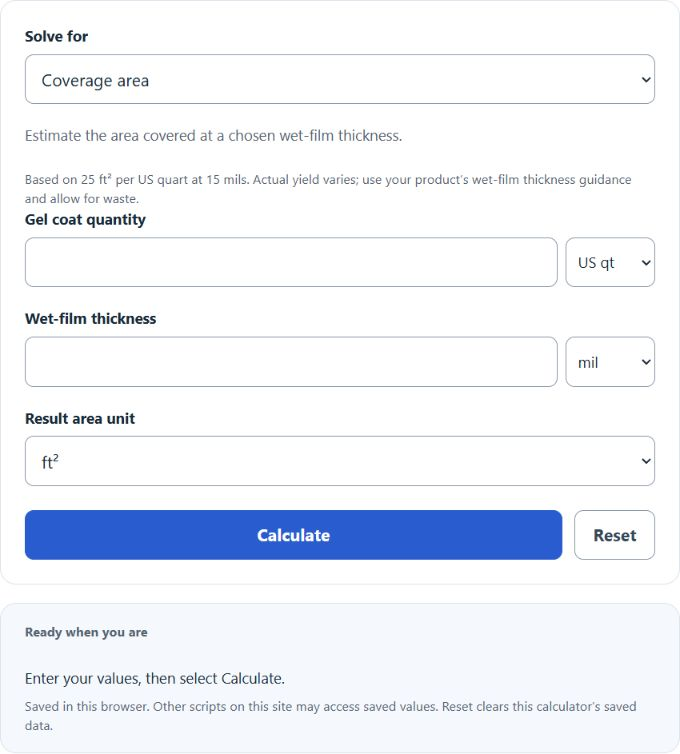
Select coverage area, gel coat quantity, or wet-film thickness, then enter the two required values and choose the result unit.
Related Calculators
- Glue Coverage Calculator
- Paint Usage Calculator
- Coverage Area Calculator
- Adhesive Coverage Calculator
- Self Leveling Coverage Calculator
- All Construction Calculators
Gel Coat Coverage Formula
The gel coat coverage calculator estimates application yield from the reference of 25 square feet per US quart at 15 mils of wet-film thickness. Coverage decreases as thickness increases, so a heavier application covers fewer square feet.
Where:
- GCC = gel coat coverage in square feet
- Q = total gel coat quantity in US liquid quarts
- T = coating thickness in mils
This equation is based on a reference point of 25 square feet per quart at 15 mils. The same relationship can be written in a more compact form:
That makes the calculator useful in three directions: estimating coverage from available material, estimating how many quarts are needed for a target area, or solving for coating thickness when coverage and material quantity are known.
Rearranged Equations
If you know the target area and thickness, solve for the amount of gel coat needed:
If you know the amount of gel coat and the area to be covered, solve for thickness:
How to Use the Calculator
- Measure the total surface area to be coated.
- Select the intended wet film thickness in mils.
- Select the value to solve, then enter its two required inputs.
- Calculate the missing value.
- Round material requirements up to a practical purchase quantity.
Tip: The formula gives reference-based estimated coverage. Real-world yield can be lower because of overspray, transfer loss, surface texture, roller or brush retention, mixing waste, and material left in the pot or hose.
Thickness Reference
Because coverage changes inversely with thickness, small changes in mils can noticeably change material demand. The table below gives quick reference values for 1 quart and 5 quarts.
| Thickness | Coverage per 1 Quart | Coverage per 5 Quarts |
|---|---|---|
| 10 mils | 37.5 sq ft | 187.5 sq ft |
| 12 mils | 31.25 sq ft | 156.25 sq ft |
| 15 mils | 25 sq ft | 125 sq ft |
| 18 mils | 20.83 sq ft | 104.17 sq ft |
| 20 mils | 18.75 sq ft | 93.75 sq ft |
| 25 mils | 15 sq ft | 75 sq ft |
| 30 mils | 12.5 sq ft | 62.5 sq ft |
Examples
Example 1: Coverage from available material
If you have 5 quarts of gel coat and plan to apply it at 15 mils:
The estimated coverage is 125 square feet.
Example 2: Quarts needed for a target area
If the part area is 200 square feet and the target thickness is 18 mils:
You would need an estimated 9.6 US quarts, so in practice you would normally round up to ensure full coverage.
Unit Notes
The base formula uses US liquid quarts, wet-film thickness in mils, and square feet. If you enter liters, inches, millimeters, square meters, or square yards, the calculator converts the values and applies the same coverage relationship.
A mil is not a millimeter. It is one-thousandth of an inch:
Practical Planning Tips
- Measure the true coated surface area, especially on curved or contoured parts.
- Use a consistent target thickness; uneven application causes uneven coverage and finish quality.
- Add a waste allowance when ordering material for spray jobs or irregular surfaces.
- If multiple coats are planned, calculate each coat separately and add the totals.
- When estimating purchases, round up rather than down to avoid coming up short mid-application.
Why Coverage Changes So Much with Thickness
Thickness has an inverse relationship with coverage. If the mil thickness doubles, the covered area is cut roughly in half for the same amount of material. That is why controlling film build is one of the most important factors in both finish quality and material cost.