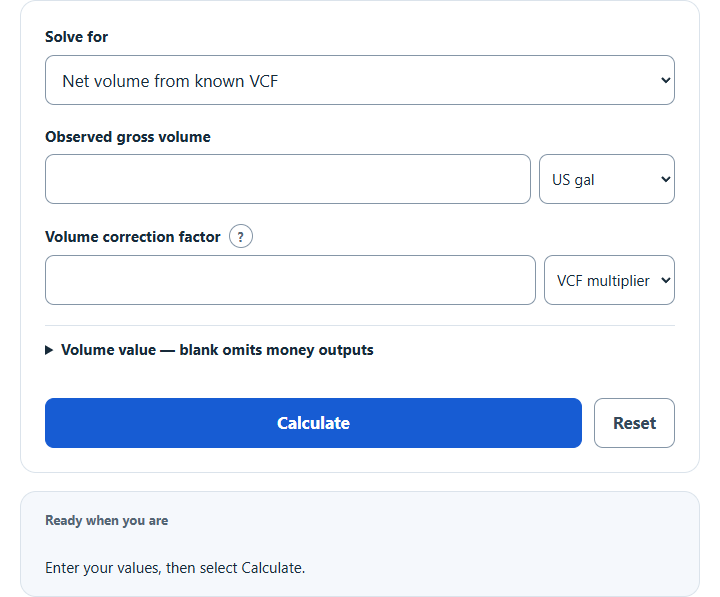
Convert gross gallons to net gallons with a volume correction factor or percent reduction, or estimate net volume from temperature. Reverse included.
- All Unit Converters
- Gallons Per Inch Calculator
- Liquid Volume Calculator
- Water Volume Calculator
- Vessel Volume Calculator
- Water Temperature Calculator
Calculator Functions
| Function | What it does | What it requires |
|---|---|---|
| Net volume from known VCF | Finds the net volume at reference conditions from a measured gross volume and a volume correction factor | Requires the observed gross volume and the VCF, as a multiplier or as a percent reduction |
| Net volume from temperature estimate | Estimates the VCF from the liquid temperature and an expansion coefficient, then finds the net volume | Requires the observed gross volume, the observed liquid temperature, the reference temperature and the volumetric expansion coefficient |
| Gross volume from net and VCF | Finds the gross volume that corresponds to a net volume at reference conditions | Requires the net volume and the VCF, as a multiplier or as a percent reduction |
Volumes can be entered in US gallons, liters or 42-gallon barrels. Every result also shows the gross and net volumes, the VCF multiplier, net minus gross, the percent adjustment, net petroleum barrels and the net volume at a VCF of 0.99, 1 and 1.01. An optional value per net US gallon adds the dollar value of the net volume and of the adjustment.
Gross Gallons to Net Gallons Formulas
| N | Net volume at the reference temperature (US gal) |
| G | Gross volume as measured at the observed temperature (US gal) |
| VCF | Volume correction factor for the product and its temperature, a multiplier near 1 |
Published correction factors for crude oils, refined products and lubricating oils come from the joint API and ASTM procedure, which corrects liquid hydrocarbon volumes for temperature and pressure to a base condition chosen by the user [1]. Liters and barrels are converted with 1 US gal = 3.785412 L and 1 barrel = 42 US gal [2].
Net volume from known VCF
The gross volume is multiplied by the VCF. With 1,000 gross gallons and a VCF of 0.98, the net volume is 1,000 × 0.98 = 980 US gal. When the factor is entered as a percent reduction, VCF = 1 − reduction ÷ 100, so a 2% reduction is 0.98. A VCF of zero or less is rejected.
Net volume from temperature estimate
α is the volumetric expansion coefficient of the liquid per degree, T is the observed liquid temperature and Tref is the reference temperature, which starts at 60 °F. Temperatures in °C are converted to °F first [2]. For 1,000 gallons at 80 °F with α = 0.0006 per °F, VCF = 1 ÷ (1 + 0.0006 × 20) = 0.988142 and the net volume is 988.142 US gal. This is a linear expansion model. It is not the API and ASTM calculation, which works from product density and also covers pressure [1].
Gross volume from net and VCF
This is the main formula rearranged. A net volume of 980 US gal at a VCF of 0.98 corresponds to 980 ÷ 0.98 = 1,000 gross gallons.
Limits of This Estimate
- The VCF must be the one for the specific product, its density and its temperature. A factor for gasoline does not apply to diesel, crude oil or a lubricating oil [1].
- Net volume from temperature estimate is a planning figure, not a custody-transfer volume. It leaves out the density-based algorithm and the pressure correction in the API and ASTM procedure. These estimates are based on the best available data and estimations.
- The expansion coefficient has to be valid near the reference temperature, and it has to be entered per °F or per °C to match the unit selected.
- Dollar values are rounded and use one price per net US gallon. The 0.99, 1 and 1.01 rows are sensitivity examples, not product data.
Sources
- ASTM International, D1250-25, Standard Guide for the Use of the Joint API and ASTM Adjunct for Temperature and Pressure Volume Correction Factors (API MPMS Chapter 11.1): what standard volume correction factors cover, and what the temperature estimate leaves out
- NIST, Guide for the Use of the International System of Units (SP 811), Appendix B.8: factors for US gallons, liters and petroleum barrels, and the °F to °C conversion