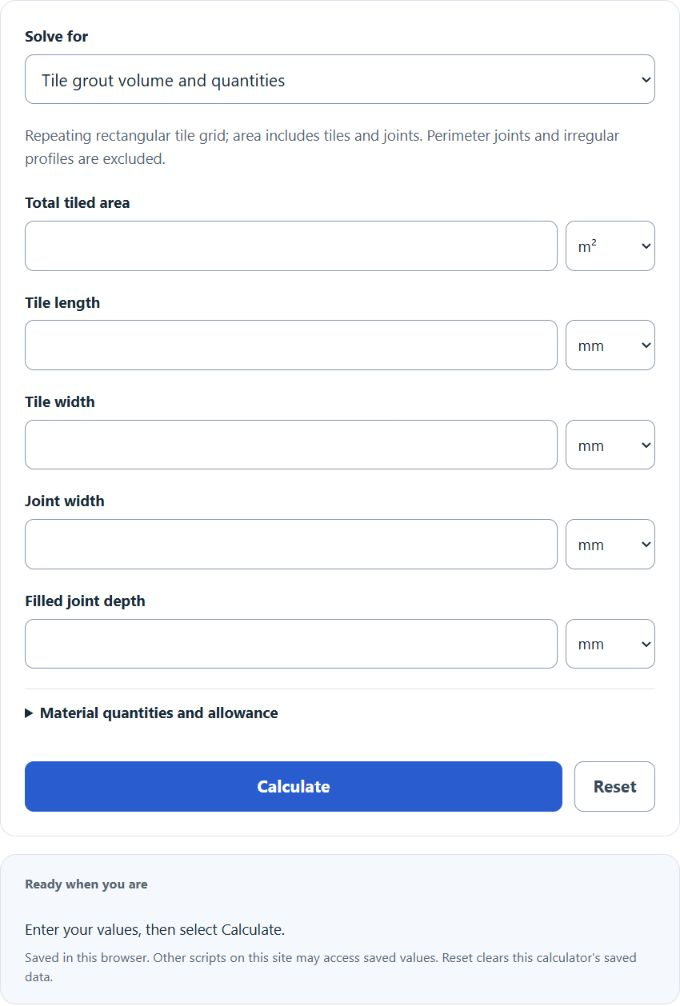
Estimate tile grout volume from tiled area and joint geometry, calculate coverage from available mixed grout, or find volume from mass and matching density. Mixed mass needs mixed density; dry bag quantities additionally need the product’s mixed-volume yield per kg of dry powder.
- All Construction Calculators
- All Volume Calculators
- Powder Volume Calculator
- Runoff Volume Calculator
- Density To Volume Calculator
Grout Volume Formula
For the mass-and-density mode, use the following formula with mass and density for the same material state. In tile-grid mode, joint fraction = 1 − LW/((L+J)(W+J)), where L and W are tile dimensions and J is joint width; volume = tiled area × joint fraction × filled depth × (1 + allowance/100). Use consistent length units and convert m³ to liters by multiplying by 1,000. This repeating-grid model counts intersections once and excludes perimeter and irregular joints.
- Where GV is the Grout Volume (m^3)
- GM is the grout mass (kg)
- GD is the grout density (kg/m^3)
How to Calculate Grout Volume?
The following example problems outline how to calculate Grout Volume.
Example Problem #1:
- First, determine the grout mass (kg).
- The grout mass (kg) is given as 500.
- Next, determine the grout density (kg/m^3).
- The illustrative grout density (kg/m^3) is provided as 2000; use your material’s actual density.
- Finally, calculate the Grout Volume using the equation above:
GV = GM / GD
The values given above are inserted into the equation below:
GV = 500 / 2000 = 0.25 (m^3), or 250 L
FAQ
What is grout density and why is it important in calculating grout volume?
Grout density, measured in kilograms per cubic meter (kg/m^3), is a measure of the mass of grout per unit volume. It’s crucial for calculating grout volume because it helps determine how much space the grout will occupy, which is essential for ensuring the right amount of grout is used in construction and repair projects.
How can you measure the mass of grout accurately?
The mass of grout can be measured using a scale. Before measuring, ensure the scale is calibrated and set to zero. Place the container with grout on the scale and record the weight in kilograms (kg). For large projects, industrial scales that can handle higher capacities may be necessary.
Can the grout volume calculator be used for any type of grout?
The mass-and-density mode applies when mass and density describe the same material state. The tile-grid modes estimate regular rectangular joints; irregular profiles, perimeter joints, application losses, and product-specific behavior need separate allowance or manufacturer coverage data. Do not divide mixed grout mass by a dry powder bag weight; use the product’s mixed-volume yield per kg of dry powder to estimate dry bags.