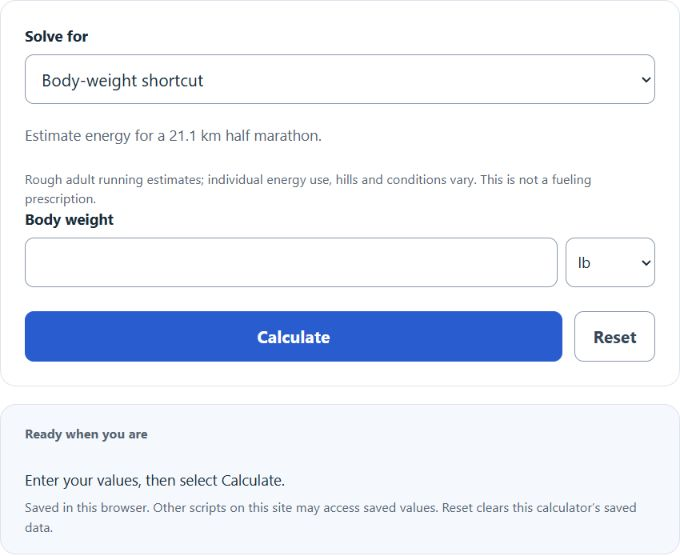
Calculate half marathon calories burned from body weight, or enter finish time to estimate calories based on pace and weight in lb or kg.
Half Marathon Calorie Formula
The body-weight shortcut estimates net running energy above rest using 1 kcal per kilogram per kilometer over 21.1 km. Pounds convert using 1 lb = 0.45359237 kg. The pace method estimates gross energy including rest: MET × 3.5 × kg ÷ 200 × minutes, using the nearest listed jogging/running speed in the 2024 Adult Compendium (2.6–14 mph). These are approximate, different models, not personal measurements or fueling targets.
Variables:
- Calories = estimated net running energy above rest (distance shortcut) or gross energy including resting expenditure (pace method)
- BW = body weight
- 21.1 = half marathon distance in kilometers (about 13.11 miles)
- 1 = approximate running energy cost in kcal per kilogram per kilometer
How to Calculate Half Marathon Calories
- Enter your body weight.
- For the basic version, convert pounds to kilograms if needed, then multiply kilograms by 21.1.
- For the pace version, enter whole hours and minutes. The nearest published pace category is used without interpolation; use the shortcut outside 2.6–14 mph.
Example
A runner who weighs 160 lb would burn about 1,531 calories in a half marathon:
Typical Half Marathon Calorie Burn
- 120 lb runner: about 1,148 calories
- 150 lb runner: about 1,436 calories
- 180 lb runner: about 1,723 calories
- 200 lb runner: about 1,914 calories
What Changes Half Marathon Calories
- Body weight has the biggest impact on total calories burned.
- Hills, wind, soft surfaces, and trail sections raise the workload.
- Faster racing increases calories burned per minute.
- Run-walk pacing can shift the total lower than steady running at the same distance.
FAQs
How many calories does a half marathon burn?
Most runners land somewhere around 1,100 to 1,900 calories for 13.1 miles. A 150 lb runner is often near 1,400 to 1,500 calories.
Is body weight or pace more important?
Body weight usually has the largest effect on the final number. Pace changes calories burned per minute more than it changes calories burned per mile.
Should I use the basic or advanced calculator?
Use the body-weight shortcut for a rough distance-based running estimate. Use the pace method to include finish time and gross energy, with a separate above-rest estimate. It assigns the nearest listed category and is not necessarily more accurate for an individual.
Does terrain change half marathon calories?
Yes. Flat road races are usually lower than hilly courses, trails, or windy races because those conditions increase the work required to cover 13.1 miles.