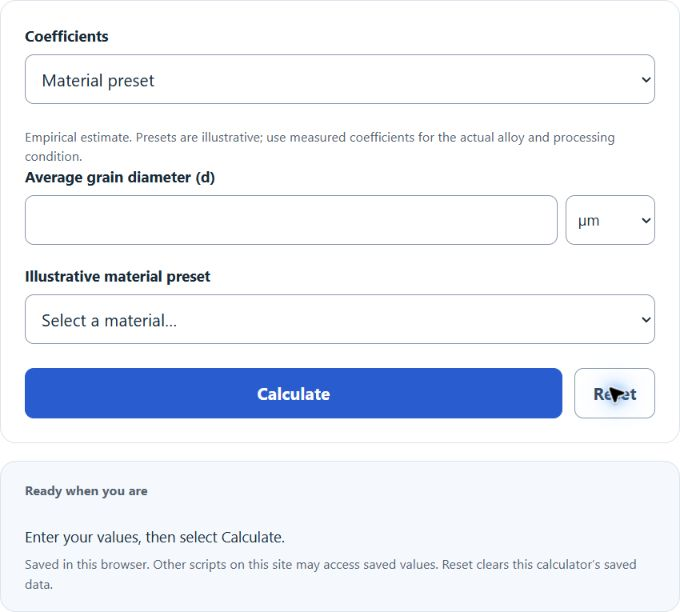
Estimate yield stress from grain size with the Hall-Petch equation, using illustrative material presets or custom measured σ₀ and k values. Coefficients depend on alloy composition and processing condition.
Hall-Petch Formula
The following empirical Hall-Petch relation estimates yield stress for a material within its fitted grain-size range.
Variables:
- YS is the yield stress (MPa)
- MC is the materials constant for starting stress dislocation movement (MPa)
- K is the strengthening coefficient (MPa-m^1/2)
- d is the average grain diameter (m)
To calculate the yield stress using the Hall-Petch equation, divide the strengthening coefficient by the square root of the grain diameter, then add the result to materials constant for starting stress dislocation movement.
How to Calculate Yield Stress From Hall-Petch Equation?
The following steps outline how to calculate the yield stress using the Hall-Petch equation.
- First, determine the materials constant for starting stress dislocation movement (MPa).
- Next, determine the strengthening coefficient (MPa-m^1/2).
- Next, determine the average grain diameter (m).
- Next, gather the formula from above = YS = MC + K / SQRT(d).
- Finally, calculate the yield stress.
- After inserting the variables and calculating the result, check your answer with the calculator above.
Example Problem:
Use the following variables as an example problem to test your knowledge.
materials constant for starting stress dislocation movement (MPa) = 25
strengthening coefficient (MPa-m^1/2) = .40
average grain diameter (m) = .75
YS = MC + K / SQRT(d) = 25 + 0.40 / √0.75 ≈ 25.4619 MPa. This is a mathematical example; a 0.75 m grain diameter is not representative of ordinary metal microstructures.