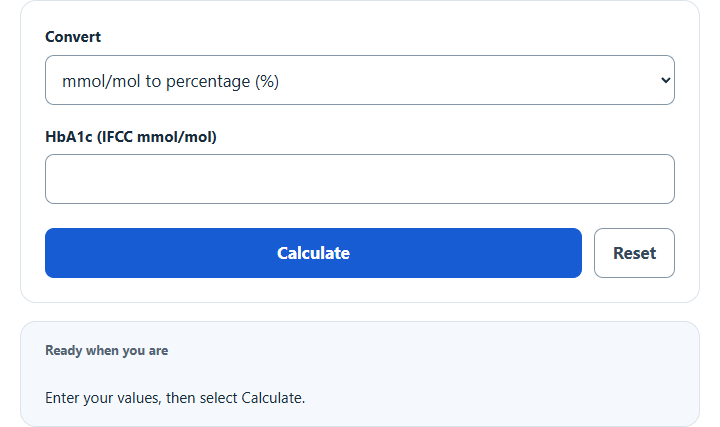
Convert HbA1c from mmol/mol to percentage (%) or from percent to mmol/mol with the IFCC–NGSP formula, plus estimated average glucose in mg/dL and mmol/L.
- All Health and Medical Calculators
- All Medical and Health Unit Converters
- HbA1c To mg/dL Calculator
- ApoB/A1 Ratio Calculator
Calculator Functions
| Function | What it does | What it requires |
|---|---|---|
| mmol/mol to percentage (%) | Converts an HbA1c result in IFCC units of mmol/mol to the NGSP percentage | Requires the HbA1c in mmol/mol, from 0 to 250 |
| Percentage (%) to mmol/mol | Converts an HbA1c percentage on the NGSP scale to IFCC mmol/mol | Requires the HbA1c in percent, from 2.152 to 25.022 |
Both functions also show the estimated average glucose in mg/dL and mmol/L. The answer is rounded the way laboratories usually report it, percent to one decimal and mmol/mol to a whole number, and the unrounded value is listed in the calculation details.
HbA1c Conversion Formulas
2.152 [1]
| NGSP | HbA1c as a percentage, the NGSP scale traceable to the DCCT reference (%) |
| IFCC | HbA1c in IFCC units (mmol/mol) |
This is the master equation that links the two reference systems [1]. It was the equation NGSP listed as of November 2026.
mmol/mol to percentage (%)
The formula above applies. An HbA1c of 48 mmol/mol is 0.09148 × 48 + 2.152 = 6.543%, reported as 6.5%.
Percentage (%) to mmol/mol
0.09148
This is the master equation solved for the IFCC value. An HbA1c of 7% is (7 − 2.152) ÷ 0.09148 = 52.995, reported as 53 mmol/mol.
mmol/mol to mg/dL (Estimated Average Glucose)
HbA1c in mmol/mol and blood glucose in mg/dL measure different things, so there is no direct unit conversion between them. The calculator first converts mmol/mol to percent and then applies this regression, which estimates average glucose (eAG) in mg/dL from the HbA1c percentage [2]. For 48 mmol/mol, 28.7 × 6.543 − 46.7 = 141 mg/dL. The calculator divides by 18 for mmol/L, giving 7.8 mmol/L. The equation comes from a study of 507 adults in which HbA1c explained 84% of the variation in average glucose [2].
HbA1c Conversion Table
| HbA1c (mmol/mol) | HbA1c (%) | eAG (mg/dL) |
|---|---|---|
| 20 | 4.0 | 68 |
| 25 | 4.4 | 81 |
| 30 | 4.9 | 94 |
| 31 | 5.0 | 96 |
| 33 | 5.2 | 102 |
| 36 | 5.4 | 110 |
| 37 | 5.5 | 112 |
| 39 | 5.7 | 117 |
| 40 | 5.8 | 120 |
| 41 | 5.9 | 123 |
| 42 | 6.0 | 125 |
| 43 | 6.1 | 128 |
| 44 | 6.2 | 131 |
| 45 | 6.3 | 133 |
| 46 | 6.4 | 136 |
| 47 | 6.5 | 138 |
| 48 | 6.5 | 141 |
| 50 | 6.7 | 146 |
| 53 | 7.0 | 154 |
| 55 | 7.2 | 159 |
| 58 | 7.5 | 167 |
| 60 | 7.6 | 173 |
| 64 | 8.0 | 183 |
| 65 | 8.1 | 186 |
| 69 | 8.5 | 196 |
| 70 | 8.6 | 199 |
| 75 | 9.0 | 212 |
| 80 | 9.5 | 225 |
| 86 | 10.0 | 241 |
| 97 | 11.0 | 270 |
| 108 | 12.0 | 299 |
How to Calculate HbA1c
HbA1c is measured by a laboratory from a blood sample. It is not calculated from other numbers. What can be calculated is the same result on the other scale: multiply a value in mmol/mol by 0.09148 and add 2.152 for the percentage, or subtract 2.152 from the percentage and divide by 0.09148 for mmol/mol [1]. For example, 69 mmol/mol is 0.09148 × 69 + 2.152 = 8.5%. A single glucose reading cannot be turned into an HbA1c, and the eAG equation is built to run from a measured HbA1c to an average glucose, not the other way.
Limits of This Estimate
- This calculator is for educational use only and is not medical advice. Do not use it to diagnose diabetes or prediabetes or to change medications, diet or treatment without a licensed clinician.
- HbA1c results can be misleading in situations such as pregnancy, anemia or iron deficiency, hemoglobin variants, recent blood loss or transfusion, and some kidney or liver conditions.
- The conversion only changes the unit of a result. It does not say whether a value is normal or on target, which depends on the person and the situation.
- eAG is a population estimate, not a measured average. The study behind it left out children, pregnant women and people with anemia, hemoglobin variants or chronic kidney or liver disease, and about 1 in 10 participants fell more than 15% from the line [2].
Sources
- NGSP, IFCC Standardization of HbA1c: master equation between IFCC mmol/mol and NGSP percent
- Nathan and others, Translating the A1C Assay Into Estimated Average Glucose Values, Diabetes Care, 2008: estimated average glucose equation, who was studied and how closely individuals fit