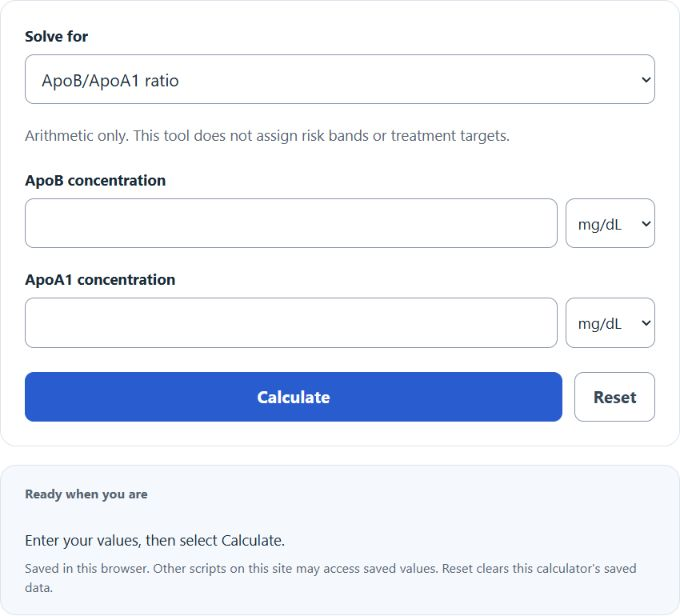
Calculate the ApoB/ApoA1 ratio from ApoB and ApoA1 in mg/dL or g/L, or rearrange the same formula to solve for one apolipoprotein value. The calculator does not assign risk bands or treatment targets.
Disclaimer: Educational use only; not medical advice. ApoB/ApoA1 results should be interpreted by a licensed clinician alongside your full lipid panel and medical history.
If you were looking for diabetes HbA1c (A1C) calculators (not ApoA1), these may help:
ApoB/ApoA1 Ratio Formula
The following formula is used to calculate the ApoB/ApoA1 ratio for given values of ApoB and ApoA1.
Variables:
- R is the ApoB/ApoA1 ratio (unitless)
- ApoB is the ApoB value (can be entered in mg/dL or g/L)
- ApoA1 is the ApoA1 value (can be entered in mg/dL or g/L)
To calculate the ApoB/ApoA1 ratio, divide the ApoB value by the ApoA1 value. The ratio is unitless as long as both values use the same concentration unit. This is an arithmetic ratio, not a diagnosis or treatment target. ApoB itself—not an ApoB/ApoA1 target ratio—is the apolipoprotein marker addressed in the 2026 ACC/AHA dyslipidemia guideline.
What is ApoB/ApoA1 Ratio?
The ApoB/ApoA1 ratio is a lab-derived marker that may be associated with cardiovascular risk in some populations. ApoB (Apolipoprotein B) and ApoA1 (Apolipoprotein A1) are proteins associated with lipoproteins in the blood. ApoB is found on atherogenic particles (often discussed alongside LDL-related risk), while ApoA1 is a major protein component of HDL particles. This ratio is only one piece of information and should be interpreted in the context of a full lipid profile and clinical history (for example: age, blood pressure, diabetes, smoking, family history, and other cholesterol markers).
How to Calculate ApoB/ApoA1 Ratio?
The following steps outline how to calculate the ApoB/ApoA1 ratio.
- First, measure the ApoB value (mg/dL or g/L).
- Next, measure the ApoA1 value (mg/dL or g/L).
- Finally, divide the ApoB value by the ApoA1 value to get the ApoB/ApoA1 ratio (unitless).
- After inserting the values and calculating the result, check your answer with the calculator above.
Example Problem :
Use the following variables as a math-only example to test your knowledge (not typical values or reference ranges).
ApoB (ApoB) = 100 mg/dL
ApoA1 (ApoA1) = 150 mg/dL
ApoB/ApoA1 Ratio (R) = 0.6667
Sources and reference ranges
Reference ranges and interpretation vary by lab and individual risk factors. For patient-friendly background, look for apolipoprotein information on reputable medical resources (for example, NIH/MedlinePlus) and discuss your results with your clinician.