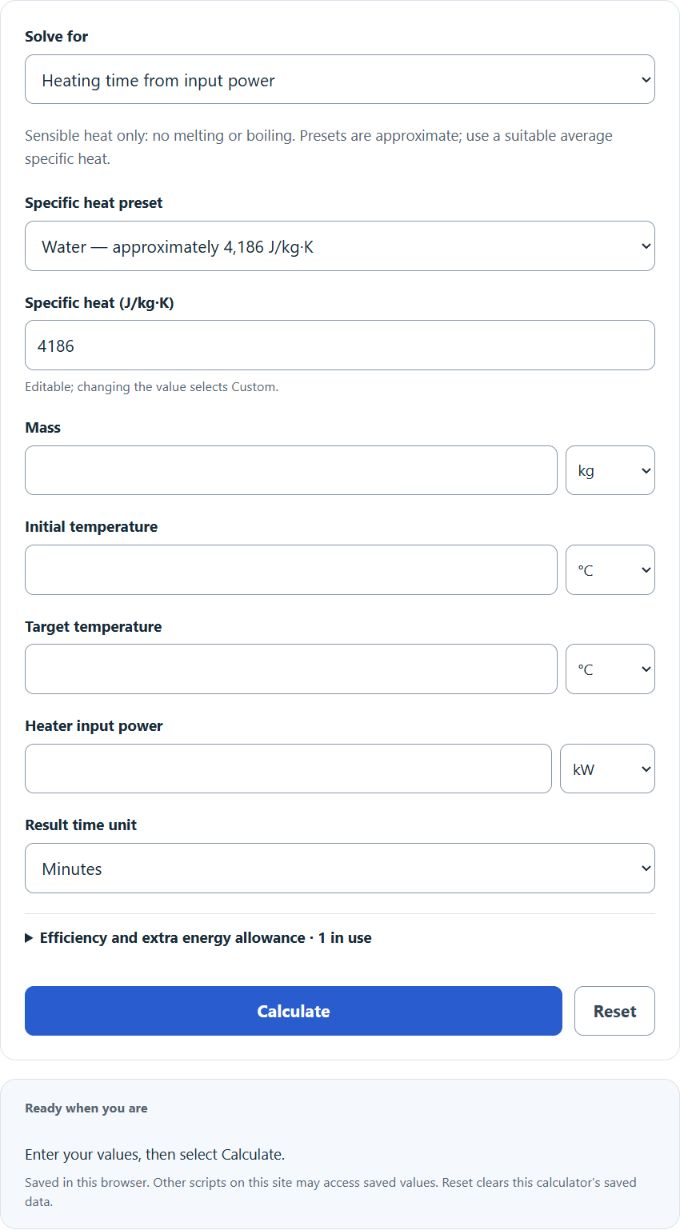
Estimate how long it takes to heat water or another material from its mass, start and target temperatures and heater power, or find the power needed.
Related Calculators
- Water Mass Calculator
- Water Volume Calculator
- Coil Temperature Calculator
- RPM To kW Calculator
- All Physics Calculators
Calculator Functions
| Function | What it does | What it requires |
|---|---|---|
| Heating time from input power | Finds how long a heater takes to bring a mass up to a target temperature | Requires the specific heat, mass, initial and target temperatures and the heater input power |
| Input heater power for a target time | Finds the heater power needed to reach the target temperature in a set time | Requires the specific heat, mass, initial and target temperatures and the heating time |
| Final temperature from power and time | Finds the temperature reached after heating for a set time | Requires the specific heat, mass, initial temperature, heater input power and heating time |
Specific heat comes from a preset for water, aluminum, carbon steel or copper, or from a custom value in J/kg·K. Mass is in kg, g or lb, temperature in °C, °F or K, and power in kW, W or Btu/h. Two optional settings adjust the ideal answer: heater-to-load efficiency, 100% if left blank, and an additional energy allowance, 0% if left blank. The time function also shows the time at 100% efficiency and at 10 points below the entered efficiency.
Heating Time Formulas
t = Q × (1 + L) ÷ (P × η)
| Q | Heat needed to warm the material (J) |
| m | Mass (kg) |
| c | Specific heat (J/kg·K) |
| ΔT | Temperature rise, target minus initial (K or °C) |
| t | Heating time (s) |
| P | Heater input power (W) |
| η | Heater-to-load efficiency as a fraction, 1 by default |
| L | Additional energy allowance as a fraction of Q, 0 by default |
Efficiency is the share of the heater’s input that reaches the material. The allowance adds extra energy on top of Q, for example to warm the container. A loss should be counted in one of the two settings, not both. The specific heat presets are approximate:
| Preset | Specific heat (J/kg·K) |
|---|---|
| Water | 4,186 [1] |
| Aluminum | 897 |
| Carbon steel | 490 |
| Copper | 385 |
Published values near room temperature are 4,186 for water, 900 for aluminum and 386 for copper [2], and NIST lists liquid water at 75.38 J/mol·K at 298 K, which is about 4,184 J/kg·K [3]. The carbon steel value is a typical figure for plain steels, which vary with grade.
Heating time from input power
The main formulas apply directly. Heating 2 kg of water from 20 °C to 100 °C takes Q = 2 × 4,186 × 80 = 669,760 J. With a 1 kW heater at 100% efficiency, t = 669,760 ÷ 1,000 = 669.76 s, or 11.16 minutes. At 80% efficiency with a 10% allowance, t = 669,760 × 1.10 ÷ (1,000 × 0.80) = 920.92 s, or 15.35 minutes.
Input heater power for a target time
To bring the same 2 kg of water from 20 °C to 100 °C in 10 minutes, P = 669,760 ÷ 600 = 1,116 W at 100% efficiency.
Final temperature from power and time
[m × c × (1 + L)]
T₁ is the initial temperature and T₂ the final temperature. A 1 kW heater running for 5 minutes delivers 300,000 J. In 2 kg of water starting at 20 °C that is a rise of 300,000 ÷ (2 × 4,186) = 35.83 K, so the water reaches 55.83 °C.
Limits of This Estimate
- The formula covers a temperature change only. It does not apply across a phase change [1], so melting, boiling and evaporation are not included.
- Heat loss to the surroundings grows as the material gets hotter. A single efficiency or allowance figure is an average, so real heating slows near the target.
- Specific heat changes with temperature and composition. A custom value averaged over the temperature range gives a better answer than a preset.
- The whole mass is assumed to be at one temperature, and the container is not counted unless the allowance covers it. These estimates are based on the best available data and estimations.
Sources
- Georgia State University, HyperPhysics, Specific Heat: heat added as specific heat × mass × temperature change, the phase-change limit and water at 4.186 J/g·°C
- Georgia State University, HyperPhysics, Table of Specific Heats: specific heats of water, aluminum and copper at 20 °C
- NIST Chemistry WebBook, Water, liquid phase heat capacity: heat capacity of liquid water from 298 K to 500 K