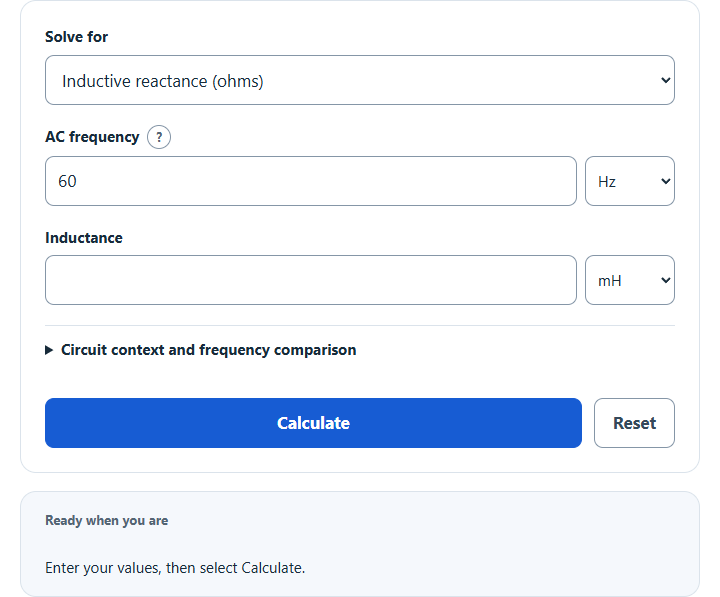
Convert henries or mH to ohms of inductive reactance at your AC frequency (60 Hz filled in), or work back from ohms to henries or to the frequency.
Calculator Functions
| Function | What it does | What it requires |
|---|---|---|
| Inductive reactance (ohms) | Converts an inductance in henrys to ohms of reactance at one frequency | Requires the AC frequency and the inductance |
| Inductance (henrys) | Finds the inductance that has a given reactance at one frequency | Requires the AC frequency and the inductive reactance |
| Frequency | Finds the frequency at which an inductor has a given reactance | Requires the inductance and the inductive reactance |
Frequency can be entered in Hz, kHz or MHz and starts at 60 Hz. Inductance takes H, mH, µH or nH, and reactance takes Ω, kΩ or MΩ. Two optional settings apply to every function: an RMS voltage across the inductor, which adds the current, and a frequency multiplier of 2×, 0.5× or 10× that shows the reactance at a second frequency. Results also list the angular frequency and the admittance magnitude.
Henry to Ohms Formulas
| XL | Inductive reactance (Ω) |
| f | Frequency (Hz) |
| L | Inductance (H) |
Henrys measure inductance and ohms measure opposition to current, so no fixed number converts one to the other. The ohm value depends on frequency: 1 H is about 377 Ω at 60 Hz, 314 Ω at 50 Hz and 6,283 Ω at 1 kHz.
Inductive reactance (ohms)
A 0.1 H inductor at 60 Hz has a reactance of 2 × π × 60 × 0.1 = 37.70 Ω. A 0.4 H coil at 60 Hz has 150.8 Ω, and on 115 V it carries 115 ÷ 150.8 = 0.76 A, because the current through an inductor is the voltage across it divided by its reactance [1].
mH to Ohms
A millihenry is one thousandth of a henry, so XL = 2 × π × f × mH ÷ 1,000. At 60 Hz, 10 mH is 3.77 Ω. At 1 kHz the same 10 mH is 62.83 Ω.
| Inductance | 50 Hz | 60 Hz | 1 kHz |
|---|---|---|---|
| 1 mH | 0.314 Ω | 0.377 Ω | 6.283 Ω |
| 10 mH | 3.142 Ω | 3.770 Ω | 62.83 Ω |
| 100 mH | 31.42 Ω | 37.70 Ω | 628.3 Ω |
| 1 H | 314.2 Ω | 377.0 Ω | 6,283 Ω |
Inductance (henrys)
This is the ohms to henrys direction. A reactance of 100 Ω at 60 Hz needs 100 ÷ (2 × π × 60) = 0.2653 H, or 265.3 mH.
Frequency
A 10 mH inductor reaches 100 Ω at 100 ÷ (2 × π × 0.01) = 1,591.5 Hz. Reactance rises in step with frequency, so doubling the frequency doubles the ohms.
Limits of This Estimate
- The result is for an ideal inductor on a steady sine-wave supply. The DC resistance of the winding and core losses are not included, so a meter reading across a real coil will differ.
- Reactance is not resistance: the current through an ideal inductor lags the voltage by 90° [1] and no power is turned into heat.
- At DC the frequency is zero and so is the reactance. At high frequencies a real inductor’s stray capacitance changes its behavior, which this formula does not model.
Sources
- U.S. Department of Energy, Fundamentals Handbook: Electrical Science, Volume 3 (DOE-HDBK-1011/3-92): inductive reactance formula and the current through an inductor