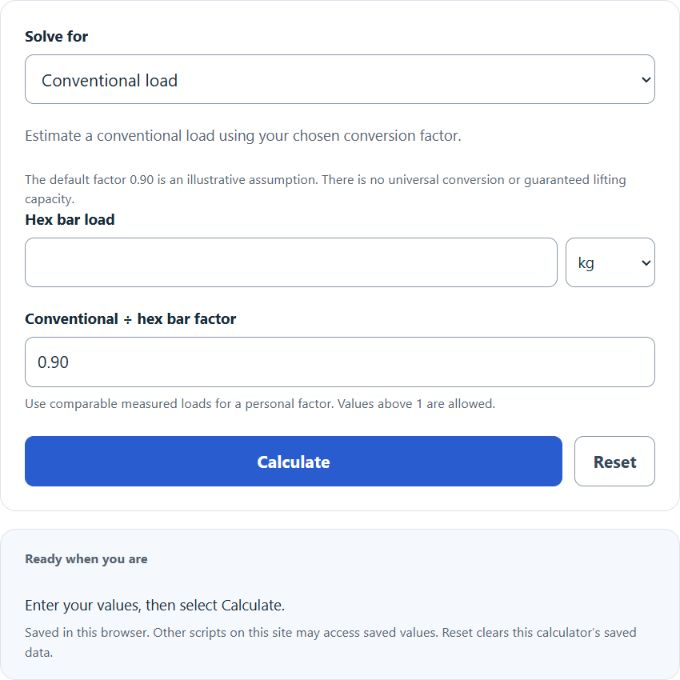
Estimate conventional deadlift weight from a hex bar deadlift or vice versa using kg or lbs and an editable conversion factor for an illustrative estimate.
Safety note: This calculator provides a rough estimate for training/programming reference only. Real-world transfer between hex-bar and conventional deadlifts varies (handle height, technique, range of motion, and experience). Do not use this number as a 1-rep-max target—start lighter, warm up, and progress gradually. If you have back/hip/knee pain or a prior injury, consult a qualified coach or clinician.
Hex Bar Deadlift to Conventional Deadlift Conversion Formula
The following formula can be used to estimate the Conventional Deadlift weight from the Hex Bar Deadlift weight using a selected conversion factor.
Variables:
- CD is the Conventional Deadlift weight
- HB is the Hex Bar Deadlift weight
- CF is the chosen conventional-to-hex-bar load ratio. The default 0.9 is an illustrative assumption, not a validated individual prediction; a personal ratio should compare measured loads at similar repetitions and effort with the same hex-bar setup.
To estimate your Conventional Deadlift equivalent, multiply the Hex Bar Deadlift weight by your chosen conversion factor (for example, 0.9).
| Hex Bar Deadlift (kg) | Conventional Deadlift (kg) |
|---|---|
| 60 | 54 |
| 70 | 63 |
| 80 | 72 |
| 90 | 81 |
| 100 | 90 |
| 110 | 99 |
| 120 | 108 |
| 130 | 117 |
| 140 | 126 |
| 150 | 135 |
| 160 | 144 |
| 170 | 153 |
| 180 | 162 |
| 190 | 171 |
| 200 | 180 |
| 210 | 189 |
| 220 | 198 |
| 230 | 207 |
| 240 | 216 |
| 250 | 225 |
| Example values use CF = 0.90 and are rounded to whole kilograms. Your best-fit factor may differ. | |
What is the Hex Bar Deadlift to Conventional Deadlift Conversion?
This conversion is a way to estimate how loads might transfer between lifts. Because a hex bar often allows a more upright torso position and can change range of motion (especially with high handles), many lifters can lift more with a hex bar than with a conventional barbell deadlift—but the size of that difference varies a lot by lifter and setup.
How to Calculate the Conventional Deadlift Equivalent?
Follow these steps to calculate the Conventional Deadlift weight:
- Measure your Hex Bar Deadlift weight (HB) in your chosen unit.
- Select Conventional load and enter your hex bar load and chosen conversion factor (CF). The default 0.9 is an example only; measured personal ratios may be below, equal to, or above 1.
- Multiply the Hex Bar Deadlift weight by CF.
- The result gives you an estimated Conventional Deadlift weight (CD).
- Select Hex bar load for the reverse calculation, HB = CD ÷ CF. An estimate does not establish a safe maximum lifting load.
Example Problem:
If your Hex Bar Deadlift weight is 200 pounds and you use CF = 0.9, then the estimated Conventional Deadlift weight is calculated as follows:
Conventional Deadlift (CD) = 200 × 0.9 = 180 pounds