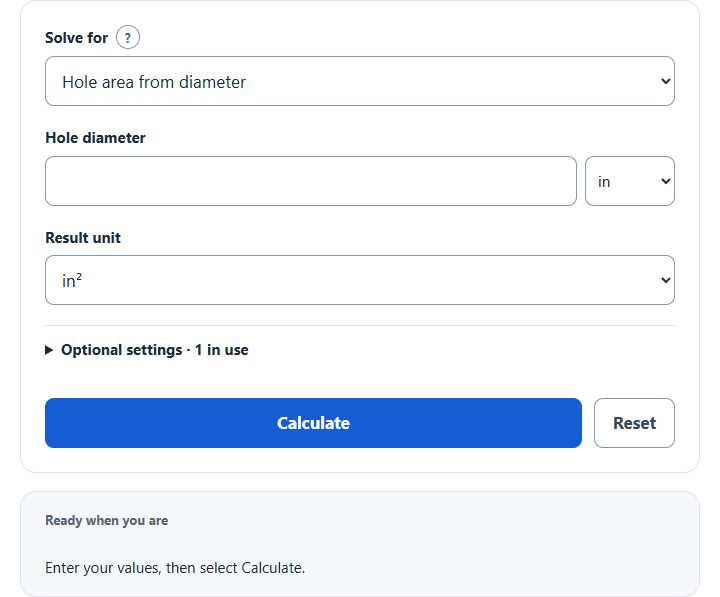
Calculate the area of a hole from its diameter, or solve hole volume, depth or diameter for round or straight-sided holes and truckloads of soil to haul.
- All Math and Numbers Calculators
- All Area Calculators
- Hole Volume Calculator
- Base Area Calculator
- Holes Per Square Inch Calculator
Calculator Functions
| Function | What it does | What it requires |
|---|---|---|
| Hole area from diameter | Finds the area of a round hole’s opening | Requires the hole diameter |
| Area from volume and depth | Finds the cross-sectional area of a hole with straight sides | Requires the hole volume and the hole depth |
| Volume from area and depth | Finds the volume of a hole with straight sides | Requires the cross-sectional area and the hole depth |
| Depth from volume and area | Finds how deep a hole with straight sides is | Requires the hole volume and the cross-sectional area |
| Circular hole volume | Finds the volume of a straight round hole | Requires the hole diameter and the hole depth |
| Circular hole depth | Finds the depth of a round hole that holds a given volume | Requires the hole diameter and the hole volume |
| Circular hole diameter | Finds the diameter of a round hole from its volume and depth | Requires the hole volume and the hole depth |
| Truckloads from volume and capacity | Finds how many truckloads a volume of material takes | Requires the total volume to haul and the truck capacity per load |
| Capacity from volume and loads | Finds the average volume carried per load | Requires the total volume to haul and the number of loads |
| Volume from capacity and loads | Finds the total volume a number of loads carries | Requires the truck capacity per load and the number of loads |
Diameter can be entered in inches, feet, centimetres or metres, depth in feet, metres, inches or centimetres, and volume in cubic feet, cubic metres or cubic yards. The round-hole functions have an auger preset from 4 in to 42 in, and the truck functions have a capacity preset from 8 to 24 cubic yards. Hole area from diameter also shows the radius, the circumference and the area in a second unit.
Hole Area Formulas
| A | Area of the hole opening |
| d | Hole diameter, in the same length unit |
Hole area from diameter
The area of a circle is π × r² [1], and the radius is half the diameter, which gives the form above. A 12 in hole has an opening of π × 12² ÷ 4 = 113.1 in², or 0.785 ft². The same formula gives the area of a drilled or punched hole in sheet material.
Area from volume and depth
V is the hole volume and D is the hole depth. A 300 ft³ hole that is 10 ft deep has a cross-section of 300 ÷ 10 = 30 ft². This works for any hole shape as long as the sides are straight. For a hole that tapers or bells out, the answer is the average area over the depth.
Volume from area and depth
A 30 ft² hole dug 10 ft deep has a volume of 30 × 10 = 300 ft³, which is 11.11 cubic yards.
Depth from volume and area
Removing 300 ft³ from a 30 ft² footprint takes the hole down 300 ÷ 30 = 10 ft.
Circular hole volume
This is the volume of a cylinder [2]. A 12 in (1 ft) post hole dug 4 ft deep holds π × 1² × 4 ÷ 4 = 3.14 ft³. The diameter is converted to feet before it is squared.
Circular hole depth
A 12 in hole has to be 4 × 10 ÷ (π × 1²) = 12.73 ft deep to hold 10 ft³.
Circular hole diameter
A round hole 4 ft deep that holds 10 ft³ is 2 × √(10 ÷ (π × 4)) = 1.784 ft across, about 21.4 in.
Truckloads from volume and capacity
C is the truck capacity per load. One cubic yard is 27 cubic feet [3], so 300 ft³ is 11.11 yd³. In a 10 yd³ truck that is 11.11 ÷ 10 = 1.11 loads, which means 2 trips with the second one part full.
Capacity from volume and loads
Hauling 300 ft³ in 2 loads averages 150 ft³ per load, or 5.56 yd³. The number of loads can be a decimal for a part load, and must be above zero.
Volume from capacity and loads
Two full loads in a 10 yd³ truck carry 20 yd³, which is 540 ft³.
Limits of This Estimate
- Every function assumes straight sides and a flat bottom. A hole that tapers, bells out or has a rough bottom holds a different volume.
- The volume is the size of the hole itself. Soil loosens when it is dug, so the pile to haul away is larger than the hole, and soil put back and compacted takes up less space.
- Truckloads count volume only. A truck can reach its weight limit before it is full, especially with wet soil, rock or concrete.
Sources
- NASA Glenn Research Center, Area: area of a circle
- NASA Glenn Research Center, Volume: volume of a circular cylinder from its diameter and length
- NIST, Guide for the Use of the International System of Units (SP 811), Appendix B.8: foot, inch, yard, cubic foot and cubic yard in metric units