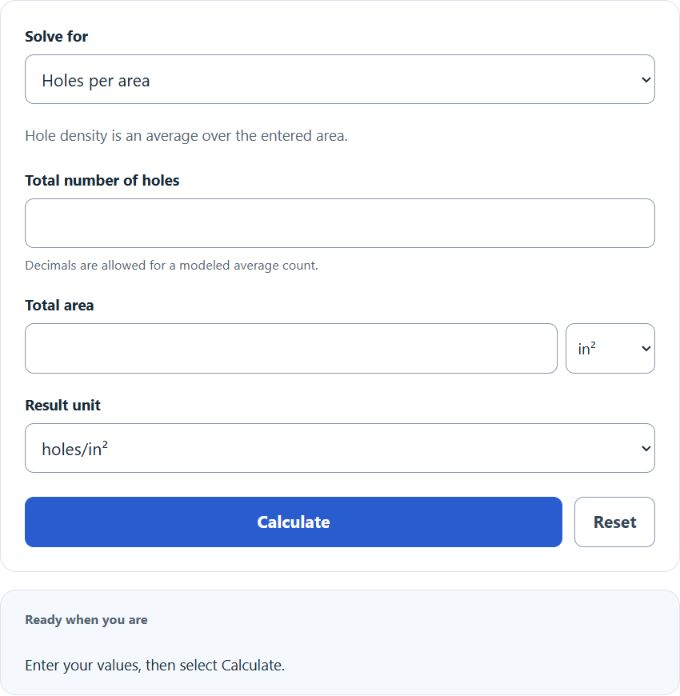
Choose total holes, area, or holes per area, then enter the two known values. Unit conversions support in², ft², yd², m², and cm².
- All Unit Converters
- Stitches Per Inch Calculator
- Inches to Square Inches Calculator
- Open Area Percentage Calculator
- Pixels Per Square Foot Calculator
- Square Inch Calculator
- Coverage Area Calculator
Holes Per Area Formula
The calculator uses the relationship between total area, hole density, and total number of holes.
- H = total number of holes
- A = total area
- D = holes per area, such as holes per in² or holes per ft²
Choose the quantity to solve and enter the two known values. Area must be positive when solving density, and density must be positive when solving area. Counts and modeled densities cannot be negative.
- Total number of holes: multiplies total area by holes per area.
- Holes per area: divides total holes by total area.
- Total area: divides total holes by holes per area.
Unit conversions are handled before the formula is applied. Area values are converted to square inches internally, and hole-density values are converted to holes per square inch. The result is then converted back to the unit you selected.
Area and Hole Density Unit Conversions
These are displayed conversion factors; nonterminating decimals are rounded here. The calculator uses full precision from the exact relation 1 in = 2.54 cm.
| Area Unit | Equivalent in Square Inches |
|---|---|
| 1 in² | 1 in² |
| 1 ft² | 144 in² |
| 1 yd² | 1296 in² |
| 1 m² | ≈ 1550.0031 in² |
| 1 cm² | ≈ 0.15500031 in² |
| Hole Density Unit | Equivalent in Holes per in² |
|---|---|
| 1 hole per in² | 1 per in² |
| 1 hole per ft² | ≈ 0.00694444 per in² |
| 1 hole per yd² | ≈ 0.000771605 per in² |
| 1 hole per m² | 0.00064516 per in² |
| 1 hole per cm² | 6.4516 per in² |
Example Calculations
Example 1: Calculate total number of holes
You have an area of 20 ft² and a hole density of 5 holes per ft².
The total number of holes is 100 holes.
Example 2: Calculate holes per area
You have 240 holes spread across 60 in².
The hole density is 4 holes per in².
FAQ
What does holes per area mean?
Holes per area is a density measurement. It tells you how many holes are placed within one unit of area. For example, 10 holes per ft² means every square foot has 10 holes on average.
Can the total number of holes be a decimal?
The formula can produce a decimal result, especially when using converted units. In real use, holes are usually whole numbers. If the result is 42.7 holes, you may need to round based on your layout, spacing rules, or manufacturing requirements.
Why do the units matter?
The area unit and the holes-per-area unit must match before the formula is applied. For example, ft² and holes per ft² work directly together. If you mix units, such as m² and holes per in², the calculator converts them first so the result stays consistent.