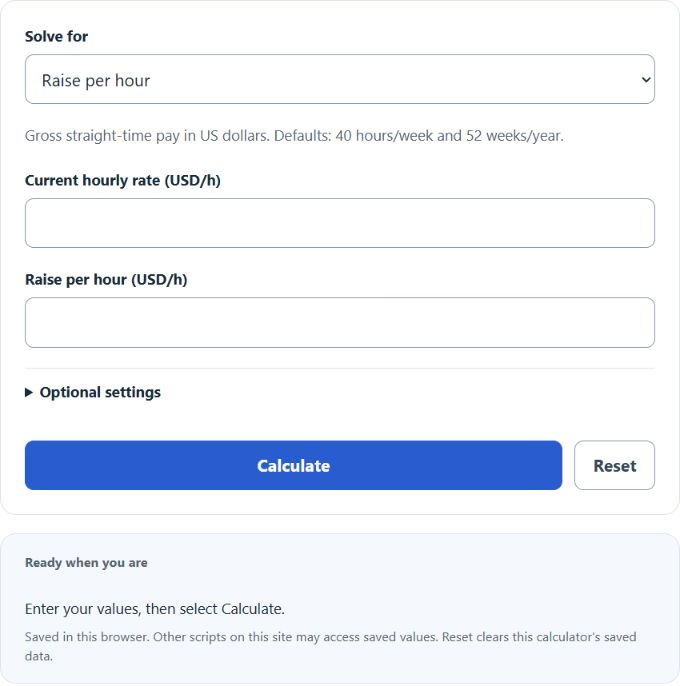
Hourly raise calculator: turn a raise per hour, percent, or new rate into extra pay per week, month, and year. See what a $1 or 50-cent raise is really worth.
Hourly Raise Formula
The calculator turns a per-hour raise into its weekly, monthly, and annual impact:
A = r * h * w
When you know the percentage or the new rate instead, the raise per hour is derived first:
r = R * p / 100 or r = Rnew - R
Variables:
- A is the extra gross pay per year from the raise
- r is the raise per hour (a 50-cent raise is r = 0.50)
- R is your current hourly rate and Rnew is the new rate
- p is the raise percentage
- h is straight-time hours per week (blank defaults to 40) and w is paid weeks per year (blank defaults to 52). Explicit zero remains zero; average monthly pay is annual pay divided by 12.
Pick what you already know: the dollar raise, the percentage, or the new rate. The calculator fills in the rest — new rate, raise percentage, and the extra pay per week, month, and year — plus your annual pay before and after. It works for any schedule: cut the hours per week for part-time work or the weeks per year for seasonal work.
What an Hourly Raise Is Worth Per Year
Extra annual gross pay at 40 hours per week, 52 weeks per year (2,080 hours).
| Raise per hour | Per week | Per month | Per year |
|---|---|---|---|
| $0.25 | $10.00 | $43.33 | $520.00 |
| $0.50 | $20.00 | $86.67 | $1,040.00 |
| $1.00 | $40.00 | $173.33 | $2,080.00 |
| $1.50 | $60.00 | $260.00 | $3,120.00 |
| $2.00 | $80.00 | $346.67 | $4,160.00 |
| $3.00 | $120.00 | $520.00 | $6,240.00 |
| $5.00 | $200.00 | $866.67 | $10,400.00 |
Illustrative percentage raises on selected hourly rates (40 hours/week, 52 paid weeks/year):
| Current rate | 3% raise | 5% raise | Extra/year at 5% |
|---|---|---|---|
| $15.00 | +$0.45 | +$0.75 | $1,560.00 |
| $18.00 | +$0.54 | +$0.90 | $1,872.00 |
| $20.00 | +$0.60 | +$1.00 | $2,080.00 |
| $25.00 | +$0.75 | +$1.25 | $2,600.00 |
| $30.00 | +$0.90 | +$1.50 | $3,120.00 |
Example Problems
Example 1: You make $18.50 per hour and get a $1.50 raise, working 40 hours a week.
The new rate is 18.50 + 1.50 = $20.00 per hour, an 8.11% raise.
A = 1.50 * 40 * 52 = $3,120 more per year, or $60 more per week.
Example 2: Your rate goes from $16.00 to $16.80. What percent raise is that?
r = 16.80 – 16.00 = $0.80, and 0.80 / 16.00 = 0.05, so it is a 5% raise worth 0.80 * 40 * 52 = $1,664 per year full time.
Frequently Asked Questions
How much is a $1 an hour raise per year?
At full time (40 hours a week, 52 weeks), every $1 per hour equals $2,080 per year before taxes. Scale it directly: a 50-cent raise is $1,040, a $2 raise is $4,160, and a $5 raise is $10,400. At 30 hours a week, $1 per hour is $1,560 per year.
Is it better to ask for a dollar amount or a percentage?
A dollar amount and a percentage can describe the same raise. Divide the hourly increase by your current rate and multiply by 100 to compare them. For example, a $1 raise on $20/hour is 5%. No typical employer increase is assumed.
Does the raise change my overtime rate too?
It may. Under the US federal FLSA, covered nonexempt employees generally receive at least 1.5 times their regular rate for hours over 40 in a workweek. The regular rate and applicable exemptions or other rules matter. This calculator estimates straight-time pay only; check the rules applicable to your job. See the US Department of Labor overtime guidance.