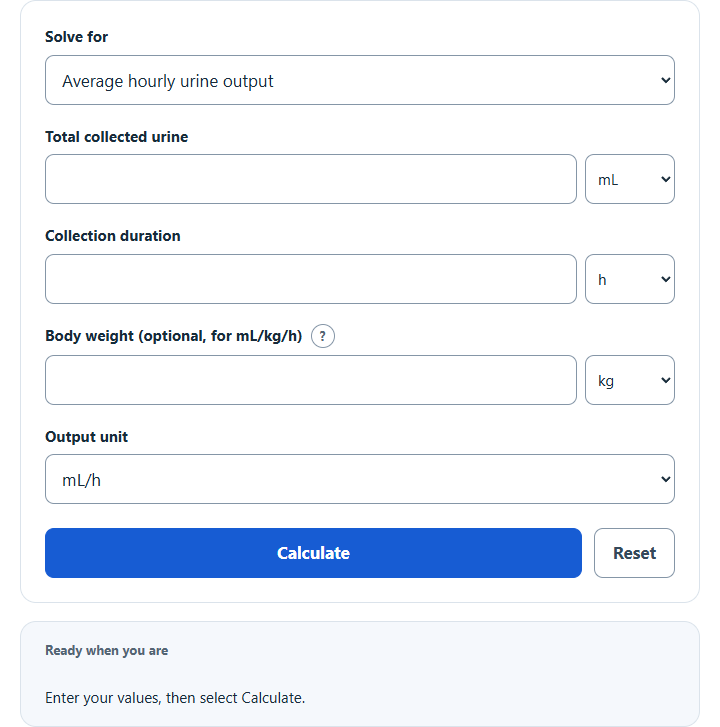
Calculate hourly urine output from total urine volume and time, or find total volume or hours, with optional mL/kg/hr using body weight.
Related Calculators
- Urine K To Creatinine Ratio Calculator
- Oxalate/Creatinine Ratio Calculator
- Serum Osmolality Calculator
- Perfusion Index Calculator
- All Health and Medical Calculators
Calculator Functions
| Function | What it does | What it requires |
|---|---|---|
| Average hourly urine output | Finds the average urine output in mL per hour over a collection period | Requires the total collected urine and the collection duration |
| Total urine volume | Finds the total volume produced at an average hourly rate over a period | Requires the average hourly urine output and the collection duration |
| Collection duration | Finds how long a collection lasted from its volume and average hourly rate | Requires the total collected urine and the average hourly urine output |
Volume is entered in mL or L, duration in hours or minutes, and rate in mL/h or L/h, with the result unit chosen separately. Body weight in kg or lb is optional in every function and adds the output in mL/kg/h. Every result also shows the 24-hour equivalent at the same rate.
Hourly Urine Output Formulas
| U | Average hourly urine output (mL/h) |
| V | Total urine collected (mL) |
| t | Collection duration (h) |
Average hourly urine output
The collected volume is divided by the hours it was collected over. 1,200 mL over 6 hours is 1,200 ÷ 6 = 200 mL/h. A duration in minutes is converted to hours first, so 50 mL in 30 minutes is 100 mL/h. The 24-hour equivalent is the hourly rate × 24, which is 4,800 mL/day at 200 mL/h.
Total urine volume
The average hourly rate is multiplied by the duration. 50 mL/h kept up for 8 hours is 400 mL.
Collection duration
The volume is divided by the average hourly rate. 400 mL at 50 mL/h took 8 hours. A rate of zero has no answer and is rejected.
Urine output in mL/kg/h
W is the body weight in kg, and a weight in pounds is multiplied by 0.45359237 first [2]. 200 mL/h for a person of 80 kg is 200 ÷ 80 = 2.5 mL/kg/h. Clinical criteria are written in this unit. In the 2012 KDIGO guideline, a urine volume below 0.5 mL/kg/h for 6 hours is one of the criteria that define acute kidney injury, with stage 1 at 6 to 12 hours below 0.5 mL/kg/h, stage 2 at 12 hours or more, and stage 3 at below 0.3 mL/kg/h for 24 hours or more, or no urine for 12 hours or more [1]. The calculator reports the number and does not sort it into normal or abnormal.
How to Calculate Urine Output
Measure all the urine produced over a known period, in mL, and note the length of the period in hours. Divide the volume by the hours to get mL/h. To compare with weight-based criteria, divide that result by the body weight in kg. For 300 mL collected over 6 hours from a 60 kg patient, the output is 300 ÷ 6 = 50 mL/h, and 50 ÷ 60 = 0.83 mL/kg/h.
Limits of This Estimate
- This calculator is for informational purposes only and does not diagnose or treat any condition. Urine output interpretation depends on factors like age, body size, medications and overall health.
- Very low or no urine output, signs of severe dehydration, confusion, chest pain, shortness of breath, severe weakness or swelling call for urgent medical care or prompt contact with a clinician.
- The result is an average over the whole collection. It can hide shorter periods of low or no output, and it is only as complete as the collection itself.
- The mL/kg/h figure depends on which weight is used. Care teams often use admission or dry weight, and the same weight should be used each time.
Sources
- KDIGO, Clinical Practice Guideline for Acute Kidney Injury, Kidney International Supplements (March 2012): urine output criteria for acute kidney injury in mL/kg/h (recommendations 2.1.1 and 2.1.2, Table 2)
- NIST, Guide for the Use of the International System of Units (SP 811), Appendix B.8: kilograms in a pound