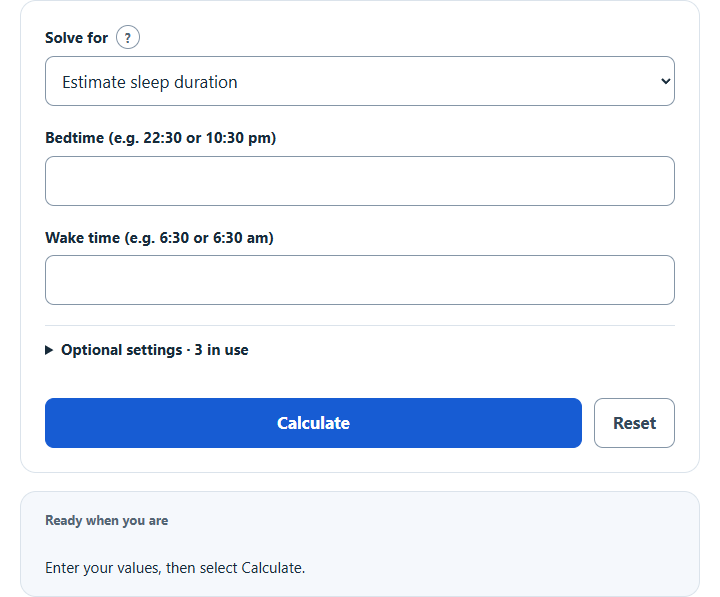
Calculate how many hours of sleep you got from your bedtime and wake time, compare it with CDC guidance for your age, or plan a bedtime by sleep cycles.
Related Calculators
- Calories Burned Lying Down Calculator
- RER (Resting Energy Requirement) Calculator
- BMI Calculator
- Weight Loss Percentage Calculator
- All Health and Medical Calculators
Calculator Functions
| Function | What it does | What it requires |
|---|---|---|
| Estimate sleep duration | Finds the hours and minutes between bedtime and wake time and compares them with the recommended amount for an age group | Requires the bedtime and the wake time |
| Plan wake time | Finds a wake time a whole number of sleep cycles after bedtime | Requires the bedtime and the number of sleep cycles |
| Plan bedtime | Finds a bedtime a whole number of sleep cycles before the wake time | Requires the wake time and the number of sleep cycles |
Times can be typed in 24-hour form (22:30) or 12-hour form (10:30 pm). Optional settings set the age group, the minutes it takes to fall asleep and the assumed cycle length, which starts at 90 minutes. Estimate sleep duration also has a wake day setting for a wake time on the same day as bedtime, such as a nap.
Hours of Sleep Formulas
| T | Time in bed (hours) |
| W | Wake time on a 24-hour clock |
| B | Bedtime on a 24-hour clock |
| D | 1 when the wake time is on the next day, otherwise 0 |
| L | Time taken to fall asleep. Blank counts as 0 |
Estimate sleep duration
The formulas above apply directly. Bed at 22:00 and up at 06:00 is 6 − 22 + 24 = 8 hours. Bed at 9:40 pm and up at 7:15 am is 9 h 35 min. A wake time earlier than the bedtime is counted as the next morning unless the wake day is set to Same day. The result is then compared with the CDC’s recommended sleep per day for the chosen age group [1], as of May 15, 2024:
| Age group | Recommended sleep per day |
|---|---|
| Child, 6–12 years | 9–12 hours |
| Teen, 13–17 years | 8–10 hours |
| Adult, 18–60 years | 7 or more hours |
| Adult, 61–64 years | 7–9 hours |
| 65 years and older | 7–8 hours |
The shortfall or surplus shown is measured against the low end of the range, so 6 h 30 min for an adult is 30 minutes short of 7 hours.
Plan wake time
n is the number of sleep cycles and c the cycle length in minutes. Five 90-minute cycles are 7.5 hours of sleep, so bed at 23:00 with 15 minutes to fall asleep gives a wake time of 06:45. Sleep moves through its stages in a cycle that starts over every 80 to 100 minutes, usually four to six times a night [2], which is why 90 minutes is the starting value.
Plan bedtime
To wake at 06:30 after five 90-minute cycles, bedtime is 23:00. The result also shows the bedtime for one cycle fewer and one cycle more.
Limits of This Estimate
- This calculator estimates elapsed time in bed from clock times and is for educational purposes only. It is not medical advice or a diagnosis. Anyone with persistent insomnia, loud snoring, witnessed breathing pauses or excessive daytime sleepiness should consider speaking with a clinician.
- Time in bed is not the same as sleep. Only the entered time to fall asleep is subtracted, so time awake during the night still counts.
- Cycle length differs between people and nights, and waking at the end of a planned cycle is not guaranteed.
- The recommended hours are general guidance by age, and the comparison ignores naps. Clock changes for daylight saving time are not handled.
Sources
- Centers for Disease Control and Prevention, About Sleep (May 15, 2024): recommended hours of sleep per day by age
- National Heart, Lung, and Blood Institute, How Sleep Works: Sleep Phases and Stages: the length of a sleep cycle and the number of cycles per night