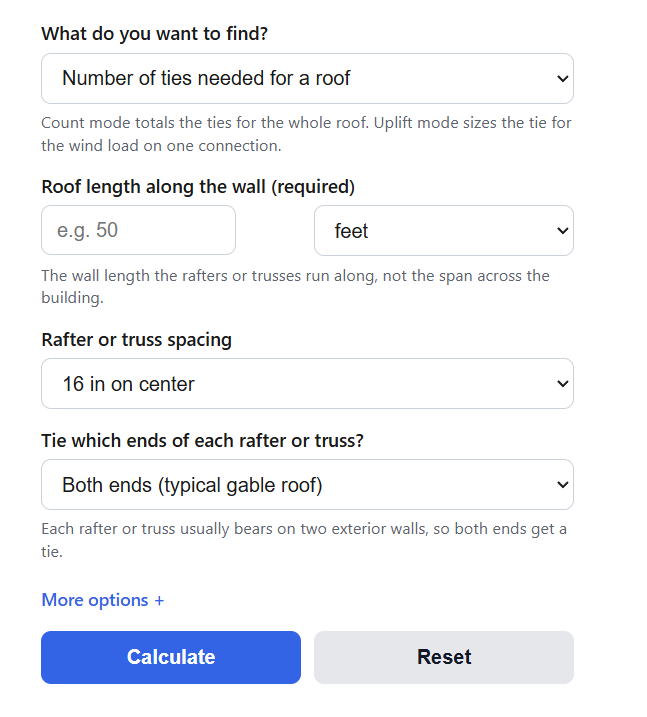
Calculate how many hurricane ties your roof needs and the wind uplift load on each rafter-to-wall connection, then check whether your tie is strong enough.
- All Construction Calculators
- Roof Truss Count Calculator
- Metal Roof Screw Calculator
- Sheathing Sheet Calculator
Hurricane Tie Formula
This calculator works two ways. To count the ties for a whole roof, it multiplies the number of rafters or trusses by the number of ends you tie:
Ties = (L / S + 1) * E
To size a tie for wind, it finds the uplift force on one roof-to-wall connection from the net uplift pressure and the area that connection carries:
U = P * A A = S * Span / 2
When you do not know the pressure, it estimates it from the design wind speed:
P = 0.00256 * V^2 * C
Variables:
- Ties is the number of hurricane ties needed for the roof
- L is the roof length along the wall the rafters run past
- S is the rafter or truss spacing (use the same unit as L and Span)
- E is the number of ends you tie per member, 1 for one wall or 2 for both walls
- U is the uplift force on one connection, in pounds
- P is the net roof uplift pressure, in pounds per square foot
- A is the tributary area one connection carries, in square feet
- Span is the roof width the rafters cross between the two bearing walls
- V is the design wind speed, in miles per hour
- C is a roof location factor, higher at edges and corners than in the field
Count mode answers how many ties to buy. It divides the wall length by the spacing, adds one for the rafter at the far end, and multiplies by the ends you tie. Because most gable roofs bear on two exterior walls, each rafter or truss usually takes a tie at both ends, so E is 2. The advanced options let you double the ties per connection, add gable or girder connections the spacing count misses, and add a spares percentage.
Uplift mode answers whether one tie is strong enough. The tributary area is the spacing times half the span, because each of the two walls carries half of what a rafter supports. Multiply that area by the net uplift pressure to get the pull on the connection, then compare it to the tie’s rated capacity. If the demand is larger than one tie can hold, you need a stronger tie or more than one per connection.
Hurricane Tie Capacity and Roof Coverage
The first table lists common Simpson Strong-Tie style connectors with a typical published allowable uplift value and the roof area a single tie covers at a net uplift of 20 psf. The coverage column is the part most guides leave out: divide the tie capacity by the design pressure to see how much tributary roof one tie can actually hold. Confirm the rated value against the current manufacturer or ICC-ES data before you build, since ratings change with wood species, fastener schedule, and code cycle.
| Connector | Typical allowable uplift | Roof area covered at 20 psf |
|---|---|---|
| H2.5A clip | about 415 lb | about 21 sq ft |
| H1 clip | about 585 lb | about 29 sq ft |
| H10A tie | about 1040 lb | about 52 sq ft |
| Heavy twist strap | about 1500 lb | about 75 sq ft |
The second table estimates the net uplift pressure in the field of the roof for a range of design wind speeds, using 0.00256 times the wind speed squared times a 0.9 field factor. Pressure at roof edges runs higher, and corners higher still, so treat these as a floor rather than a worst case.
| Design wind speed | Net field uplift pressure | Uplift on a 24 in x 30 ft-span connection |
|---|---|---|
| 90 mph | about 19 psf | about 560 lb |
| 110 mph | about 28 psf | about 836 lb |
| 130 mph | about 39 psf | about 1168 lb |
| 150 mph | about 52 psf | about 1555 lb |
| 170 mph | about 67 psf | about 1998 lb |
Example Problems
Example 1: Count the ties for a roof.
A gable roof is 50 feet long with trusses spaced 24 inches (2 feet) on center, and you tie both ends. First find the number of trusses, then multiply by two ends:
Ties = (50 / 2 + 1) * 2 = 26 * 2 = 52 ties.
Order a few spares on top of that, since a tie with a missing or bent nail hole should be replaced rather than installed short.
Example 2: Size a tie for the wind.
The design wind speed is 130 mph and the trusses are 24 inches on center on a 30 foot span in the field of the roof. The net pressure is 0.00256 * 130^2 * 0.9 = 38.9 psf, the tributary area is 2 * 30 / 2 = 30 square feet, so the uplift is:
U = 38.9 * 30 = 1168 lb per connection.
A single H2.5A rated near 415 lb is not enough, since 1168 divided by 415 rounds up to three clips. A 1500 lb twist strap carries the same connection with one fastener.
Frequently Asked Questions
How many hurricane ties do I need?
Use one tie at each point where a rafter or truss lands on an exterior wall. On a typical gable roof that is two ties per member, one at each bearing wall, so a roof with 26 trusses needs about 52 ties. Divide the wall length by the rafter spacing, add one, and multiply by the number of ends you tie, then add a few spares. High wind details can call for a tie on each side of the member, which doubles the count.
Do hurricane ties go on the inside or outside of the wall?
Either face can work as long as the tie wraps the rafter or truss to the top plate and gets its full nail pattern. Many builders set them on the inside so they are hidden and protected, while retrofit crews often use the outside face for easier access before sheathing or fascia goes on. What matters for capacity is that every nail hole is filled with the specified fastener, because a tie installed with fewer nails carries far less than its rated load.
When is a hurricane tie required instead of just nails?
Building codes generally allow prescriptive toenailing only where the uplift on the connection stays low, around 200 pounds or less. Above that, a rated connector is required, and the calculator flags when your connection is in that range. Since uplift climbs quickly with wind speed and roof span, most connections in coastal and high wind regions land well past the toenail limit and need a tie sized to the load.