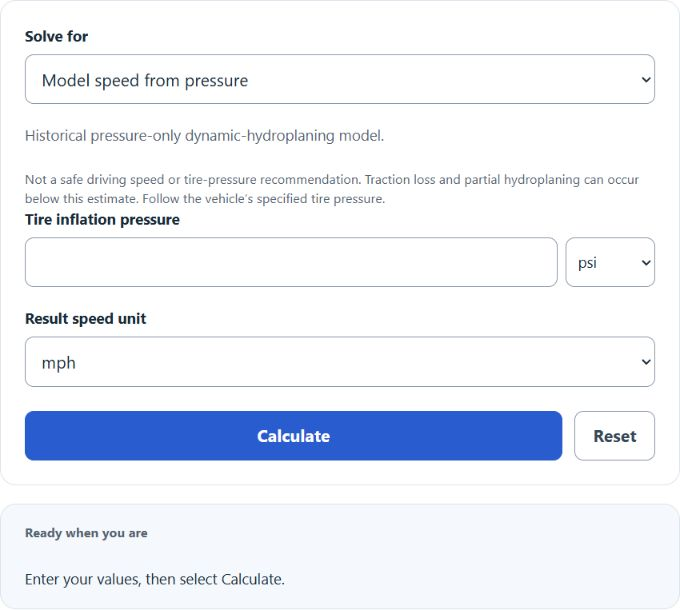
Estimate a historical dynamic-hydroplaning model speed from tire pressure or algebraically invert the model, with mph, kph, m/s, psi, bar, and kPa units.
- All Automotive Calculators
- Drift Angle Calculator
- Maximum Cornering Speed Calculator
- Reaction Distance Calculator
- Stopping Distance Calculator
- Tire Pressure Temperature Calculator
- Tire Pressure Difference Calculator
Hydroplaning Speed Formula
The calculator uses the historical NASA pressure-only dynamic-hydroplaning model V ≈ 10.35√P, with tire inflation pressure in psi and speed in statute mph (NASA TN D-2056). This is an approximate model, not a universal onset threshold or safe driving speed. Partial hydroplaning and traction loss can occur below its estimate.
- V = estimated hydroplaning speed in miles per hour
- P = tire pressure in pounds per square inch
The inverse gives only the pressure implied by the model. It is not an inflation recommendation; follow the vehicle manufacturer’s specified tire pressure:
- P = tire pressure in psi
- V = hydroplaning speed in mph
If you enter tire pressure, the calculator converts it to psi if needed, applies the speed formula, then converts the result to your selected speed unit. If you enter hydroplaning speed, it converts the speed to mph, applies the pressure formula, then converts the result to your selected pressure unit.
Estimated Hydroplaning Speeds by Tire Pressure
These values use the same formula as the calculator, with speed rounded to one decimal place.
| Tire Pressure | Estimated Speed | Metric Equivalent |
|---|---|---|
| 24 psi | 50.7 mph | 81.6 kph |
| 28 psi | 54.8 mph | 88.1 kph |
| 32 psi | 58.5 mph | 94.2 kph |
| 36 psi | 62.1 mph | 99.9 kph |
| 40 psi | 65.5 mph | 105.3 kph |
Unit Conversion Reference
| Quantity | Conversion |
|---|---|
| Speed | 1 mph = 1.609344 kph |
| Speed | 1 mph = 0.44704 m/s |
| Pressure | 1 bar = 14.5038 psi |
| Pressure | 1 kPa = 0.145038 psi |
Example Calculations
Example 1: Find hydroplaning speed from tire pressure
If tire pressure is 32 psi, use:
The square root of 32 is about 5.657.
The estimated hydroplaning speed is about 58.5 mph.
Example 2: Find tire pressure from hydroplaning speed
If the hydroplaning speed is 60 mph, use:
60 divided by 10.35 is about 5.797.
The tire pressure corresponding to 60 mph is about 33.6 psi.
FAQ
What does hydroplaning speed mean?
Hydroplaning speed is an estimate of the speed where a tire may begin to ride on top of water instead of maintaining full contact with the road or runway surface. It is not a guaranteed threshold. Water depth, tread condition, vehicle weight, surface texture, and braking can all affect when hydroplaning occurs.
Why does tire pressure affect hydroplaning speed?
In this simplified dynamic model, speed scales with the square root of inflation pressure. It omits tread, water depth, pavement texture, and other hydroplaning mechanisms. Increasing tire pressure to chase a calculated speed is unsafe; use the vehicle’s specified inflation pressure.
Can this result be used as a safe driving speed in rain?
No. The result is only a formula-based estimate. Safe speed in wet conditions should be lower than normal and should account for visibility, traffic, water depth, tire condition, and stopping distance.