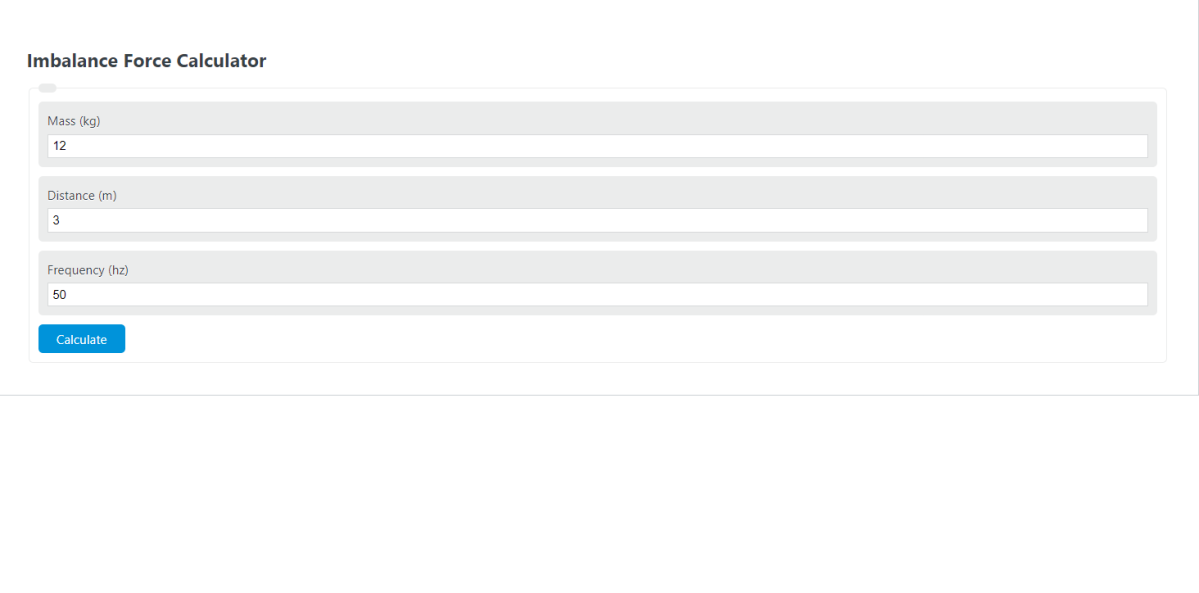
Calculate imbalance force, mass, distance, or frequency by entering any 3 values and converting between kg, lb, m, cm, ft, in, Hz, RPM, N, and lbf.
- All Physics Calculators
- All Force Calculators
- Vibration G Force Calculator
- RPM to G Force Calculator
- Pendulum Force Calculator
Imbalance Force Formula
Imbalance force is the rotating force created when a mass is not centered on the true axis of rotation. In practical terms, a rotor, wheel, fan, pulley, or shaft assembly produces an alternating radial load whenever some portion of its mass is offset from center. This calculator estimates that excitation force from the unbalanced mass, its offset distance, and rotational frequency.
It can also be written in terms of angular velocity.
If your machine speed is given in revolutions per minute, convert it to frequency first.
Variable Definitions
| Symbol | Meaning | Common Units |
|---|---|---|
| IF | Imbalance force generated by the rotating unbalance | N, lbf |
| m | Unbalanced mass, not the total machine mass | kg, lb |
| R | Radial offset from the axis of rotation to the unbalanced mass | m, cm, ft, in |
| f | Rotational frequency | Hz |
| ω | Angular velocity | rad/s |
How to Use the Calculator
- Enter the unbalanced mass causing the offset.
- Enter the distance from the center of rotation to that mass.
- Enter the rotational frequency in hertz, or convert from RPM first.
- Calculate the unknown value. If you know any three variables, the calculator can solve for the fourth.
The most common input mistake is using the entire rotor mass instead of the off-center portion of the mass. Another common mistake is entering RPM directly where the formula expects hertz.
Rearranged Forms
These forms are useful when you need to solve for mass, radius, or frequency instead of force.
Why Speed Has Such a Large Effect
Imbalance force increases with the square of rotational speed. That means a small increase in speed can create a much larger increase in force. If rotational frequency doubles, the imbalance force becomes four times larger. This is why machines that seem acceptable at low speed can vibrate severely at higher operating speeds.
Engineers often group the mass and offset together as a single unbalance term.
This form is especially useful in balancing work because it shows that force depends on both the amount of unbalance and the operating speed.
Example
Suppose a rotating component has an unbalanced mass of 0.20 kg located 0.01 m from the shaft centerline, and it spins at 30 Hz.
The resulting imbalance force is approximately 71.1 N. Even though the mass and offset are small, the force becomes significant because of the squared speed term.
What the Result Means
The calculated value is the rotating excitation force produced by the unbalance. In real machinery, the actual vibration level also depends on bearing stiffness, support flexibility, damping, shaft geometry, and whether the machine is operating near a critical speed. In other words, this calculator estimates the forcing input, not the full vibration response of the machine.
- Higher mass increases force directly.
- Larger radius increases force directly.
- Higher speed increases force very rapidly.
Typical Applications
- Rotor and shaft balancing checks
- Fan, blower, and pump vibration analysis
- Motor, pulley, and flywheel troubleshooting
- Estimating dynamic loads on bearings and supports
- Comparing force levels before and after balancing corrections
Unit and Input Notes
- Keep mass, length, and force units consistent throughout the calculation.
- Use radius, not diameter.
- Use the offset distance from the rotational centerline to the unbalanced mass.
- If speed is provided in RPM, convert it to hertz before using the main equation.
- For very high-speed systems, small unit conversion errors can create large force errors.
Common Questions
Is imbalance force constant?
Its magnitude stays constant for a steady speed and fixed unbalance, but its direction rotates with the shaft, so the machine experiences a repeating radial load.
Does this formula apply to any rotating part?
It is a good first-order estimate for a rotating mass with eccentricity. More complex rotors may require multi-plane balancing or full rotor-dynamics analysis.
Why can a tiny offset cause major vibration?
Because the force depends on speed squared. At moderate or high speed, even a small unbalanced mass at a small radius can generate a surprisingly large alternating force.