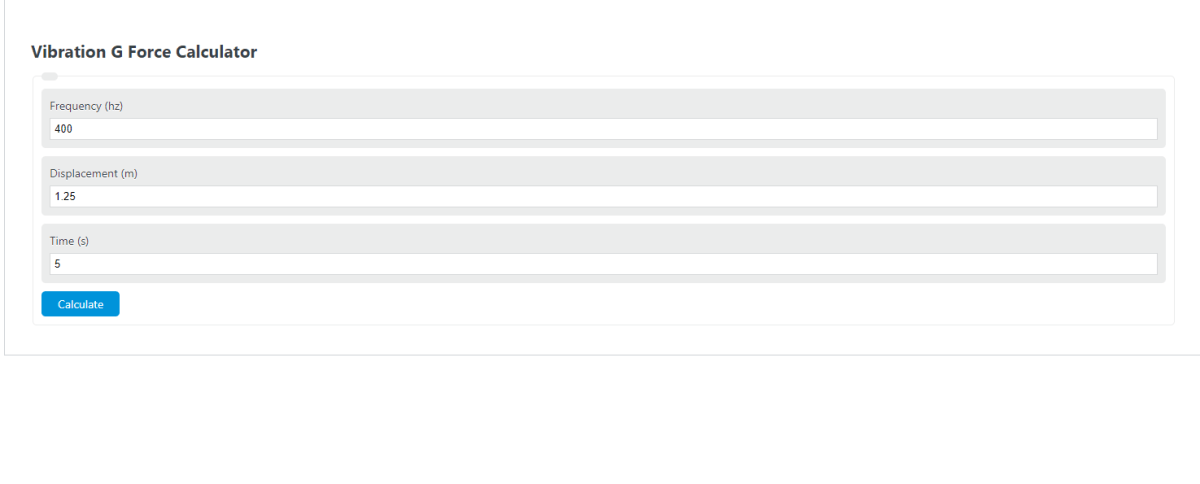
Calculate sinusoidal vibration g-force, amplitude, or frequency with Hz, RPM, mm, microns, inches, peak-to-peak travel, velocity, and worked steps.
- All Physics Calculators
- All Force Calculators
- Newtons to G Force Calculator
- MPH to G Force Calculator
- RPM to G Force Calculator
- Imbalance Force Calculator
Vibration G Force Formula
Vibration g-force expresses sinusoidal acceleration as a multiple of standard gravity. For a vibrating system with displacement amplitude D, frequency f, and time t, the motion can be modeled from displacement to acceleration and then converted into g’s.
Where:
- GF(t) = instantaneous vibration g-force
- D = displacement amplitude in meters
- f = frequency in hertz
- t = time in seconds
- 9.80665 = standard gravity in m/s2
The calculator reports the magnitude of the acceleration, so the displayed result is non-negative. If you need the directional sign of the acceleration, use the signed acceleration expression instead of the magnitude form.
Peak Vibration G Force
If you want the maximum acceleration reached during one full cycle, use the peak form. This occurs when the sine term reaches its maximum magnitude.
This version is especially useful for shaker testing, machinery vibration checks, design limits, and quick comparisons between different amplitudes and frequencies.
Useful Rearrangements
If you know the peak g-force and need to solve for displacement amplitude or frequency, these forms are helpful:
Use the last relation when your measurement is peak-to-peak displacement rather than amplitude. Entering peak-to-peak travel as amplitude will overstate the calculated g-force.
How to Calculate Vibration G Force
- Convert frequency to hertz, displacement amplitude to meters, and time to seconds.
- If your motion is given as peak-to-peak displacement, divide by 2 to get amplitude.
- Determine the phase of the motion from frequency and time.
- Compute acceleration from the sinusoidal relation.
- Divide acceleration by standard gravity to express the result in g.
At the start of a cycle, the instantaneous g-force is zero. At one-quarter of a cycle, the instantaneous g-force reaches its peak magnitude.
Example
Suppose a vibration has a frequency of 400 Hz, a displacement amplitude of 1.25 mm, and a time equal to one-quarter of a cycle. At that instant, the sine term equals 1, so the instantaneous g-force is also the peak g-force.
The vibration acceleration is approximately 805.13 g.
Quick Interpretation
| Change | Effect on Vibration G Force |
|---|---|
| Double the displacement amplitude | The g-force doubles |
| Double the frequency | The g-force increases by four times |
| Measure at the start of a cycle | The instantaneous g-force is zero |
| Measure at one-quarter of a cycle | The instantaneous g-force reaches peak magnitude |
Input Notes That Prevent Errors
- Amplitude is not total travel. If a system moves 2 mm peak-to-peak, the amplitude is 1 mm.
- Frequency has the strongest influence. Because acceleration scales with the square of frequency, even modest frequency increases can produce much larger g values.
- Time only matters for instantaneous results. If you only need the highest acceleration in a cycle, use the peak formula.
- Magnitude removes direction. The positive and negative halves of the cycle have opposite acceleration directions but the same magnitude.
- Unit consistency matters. Most unrealistic outputs come from mixing inches, millimeters, hertz, or time units without converting properly.
Where This Calculation Is Used
- Rotating machinery and imbalance analysis
- Shaker table and sinusoidal vibration testing
- Electronics, sensors, and PCB durability checks
- Automotive and aerospace vibration environments
- Mount, isolator, and fixture design reviews
- Comparing allowable vibration limits against test conditions
Assumptions and Limits
This calculator is intended for sinusoidal vibration. It is most accurate when the motion can be represented by a single frequency and a single displacement amplitude.
- It does not model random vibration spectra.
- It does not replace shock or impact calculations.
- It assumes the reported displacement is the amplitude for the same axis being evaluated.
- Inverse solutions can have multiple valid times because sinusoidal motion repeats every cycle.
Frequently Asked Questions
What is the difference between acceleration in m/s2 and acceleration in g?
They describe the same physical acceleration on different scales. Expressing acceleration in g simply normalizes it by standard gravity.
Why can a very small displacement create a very large g-force?
Because vibration acceleration grows with the square of frequency. High-frequency motion can create large acceleration even when the actual displacement is tiny.
When should I use peak g-force instead of instantaneous g-force?
Use peak g-force when you want the maximum acceleration reached during a cycle. Use instantaneous g-force when the exact time or phase of motion matters.
Is vibration g-force the same as shock g-force?
No. Vibration g-force is typically tied to continuous periodic motion, while shock g-force describes a short-duration impact or pulse. The analysis methods and assumptions are different.
What is the most common input mistake?
The most common mistake is entering peak-to-peak displacement as amplitude. If your displacement measurement is peak-to-peak, divide it by 2 before using the formula or calculator.