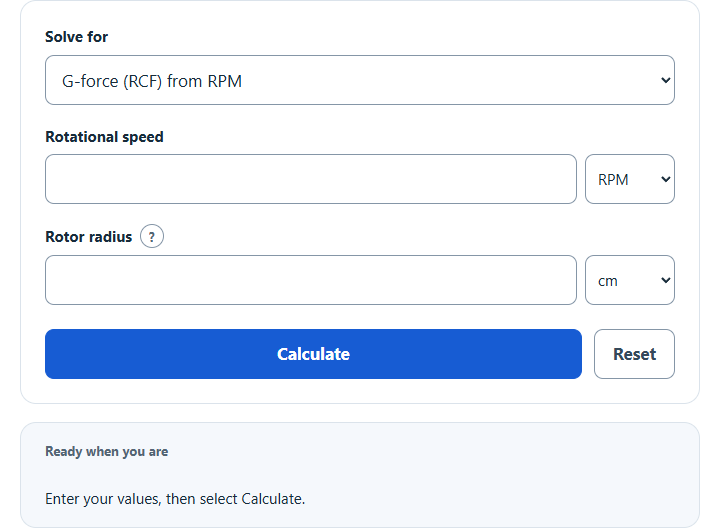
Convert RPM to g-force (RCF) for a centrifuge from rotor speed and radius, or convert g to RPM to find the speed needed for a target × g.
- All Unit Converters
- Mechanics and Physics Unit Converters
- All Force Calculators
- MPH to G Force Calculator
- Vibration G Force Calculator
- G-Force To Velocity Calculator
- G Force To Acceleration Calculator
RPM to G Force Formula
The following equation gives relative centrifugal force (RCF), the magnitude of rotational acceleration divided by standard gravity g₀ = 9.80665 m/s². RCF is expressed as a multiple of g₀, not a force in newtons. Use radius in meters with the formula below; this is a geometric conversion, not an equipment speed rating.
- Where GF is the RCF (multiples of standard gravity)
- r is the radius of rotation in meters; for centrifuge RCF, use the specified radius to the sample position (commonly the bottom of the tube), accounting for adapters
- RPM is the number of rotations per minute
| RPM (rpm) | Radius (cm) | G-Force (g) |
|---|---|---|
| 500 | 10 | 27.96 |
| 750 | 10 | 62.90 |
| 1,000 | 10 | 111.82 |
| 1,200 | 10 | 161.03 |
| 1,500 | 10 | 251.60 |
| 2,000 | 10 | 447.30 |
| 2,500 | 10 | 698.90 |
| 3,000 | 10 | 1,006.42 |
| 3,500 | 10 | 1,369.85 |
| 4,000 | 10 | 1,789.19 |
| 4,500 | 10 | 2,264.44 |
| 5,000 | 10 | 2,795.61 |
| 6,000 | 10 | 4,025.68 |
| 7,000 | 10 | 5,479.40 |
| 8,000 | 10 | 7,156.76 |
| 9,000 | 10 | 9,057.78 |
| 10,000 | 10 | 11,182.44 |
| 12,000 | 10 | 16,102.71 |
| 15,000 | 10 | 25,160.49 |
| 20,000 | 10 | 44,729.76 |
| Assumes fixed radius r = 10 cm (0.10 m). RCF = ((2π × RPM / 60)² × r(m)) / 9.80665 ≈ 1.118243958×10⁻⁵ × r(cm) × RPM². Values use full π and standard gravity, then round to two decimals; the common 1.118×10⁻⁵ shortcut is rounded. | ||
Can RPM be converted to G Force?
RPM can be converted to G force if you also know the radius of rotation. In this example, the RPM is first converted to tangential velocity, then the number of g forces is calculated.
How to Calculate G Force from RPM?
Example Problem:
The following example outlines the steps and information needed to calculate the g forces from RPM.
First, determine the total rotations per minute. In this example, the RPM is 50.
Next, determine the radius of rotation. This is provided as 2 m.
Finally, calculate the g forces from the rpm using the formula above:
GF = (2*pi*RPM/60)2 * r / 9.80665
GF = (2*pi*50/60)2 * 2 / 9.80665
GF ≈ 5.591 × g₀