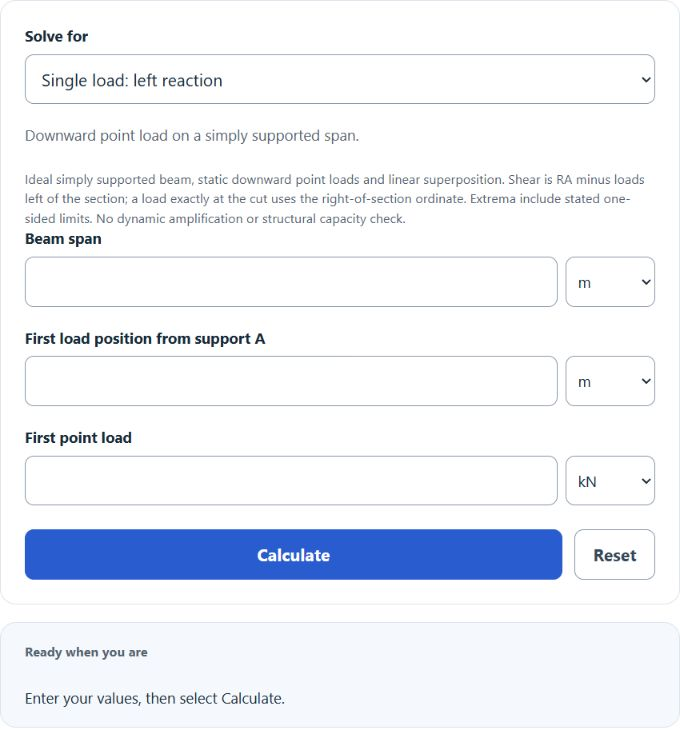
Calculate left-reaction, section-shear and section-moment influence ordinates for an ideal simply supported beam. Single loads and fixed two-axle groups are evaluated only while all entered loads are on the span; critical positions and one-sided shear limits are checked directly.
Influence Line Formula
An influence line gives the value of a chosen structural response (reaction, shear, moment, deflection, etc.) at a point due to a unit moving load. For a single point load, the response equals the load magnitude times the influence line ordinate at the load position. For a distributed load, the response equals the load intensity integrated against the influence line over the loaded length.
Variables:
- IL(x) is the influence line ordinate for the selected response at load position x (often unitless for reactions/shear; has units of length for moment influence lines)
- E is the resulting response (e.g., a support reaction, a shear at x₀, or a moment at x₀)
- P is a point load magnitude
- W is a uniform load intensity (force per length)
- L is the loaded length used with the uniform load (often the full span length)
For a point load, divide the response by the point load magnitude to get the influence line ordinate at that load position (IL = E/P). For a uniform load of constant intensity applied over the full length L, the response is E = W·L·ILavg, where ILavg is the average influence ordinate over that loaded length.
What is an Influence Line?
An influence line is a graphical representation used in structural engineering to illustrate how a moving load on a structure (such as a bridge or a beam) affects a particular response quantity, such as a support reaction, internal shear, internal moment, or deflection at a specified point. The x-axis represents the position of the moving load along the structure, and the y-axis represents the value of the response quantity produced by a unit load at that position. Influence lines help engineers identify where a moving load causes the maximum (or minimum) effect for design and analysis.
How to Calculate an Influence Line
The following steps describe influence-line construction in general. This widget evaluates the simply supported reaction, shear and moment relations for one or two downward point loads; distributed loads and deflection are reference context only.
- Choose the response quantity you want (e.g., reaction at a support, shear at x₀, moment at x₀, or deflection at a point).
- Identify load positions at supports and at the section of interest, plus positions where each axle crosses those points.
- Place a unit load at one position and compute the response quantity at the point of interest (using statics for determinate structures, or appropriate structural analysis methods for indeterminate structures).
- For this determinate beam, the response is linear between critical load positions. Evaluate those positions and both admissible sides of a shear discontinuity instead of relying on a sampled sweep.
- Plot the computed response values against load position and connect the points to form the influence line (noting any discontinuities, such as the jump in the shear influence line at x₀).
Example Problem:
Simply supported beam length L = 10 m. A point load P = 25 kN is located at x = 6 m from support A. The support reactions are:
RA = P·(L − x)/L = 25·(10 − 6)/10 = 10 kN
RB = P·x/L = 25·6/10 = 15 kN
The influence line ordinates at that load position are ILRA = RA/P = 10/25 = 0.4 and ILRB = RB/P = 15/25 = 0.6.