Calculate instantaneous velocity, time, acceleration, or initial velocity by selecting the unknown and entering the other three values, using constant acceleration and unit options.
- All Physics Calculators
- All Velocity Calculators
- Acceleration Calculator
- Velocity Calculator
- Final Velocity Calculator
- Instantaneous Power Calculator
Instantaneous Velocity Formula
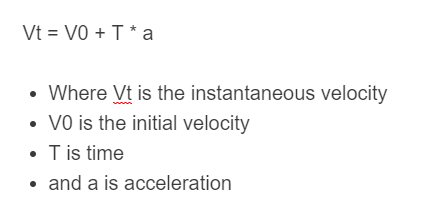
For motion with constant acceleration, the instantaneous velocity at time t is found with:
Where:
- vt = instantaneous velocity at time t
- v0 = initial velocity
- a = constant acceleration
- t = elapsed time
Select the quantity to solve for and enter the other three known values. Time is nonnegative elapsed time from the chosen starting instant.
Rearranged Forms
If you need to solve for a different variable, use the equivalent forms below:
What Instantaneous Velocity Means
Instantaneous velocity is the velocity of an object at one specific moment in time. It includes both magnitude and direction. In one-dimensional motion, the sign of the answer matters:
- A positive velocity means motion in the chosen positive direction.
- A negative velocity means motion in the opposite direction.
- A value of zero means the object is momentarily at rest.
In calculus, instantaneous velocity is defined as the rate of change of position with respect to time:
When acceleration is constant, that derivative-based definition simplifies to the linear equation used by this calculator.
When This Calculator Applies
This calculator is appropriate when acceleration remains constant over the time interval being analyzed. Common examples include:
- Vehicles speeding up or slowing down at a steady rate
- Objects in introductory kinematics problems
- Vertical motion near Earth when air resistance is neglected
- Machinery or test systems with controlled linear acceleration
If acceleration changes continuously during the motion, the result from this calculator may not represent the true instantaneous velocity.
How to Calculate Instantaneous Velocity
- Identify the initial velocity.
- Determine the constant acceleration.
- Measure the elapsed time from the start of motion.
- Multiply acceleration by time.
- Add that change in velocity to the initial velocity.
Example
An object starts at 12 m/s and accelerates at 3 m/s2 for 4 s.
After 4 seconds, the instantaneous velocity is 24 m/s.
Deceleration Example
A car moves at 30 m/s and slows at 2 m/s2 for 5 s. Slowing down is represented by negative acceleration.
The car is still moving forward, but at a lower velocity.
Change in Velocity
The term a t is the total change in velocity during the elapsed time:
That makes the main equation easy to interpret:
If acceleration is positive, velocity increases in the positive direction. If acceleration is negative, velocity decreases or reverses direction depending on the starting conditions.
Units and Conversions
Use consistent units for accurate results. Typical combinations include:
- Velocity: m/s, km/h, mph, ft/s
- Acceleration: m/s2, ft/s2
- Time: s, min, h
Choose the unit for each input; the calculator converts mixed units automatically and lets you select the result unit. The acceleration unit km/h² means 1,000/3,600² m/s², not km/h per second.
Instantaneous Velocity vs. Average Velocity
These terms are related but not identical:
- Instantaneous velocity describes motion at a single moment.
- Average velocity describes overall displacement divided by total time over an interval.
For constant acceleration, the average velocity over a time interval can be written as:
That formula should not be confused with the instantaneous velocity equation used in this calculator.
Common Mistakes
- Using distance instead of displacement: velocity depends on direction.
- Ignoring negative signs: negative acceleration or negative velocity can change the interpretation completely.
- Mixing units: m/s with hours or mph with seconds produces incorrect answers unless converted properly.
- Using the formula for non-constant acceleration: this equation assumes acceleration does not vary over time.
- Treating speed and velocity as identical: speed has no direction, velocity does.
Special Cases
- If a = 0, then velocity stays constant and the final value equals the initial value; equal velocities do not determine a unique elapsed time.
- If t = 0, then the instantaneous velocity is simply the initial velocity; acceleration cannot be uniquely inferred from equal velocities at time zero.
- If the calculated velocity changes sign, the object has reversed direction at some point during the interval.
FAQ
Is instantaneous velocity the same as speed?
No. Speed is the magnitude only, while instantaneous velocity includes direction. In straight-line motion, speed is the absolute value of velocity.
Can instantaneous velocity be negative?
Yes. A negative result means the object is moving in the direction defined as negative in the coordinate system.
What if acceleration is not constant?
The calculator’s main equation is no longer exact. In that case, instantaneous velocity is generally found from position data using a derivative or from acceleration data using integration.
Why does time start at zero?
The formula measures elapsed time from the chosen starting instant. That starting instant is typically defined as t = 0 for convenience.
Can this be used for free-fall problems?
Yes, as long as acceleration is treated as constant over the interval and a clear sign convention is used for upward and downward motion.