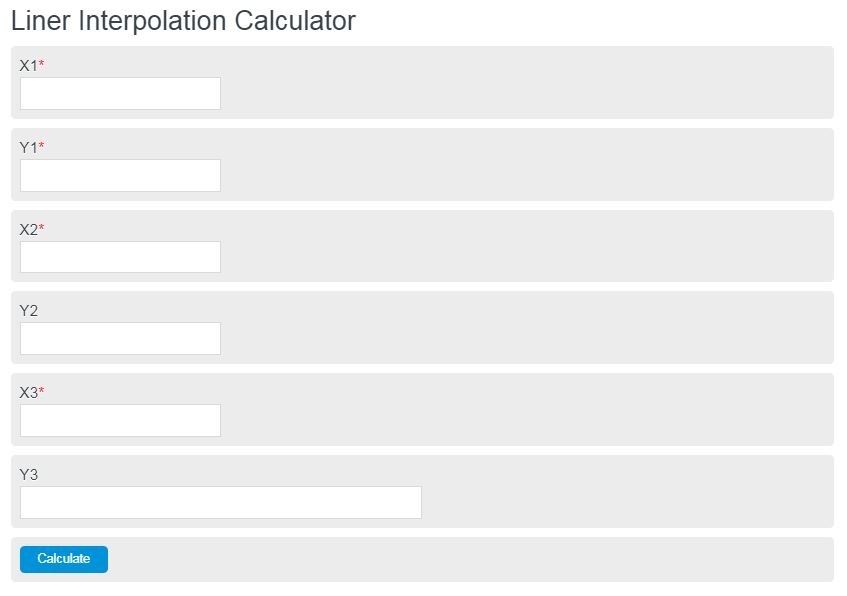
Calculate a missing x or y value between two points with linear interpolation, slope, line equation, interval position, and step-by-step substitution.
Assumptions Read first
- Uses simple linear interpolation (or extrapolation) between two known points: Y3 = Y1 + ((X3 − X1) × (Y2 − Y1)) / (X2 − X1).
- X1, Y1 and X2, Y2 define a straight-line relationship; no curve fitting, smoothing, or weighting is applied.
- All inputs must be numeric, and X1 ≠ X2 (to avoid a zero denominator).
- Units must be consistent: X1, X2, X3 share the same unit; Y1, Y2 (and thus Y3) share the same unit.
- Best used when the true relationship is approximately linear between X1 and X2; extrapolation (X3 outside the X1–X2 range) is permitted but may be less reliable.
- Outputs are purely computational; no error bounds or data validation beyond basic checks are provided.
When to Use This Calculator
- Estimate a missing Y value at a target X using two known data points.
- Fill gaps in tables, charts, or schedules when linear change is reasonable.
- Perform quick two-point calibration or mapping between scales.
- Not ideal for strongly nonlinear relationships or when multiple data points are available—consider regression, polynomial, or spline methods instead.
Input Definitions
- X1 — first known value of the independent variable.
- Y1 — dependent value corresponding to X1.
- X2 — second known value of the independent variable (must differ from X1).
- Y2 — dependent value corresponding to X2.
- X3 — target independent variable at which to estimate Y3.
- Y3 — computed estimate of the dependent variable at X3 (read-only).
- Unit note — keep X-units consistent across X1, X2, X3 and Y-units consistent across Y1, Y2, Y3.
Related Calculators
- Muller Equation Calculator
- Relative Error Calculator
- Inverse Slope Calculator
- Rounding Calculator
- All Math and Numbers Calculators
Interpolation Formula
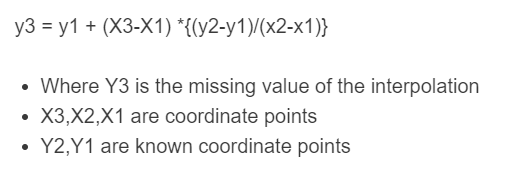
The following formula is used to calculate a linear interpolation.
- Where Y3 is the missing value of the interpolation
- X3,X2,X1 are coordinate points
- Y2,Y1 are known coordinate points
Linear Interpolation Definition
Interpolation is defined as the extrapolation of data using past data. For instance, in stock you could say the price has risen 10% over the last year, therefore, you’re going to extrapolate that the stock will rise 10% over the next year as well. In reality, this might not be true, but it is an example of using past data to interpolate.
Linear Interpolation specifically refers to the extrapolation of data across a linear line. For example, let’s say you have 2 points (X1, Y1) (X2, Y2). These two points represent a line. Now let’s say you want to extend that line out to a new point, say X3. You can calculate the value of Y3 by multiplying the slope of that line by X3, or in other words Y3=slope*X3 where the slope is (X2-X1)/(Y2-Y1). This is an example of linear interpolation.
As you can see, you can interpolate the data point of Y3 or X3 by altering the equation. As long as you have the slope of a line and two points along that line, you can determine the final destination of any point given the X or Y coordinate.
How to perform a linear interpolation?
Performing a linear interpolation is as simple as using the equation above. First, find the known coordinate points, then plug the values into the calculator or formula.
FAQ
Interpolation is defined as the extrapolation of data using past data.