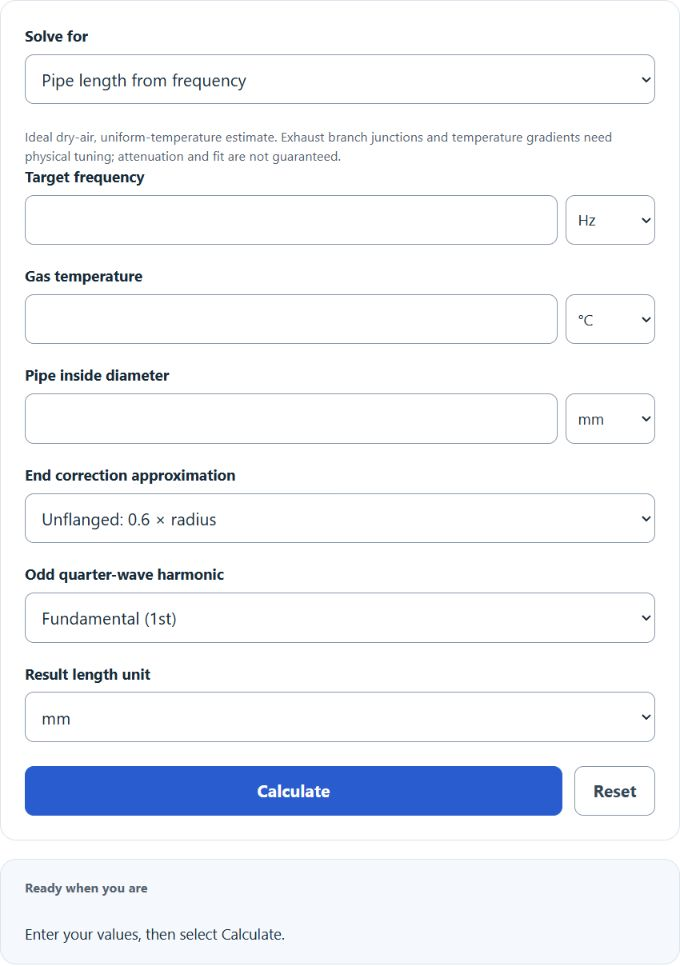
Size a J-pipe from frequency or four-stroke RPM, reverse-check a built length, and include gas temperature, odd harmonics, inside diameter, and end correction.
- All Automotive Calculators
- Closed Pipe Resonance Calculator
- Exhaust Length Calculator
- Exhaust Diameter Calculator
- Resonant Frequency Calculator
- Room Resonant Frequency Calculator
J Pipe Resonator Formula
The quarter-wave resonance formula governing a J-pipe is:
Where f is frequency in Hz, v is sound speed in m/s, and L is effective acoustic length in m. For odd harmonic n = 1, 3 or 5, f = nv / (4L). Physical centerline length is L minus the selected end correction.
What is a J Pipe Resonator?
A J-pipe resonator is a closed side-branch tube connected to an exhaust system. Its quarter-wave resonance can reduce sound near a target frequency. Junction geometry, losses, temperature and coupling affect the actual phase and attenuation, so this ideal model does not guarantee complete cancellation.
The name comes from the pipe's typical shape when fabricated: the branch curves away from the main exhaust and back alongside it, forming a "J" profile. In acoustic engineering, this device is classified as a quarter-wave resonator or side-branch resonator. It is distinct from a Helmholtz resonator, which uses a closed volume (chamber) connected by a narrow neck rather than a simple tube.
Quarter-wave resonators are inherently narrow-band devices. They attenuate a tight window of frequencies centered on the fundamental tuning frequency, plus odd harmonics (3rd, 5th, etc.). This makes them effective for targeting a single problematic frequency, such as exhaust drone at highway cruising RPM, without broadly altering the exhaust note across the rest of the RPM range.
J-Pipe vs Helmholtz Resonator
Both devices cancel sound through destructive interference, but they differ in geometry, tuning parameters, and packaging. A J-pipe (quarter-wave resonator) is a straight or gently curved tube, closed at one end. Its resonant frequency depends primarily on tube length and the local speed of sound. The pipe diameter has a minor effect through the end correction factor, but length is the dominant variable. J-pipes are simple to fabricate from standard exhaust tubing and easy to make adjustable by using a telescoping sleeve with a set screw.
A Helmholtz resonator is a closed chamber (volume) connected to the exhaust by a short neck tube. Its resonant frequency depends on three variables: chamber volume, neck cross-sectional area, and neck length. This gives more tuning flexibility and allows a compact package when space is limited, since a wide, short canister can replace a long tube. However, fabrication is more complex, and changing the tuning requires modifying the chamber or neck dimensions rather than simply trimming a pipe.
For most aftermarket exhaust drone problems where underbody space allows a 20 to 35 inch tube, a J-pipe is the simpler and more common solution. When packaging constraints are tight or when broader attenuation bandwidth is needed, a Helmholtz resonator may be preferable.
End Correction Factor
The simple formula L = v / (4f) assumes the acoustic pressure node sits exactly at the open mouth of the pipe. In practice, the effective acoustic length extends slightly beyond the physical end of the tube. This additional length is called the end correction and depends on the pipe's inner radius and how the open end terminates.
For an unflanged pipe (flush-cut or inserted into the main exhaust pipe without a flange), the end correction is approximately 0.6 times the inner radius (0.6r). For a flanged or baffled opening, it increases to approximately 0.85r. The corrected formula becomes:
Where delta is the assumed end correction (0.6r for the unflanged approximation, 0.85r for the flanged approximation). For a 2.5-inch inside diameter, these are about 19 mm and 27 mm. These isolated open-end approximations are starting models, not a calibrated exhaust-junction correction. Select the end correction in any solve mode.
Speed of Sound in Exhaust Gas
Because quarter-wave resonators depend on the speed of sound, temperature is a critical input. The speed of sound in an ideal gas is proportional to the square root of absolute temperature: v = 20.05 * sqrt(T), where T is in kelvin. The following table shows approximate values at selected temperatures in dry air (gamma = 1.4, which closely approximates lean exhaust gas):
| Temperature | Speed of Sound (m/s) | Speed of Sound (ft/s) |
|---|---|---|
| 0 C / 32 F | 331 | 1086 |
| 20 C / 68 F | 343 | 1125 |
| 100 C / 212 F | 387 | 1270 |
| 150 C / 302 F | 413 | 1355 |
| 200 C / 392 F | 436 | 1431 |
| 300 C / 572 F | 480 | 1575 |
| 400 C / 752 F | 520 | 1706 |
The closed branch has little through-flow, and its temperature can differ from the main exhaust stream. Use a measured or explicitly estimated branch gas temperature; no universal street-vehicle temperature is assumed or prefilled. Gas temperature gradients and gas composition can shift real tuning.
Real exhaust gas differs from dry air in composition and temperature-dependent heat capacities. The calculator retains an ideal dry-air approximation with gamma = 1.4 and R = 287.05 J/(kg·K). It does not calculate the gas mixture properties of a particular engine.
Common Drone Frequencies by Engine Configuration
Exhaust drone is caused by low-frequency pulses entering the cabin, typically between 50 and 200 Hz. The dominant firing frequency of a four-stroke engine is calculated as: f = (RPM / 60) * (cylinders / 2). The table below shows the firing frequency for common engine types at typical drone RPM ranges:
| Engine | Drone RPM | Firing Frequency (Hz) | Typical J-Pipe Length (in)* |
|---|---|---|---|
| 4-Cylinder | 1800 | 60 | 66 |
| 4-Cylinder | 2500 | 83 | 47 |
| 4-Cylinder | 3000 | 100 | 39 |
| V6 / I6 | 1800 | 90 | 44 |
| V6 / I6 | 2200 | 110 | 36 |
| V6 / I6 | 2800 | 140 | 28 |
| V8 | 1600 | 107 | 37 |
| V8 | 2000 | 133 | 30 |
| V8 | 2400 | 160 | 25 |
*Approximate physical length assuming 400 m/s speed of sound and no end correction. Actual length should be calculated with the calculator above using measured or estimated exhaust temperature and pipe diameter.
The dominant drone frequency depends on engine order, exhaust routing and vehicle conditions. The RPM mode assumes evenly spaced firing pulses from all entered cylinders in a four-stroke engine. A measured spectrum at the problematic operating condition is preferable when that firing-frequency assumption does not match the observed sound.
Installation and Tuning
A J-pipe is typically welded at a 90-degree angle to the main exhaust pipe, between the catalytic converter and the muffler. The branch should use smooth, mandrel bends if curves are necessary; crushed or crimped bends disrupt the standing wave and reduce effectiveness. The closed end is simply a welded cap or a plug.
Pipe diameter is less critical than length. A common guideline is to use tubing about 25 to 30% smaller in diameter than the main exhaust pipe. For a 3-inch main pipe, a 2 to 2.25-inch J-pipe branch works well. Larger diameters increase the coupling between the branch and the main pipe, which broadens the attenuation band slightly but also increases backpressure effects.
Because the calculation depends on temperature (which varies by driving conditions and resonator position), building an adjustable-length J-pipe is strongly recommended for first-time installations. A telescoping inner sleeve with a clamp allows tuning the physical length by 2 to 3 inches in either direction after installation. Once the optimal length is confirmed by test driving at the problematic RPM, the sleeve can be welded in place permanently.
A single J-pipe primarily targets one fundamental band and its odd resonances. Multiple branches can interact through the exhaust system; evaluate the combined system rather than assuming independent cancellation.